Challenge, Not Revenge
English book, p. 48
By Maulana Wahiduddin Khan
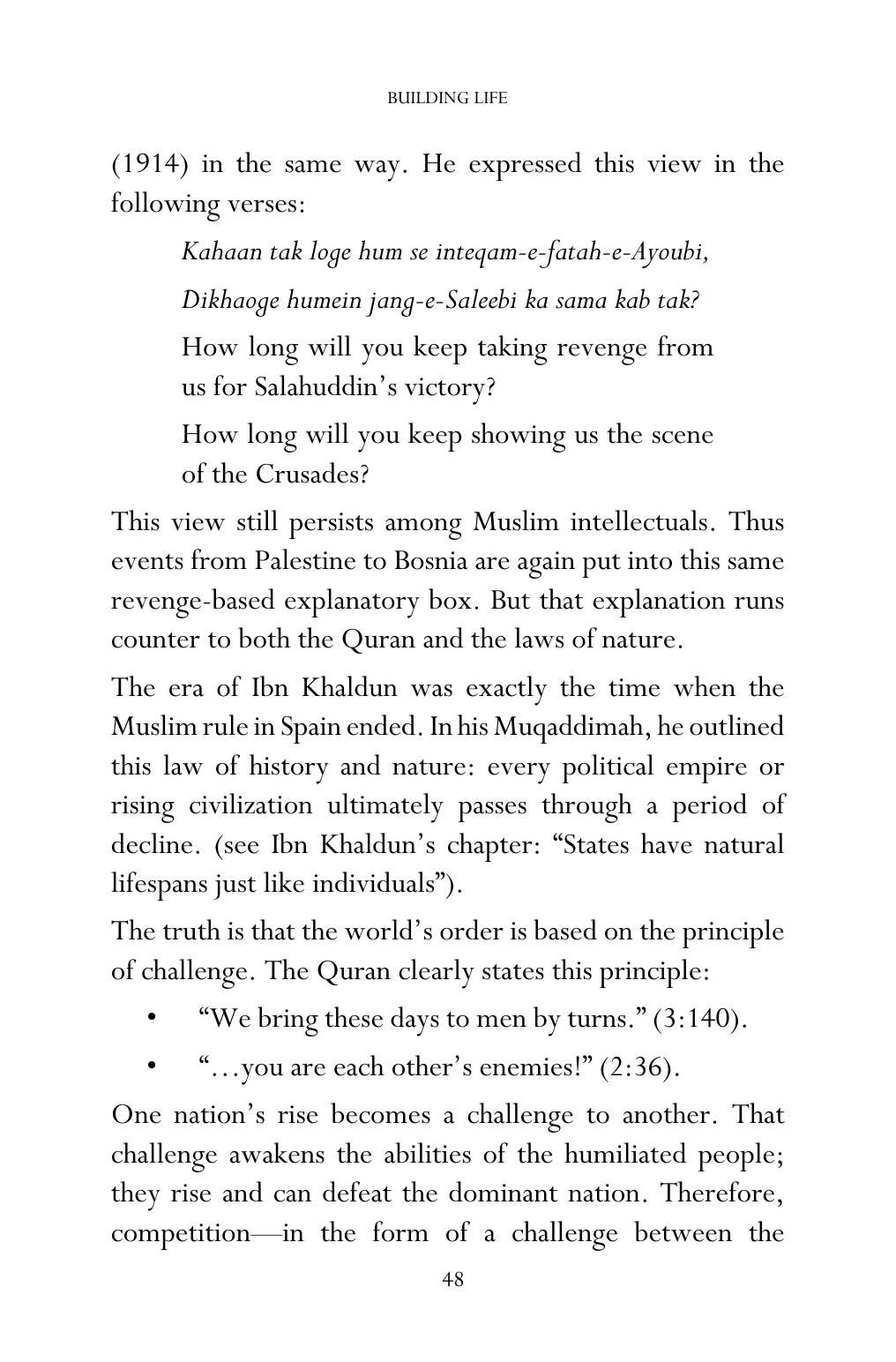
(1914) in the same way. He expressed this view in the following verses: Kahaan tak loge hum se inteqam-e-fatah-e-Ayoubi, Dikhaoge humein jang-e-Saleebi ka sama kab tak? How long will you keep taking revenge from us for Salahuddin’s victory? How long will you keep showing us the scene of the Crusades? This view still persists among Muslim intellectuals. Thus events from Palestine to Bosnia are again put into this same revenge-based explanatory box. But that explanation runs counter to both the Quran and the laws of nature. The era of Ibn Khaldun was exactly the time when the Muslim rule in Spain ended. In his Muqaddimah, he outlined this law of history and nature: every political empire or rising civilization ultimately passes through a period of decline. (see Ibn Khaldun’s chapter: “States have natural lifespans just like individuals”). The truth is that the world’s order is based on the principle of challenge. The Quran clearly states this principle: • “We bring these days to men by turns.” (3:140). • “…you are each other’s enemies!” (2:36). One nation’s rise becomes a challenge to another. That challenge awakens the abilities of the humiliated people; they rise and can defeat the dominant nation. Therefore, competition—in the form of a challenge between the
‹ Previous page Next page › About this book Open in the reader