The Heart and Mind
English book, p. 31
By Maulana Wahiduddin Khan
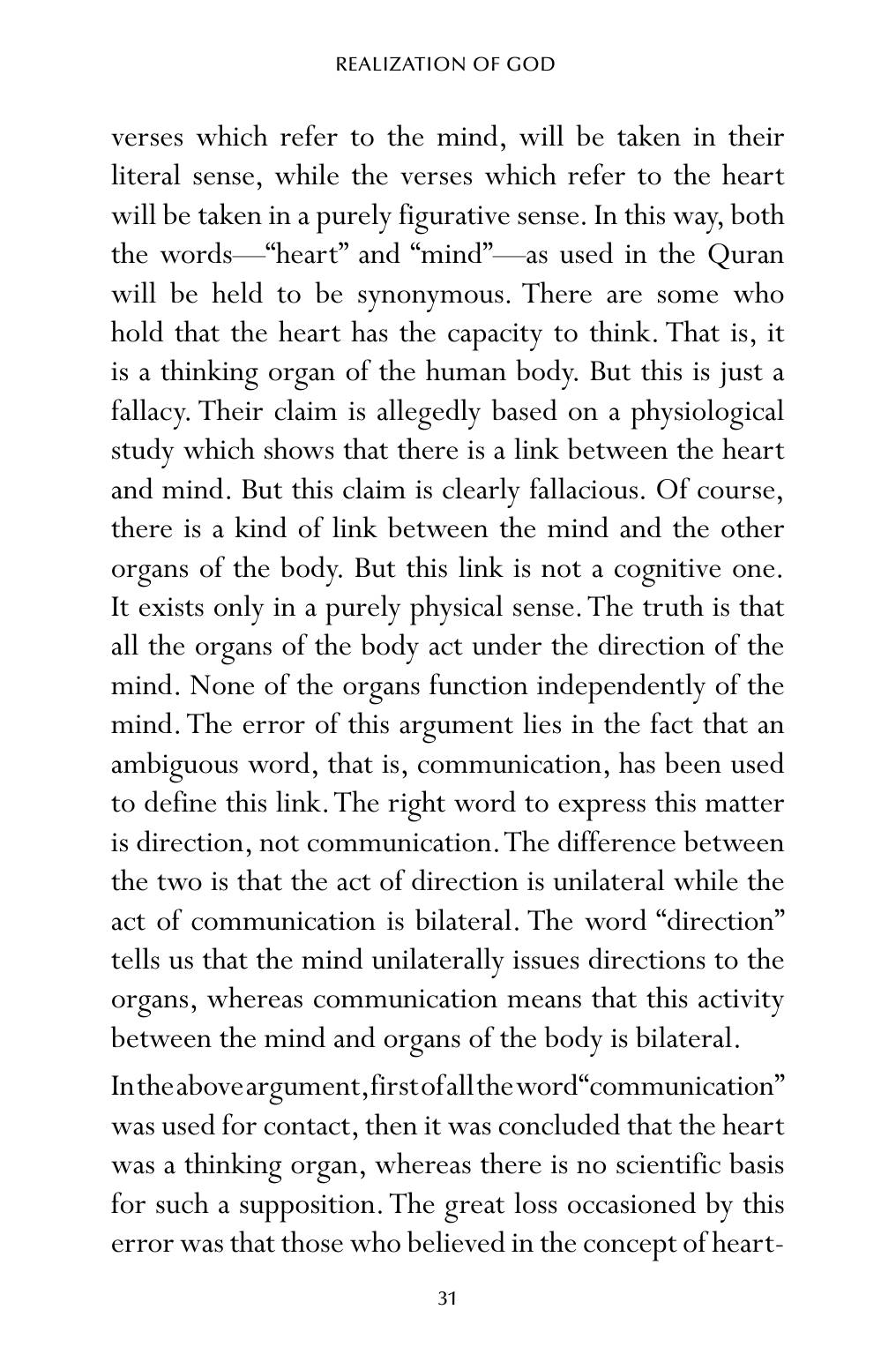
Realization of God verses which refer to the mind, will be taken in their literal sense, while the verses which refer to the heart will be taken in a purely figurative sense. In this way, both the words—“heart” and “mind”—as used in the Quran will be held to be synonymous. There are some who hold that the heart has the capacity to think. That is, it is a thinking organ of the human body. But this is just a fallacy. Their claim is allegedly based on a physiological study which shows that there is a link between the heart and mind. But this claim is clearly fallacious. Of course, there is a kind of link between the mind and the other organs of the body. But this link is not a cognitive one. It exists only in a purely physical sense. The truth is that all the organs of the body act under the direction of the mind. None of the organs function independently of the mind. The error of this argument lies in the fact that an ambiguous word, that is, communication, has been used to define this link. The right word to express this matter is direction, not communication. The difference between the two is that the act of direction is unilateral while the act of communication is bilateral. The word “direction” tells us that the mind unilaterally issues directions to the organs, whereas communication means that this activity between the mind and organs of the body is bilateral. In the above argument, first of all the word “communication” was used for contact, then it was concluded that the heart was a thinking organ, whereas there is no scientific basis for such a supposition. The great loss occasioned by this error was that those who believed in the concept of heart-
‹ Previous page Next page › About this book Open in the reader