War and Peace in Islam
English book, p. 86
By Maulana Wahiduddin Khan
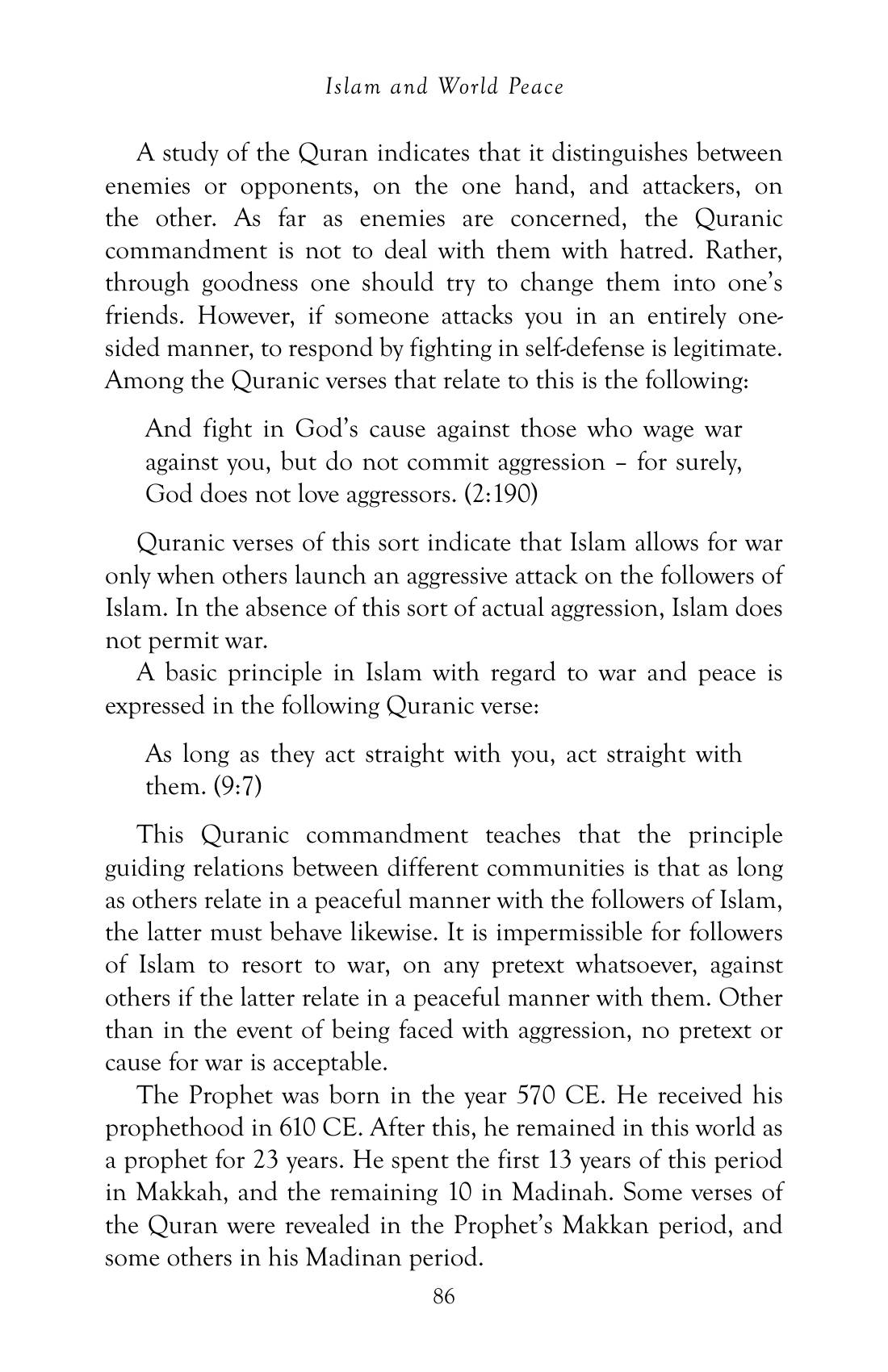
A study of the Quran indicates that it distinguishes between enemies or opponents, on the one hand, and attackers, on the other. As far as enemies are concerned, the Quranic commandment is not to deal with them with hatred. Rather, through goodness one should try to change them into one’s friends. However, if someone attacks you in an entirely onesided manner, to respond by fighting in self-defense is legitimate. Among the Quranic verses that relate to this is the following: And fight in God’s cause against those who wage war against you, but do not commit aggression – for surely, God does not love aggressors. (2:190) Quranic verses of this sort indicate that Islam allows for war only when others launch an aggressive attack on the followers of Islam. In the absence of this sort of actual aggression, Islam does not permit war. A basic principle in Islam with regard to war and peace is expressed in the following Quranic verse: As long as they act straight with you, act straight with them. (9:7) This Quranic commandment teaches that the principle guiding relations between different communities is that as long as others relate in a peaceful manner with the followers of Islam, the latter must behave likewise. It is impermissible for followers of Islam to resort to war, on any pretext whatsoever, against others if the latter relate in a peaceful manner with them. Other than in the event of being faced with aggression, no pretext or cause for war is acceptable. The Prophet was born in the year 570 CE. He received his prophethood in 610 CE. After this, he remained in this world as a prophet for 23 years. He spent the first 13 years of this period in Makkah, and the remaining 10 in Madinah. Some verses of the Quran were revealed in the Prophet’s Makkan period, and some others in his Madinan period.
‹ Previous page Next page › About this book Open in the reader