Islamic Fundamentalism
English book, p. 144
By Maulana Wahiduddin Khan
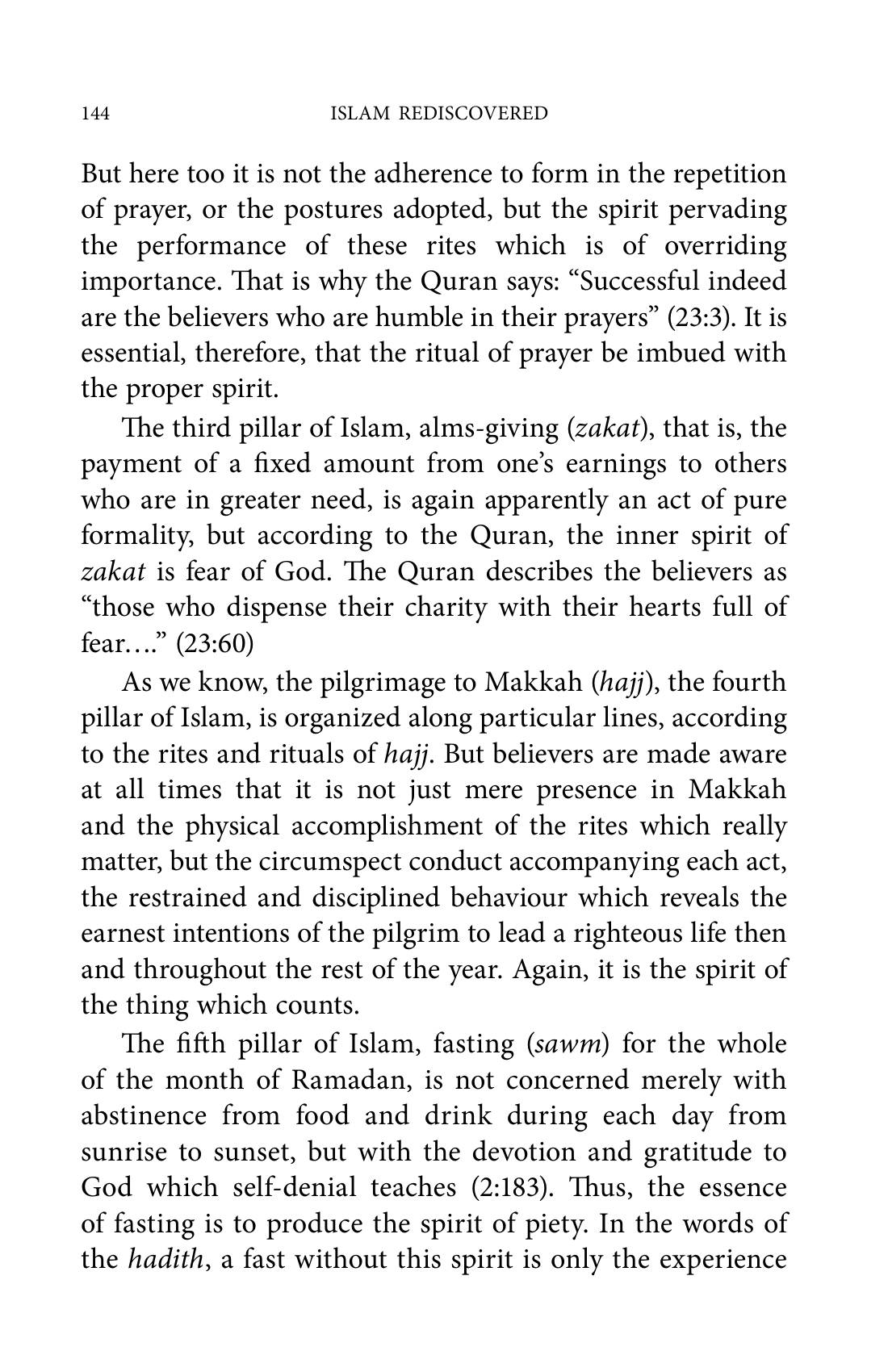
But here too it is not the adherence to form in the repetition of prayer, or the postures adopted, but the spirit pervading the performance of these rites which is of overriding importance. That is why the Quran says: “Successful indeed are the believers who are humble in their prayers” (23:3). It is essential, therefore, that the ritual of prayer be imbued with the proper spirit. The third pillar of Islam, alms-giving (zakat), that is, the payment of a fixed amount from one’s earnings to others who are in greater need, is again apparently an act of pure formality, but according to the Quran, the inner spirit of zakat is fear of God. The Quran describes the believers as “those who dispense their charity with their hearts full of fear….” (23:60) As we know, the pilgrimage to Makkah (hajj), the fourth pillar of Islam, is organized along particular lines, according to the rites and rituals of hajj. But believers are made aware at all times that it is not just mere presence in Makkah and the physical accomplishment of the rites which really matter, but the circumspect conduct accompanying each act, the restrained and disciplined behaviour which reveals the earnest intentions of the pilgrim to lead a righteous life then and throughout the rest of the year. Again, it is the spirit of the thing which counts. The fifth pillar of Islam, fasting (sawm) for the whole of the month of Ramadan, is not concerned merely with abstinence from food and drink during each day from sunrise to sunset, but with the devotion and gratitude to God which self-denial teaches (2:183). Thus, the essence of fasting is to produce the spirit of piety. In the words of the hadith, a fast without this spirit is only the experience
‹ Previous page Next page › About this book Open in the reader