Islam in History
English book, p. 243
By Maulana Wahiduddin Khan
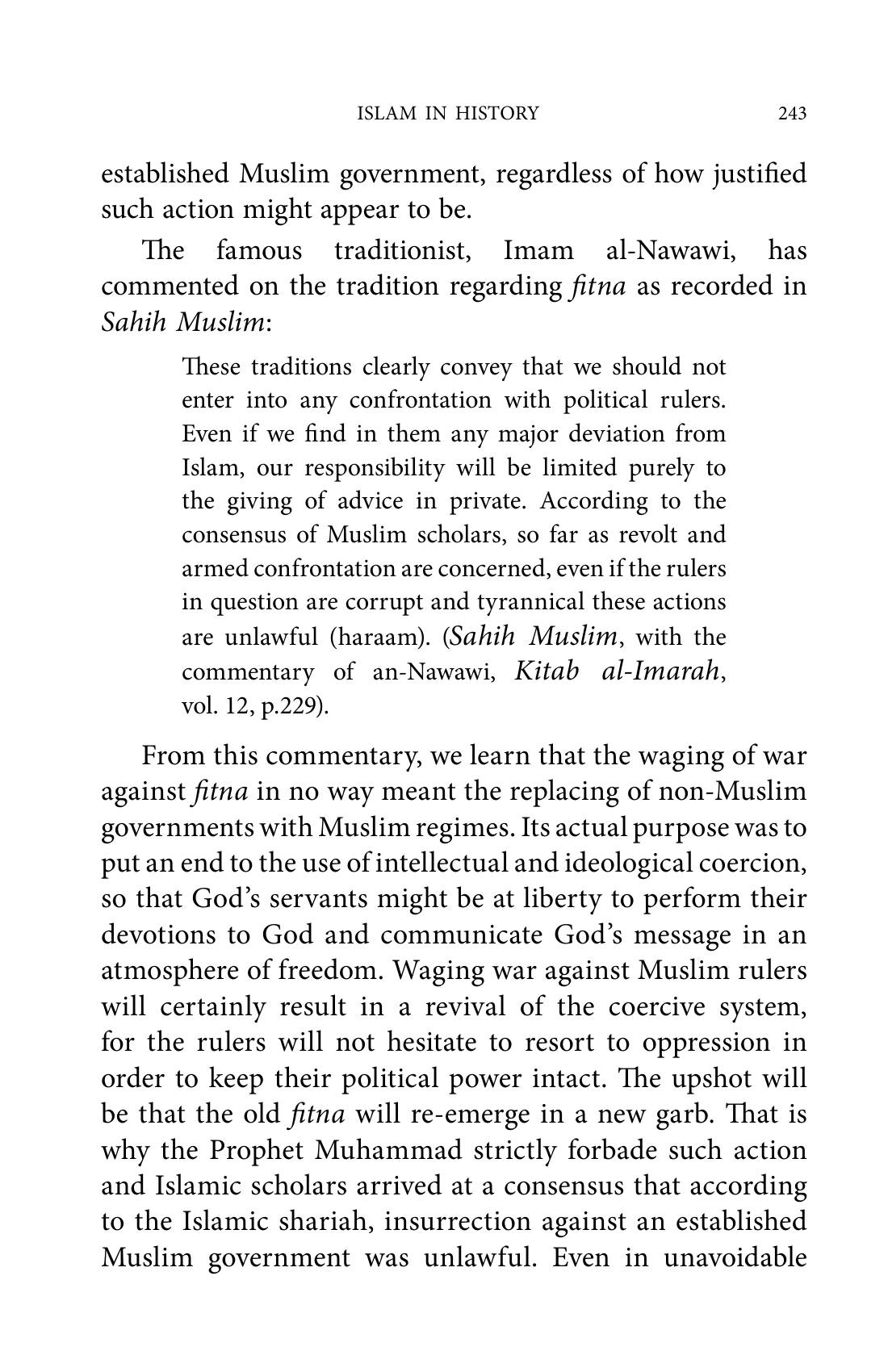
ISLAM IN HISTORY established Muslim government, regardless of how justified such action might appear to be. The famous traditionist, Imam al-Nawawi, has commented on the tradition regarding fitna as recorded in Sahih Muslim: These traditions clearly convey that we should not enter into any confrontation with political rulers. Even if we find in them any major deviation from Islam, our responsibility will be limited purely to the giving of advice in private. According to the consensus of Muslim scholars, so far as revolt and armed confrontation are concerned, even if the rulers in question are corrupt and tyrannical these actions are unlawful (haraam). (Sahih Muslim, with the commentary of an-Nawawi, Kitab al-Imarah, vol. 12, p.229). From this commentary, we learn that the waging of war against fitna in no way meant the replacing of non-Muslim governments with Muslim regimes. Its actual purpose was to put an end to the use of intellectual and ideological coercion, so that God’s servants might be at liberty to perform their devotions to God and communicate God’s message in an atmosphere of freedom. Waging war against Muslim rulers will certainly result in a revival of the coercive system, for the rulers will not hesitate to resort to oppression in order to keep their political power intact. The upshot will be that the old fitna will re-emerge in a new garb. That is why the Prophet Muhammad strictly forbade such action and Islamic scholars arrived at a consensus that according to the Islamic shariah, insurrection against an established Muslim government was unlawful. Even in unavoidable
‹ Previous page Next page › About this book Open in the reader