The Importance of Knowledge
English book, p. 23
By Maulana Wahiduddin Khan
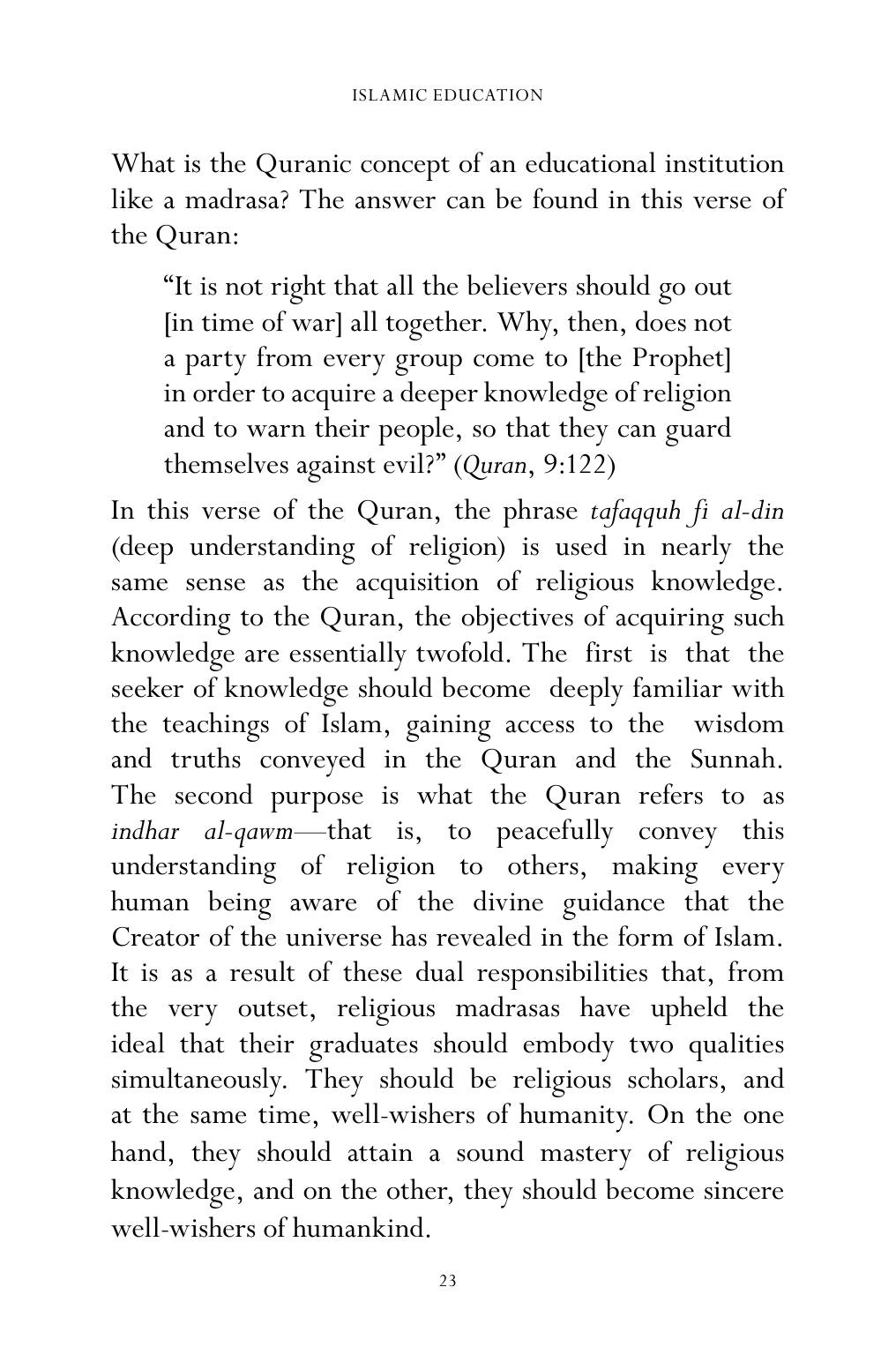
What is the Quranic concept of an educational institution like a madrasa? The answer can be found in this verse of the Quran: “It is not right that all the believers should go out [in time of war] all together. Why, then, does not a party from every group come to [the Prophet] in order to acquire a deeper knowledge of religion and to warn their people, so that they can guard themselves against evil?” (Quran, 9:122) In this verse of the Quran, the phrase tafaqquh fi al-din (deep understanding of religion) is used in nearly the same sense as the acquisition of religious knowledge. According to the Quran, the objectives of acquiring such knowledge are essentially twofold. The first is that the seeker of knowledge should become deeply familiar with the teachings of Islam, gaining access to the wisdom and truths conveyed in the Quran and the Sunnah. The second purpose is what the Quran refers to as indhar al-qawm—that is, to peacefully convey this understanding of religion to others, making every human being aware of the divine guidance that the Creator of the universe has revealed in the form of Islam. It is as a result of these dual responsibilities that, from the very outset, religious madrasas have upheld the ideal that their graduates should embody two qualities simultaneously. They should be religious scholars, and at the same time, well-wishers of humanity. On the one hand, they should attain a sound mastery of religious knowledge, and on the other, they should become sincere well -wishers of humankind.
‹ Previous page Next page › About this book Open in the reader