The Role of Madrasa in Religious Understanding
English book, p. 48
By Maulana Wahiduddin Khan
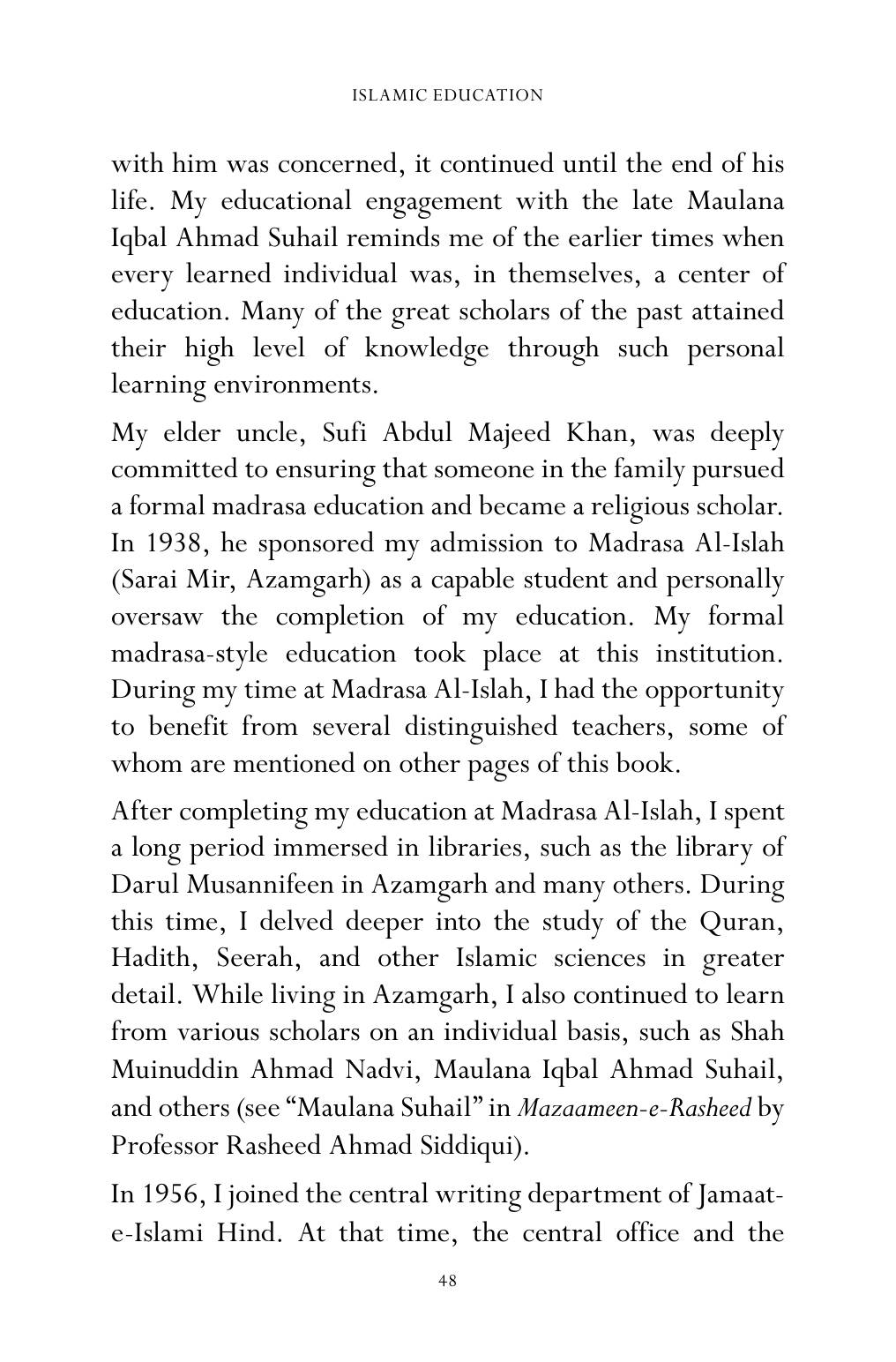
with him was concerned, it continued until the end of his life. My educational engagement with the late Maulana Iqbal Ahmad Suhail reminds me of the earlier times when every learned individual was, in themselves, a center of education. Many of the great scholars of the past attained their high level of knowledge through such personal learning environments. My elder uncle, Sufi Abdul Majeed Khan, was deeply committed to ensuring that someone in the family pursued a formal madrasa education and became a religious scholar. In 1938, he sponsored my admission to Madrasa Al-Islah (Sarai Mir, Azamgarh) as a capable student and personally oversaw the completion of my education. My formal madrasa-style education took place at this institution. During my time at Madrasa Al-Islah, I had the opportunity to benefit from several distinguished teachers, some of whom are mentioned on other pages of this book. After completing my education at Madrasa Al-Islah, I spent a long period immersed in libraries, such as the library of Darul Musannifeen in Azamgarh and many others. During this time, I delved deeper into the study of the Quran, Hadith, Seerah, and other Islamic sciences in greater detail. While living in Azamgarh, I also continued to learn from various scholars on an individual basis, such as Shah Muinuddin Ahmad Nadvi, Maulana Iqbal Ahmad Suhail, and others (see “Maulana Suhail” in Mazaameen-e-Rasheed by Professor Rasheed Ahmad Siddiqui). In 1956, I joined the central writing department of Jamaate-Islami Hind. At that time, the central office and the
‹ Previous page Next page › About this book Open in the reader