Islamic Fundamentalism
English book, p. 4
By Maulana Wahiduddin Khan
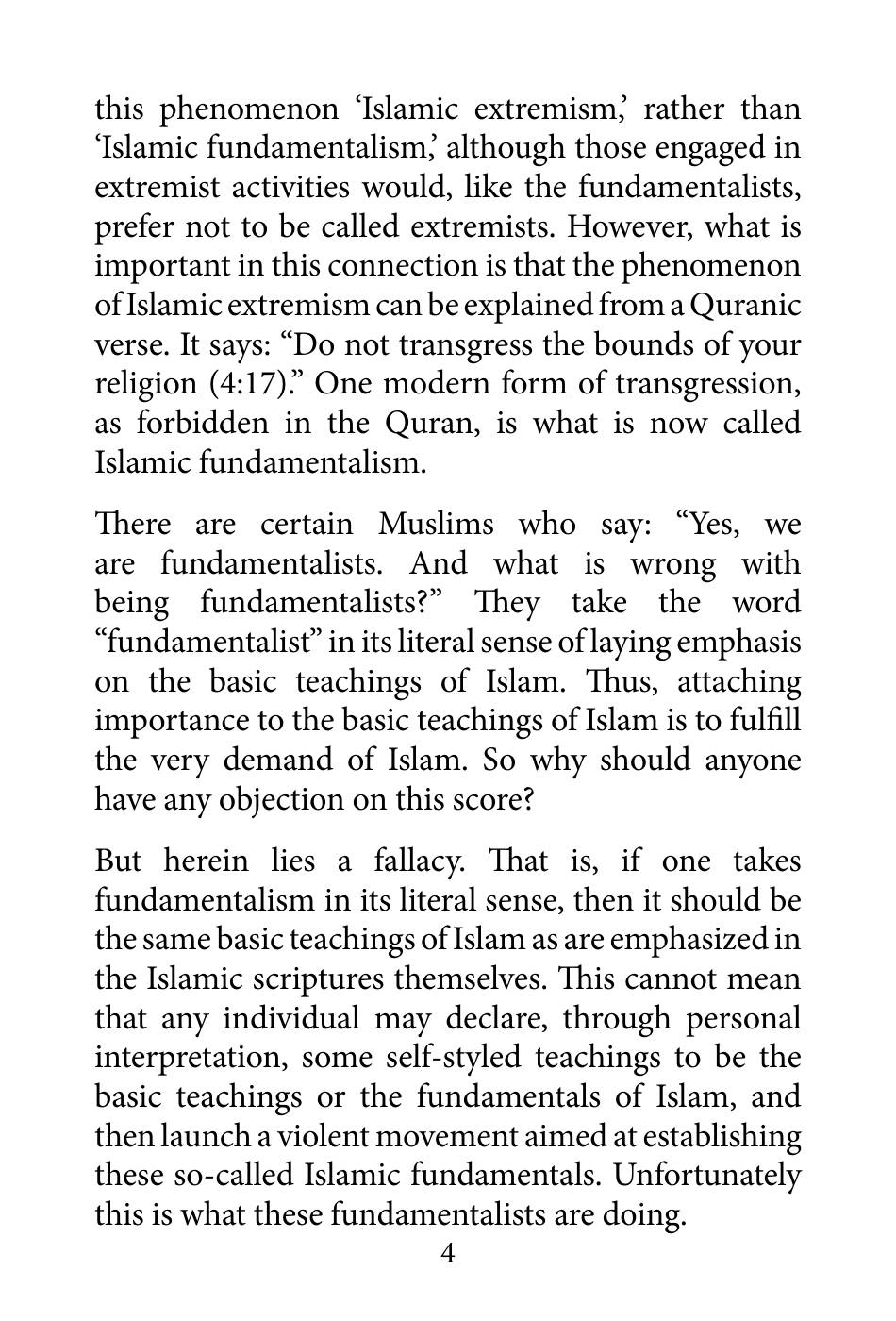
this phenomenon ‘Islamic extremism,’ rather than ‘Islamic fundamentalism,’ although those engaged in extremist activities would, like the fundamentalists, prefer not to be called extremists. However, what is important in this connection is that the phenomenon of Islamic extremism can be explained from a Quranic verse. It says: “Do not transgress the bounds of your religion (4:17).” One modern form of transgression, as forbidden in the Quran, is what is now called Islamic fundamentalism. There are certain Muslims who say: “Yes, we are fundamentalists. And what is wrong with being fundamentalists?” They take the word “fundamentalist” in its literal sense of laying emphasis on the basic teachings of Islam. Thus, attaching importance to the basic teachings of Islam is to fulfill the very demand of Islam. So why should anyone have any objection on this score? But herein lies a fallacy. That is, if one takes fundamentalism in its literal sense, then it should be the same basic teachings of Islam as are emphasized in the Islamic scriptures themselves. This cannot mean that any individual may declare, through personal interpretation, some self-styled teachings to be the basic teachings or the fundamentals of Islam, and then launch a violent movement aimed at establishing these so-called Islamic fundamentals. Unfortunately this is what these fundamentalists are doing.
‹ Previous page Next page › About this book Open in the reader