Ease in Difficulty
English book, p. 161
By Maulana Wahiduddin Khan
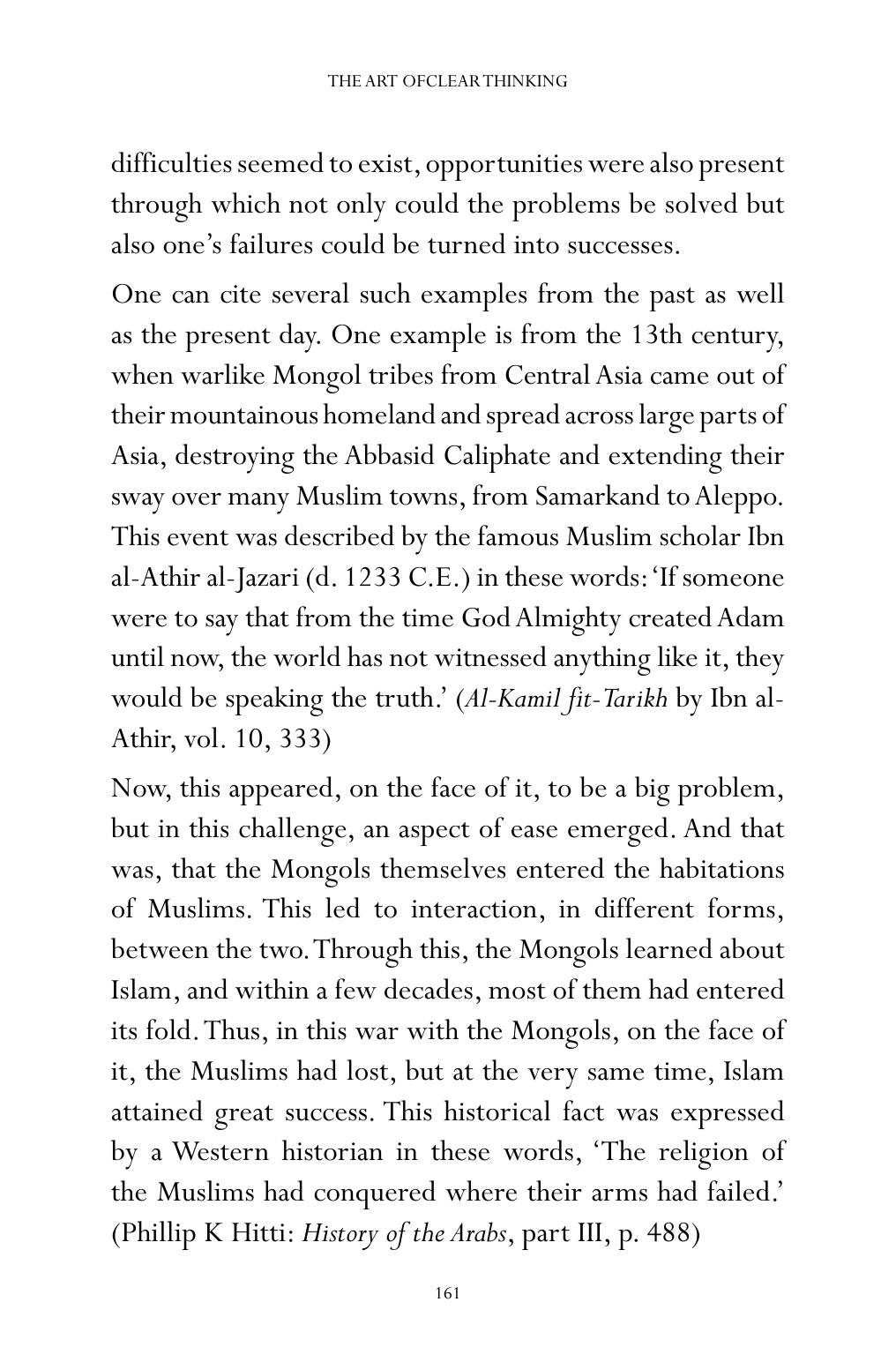
THE ART OFCLEAR THINKING difficulties seemed to exist, opportunities were also present through which not only could the problems be solved but also one’s failures could be turned into successes. One can cite several such examples from the past as well as the present day. One example is from the 13th century, when warlike Mongol tribes from Central Asia came out of their mountainous homeland and spread across large parts of Asia, destroying the Abbasid Caliphate and extending their sway over many Muslim towns, from Samarkand to Aleppo. This event was described by the famous Muslim scholar Ibn al-Athir al-Jazari (d. 1233 C.E.) in these words: ‘If someone were to say that from the time God Almighty created Adam until now, the world has not witnessed anything like it, they would be speaking the truth.’ (Al-Kamil fit-Tarikh by Ibn alAthir, vol. 10, 333) Now, this appeared, on the face of it, to be a big problem, but in this challenge, an aspect of ease emerged. And that was, that the Mongols themselves entered the habitations of Muslims. This led to interaction, in different forms, between the two. Through this, the Mongols learned about Islam, and within a few decades, most of them had entered its fold. Thus, in this war with the Mongols, on the face of it, the Muslims had lost, but at the very same time, Islam attained great success. This historical fact was expressed by a Western historian in these words, ‘The religion of the Muslims had conquered where their arms had failed.’ (Phillip K Hitti: History of the Arabs, part III, p. 488)
‹ Previous page Next page › About this book Open in the reader