Issues of Ijtihad
English book, p. 33
By Maulana Wahiduddin Khan
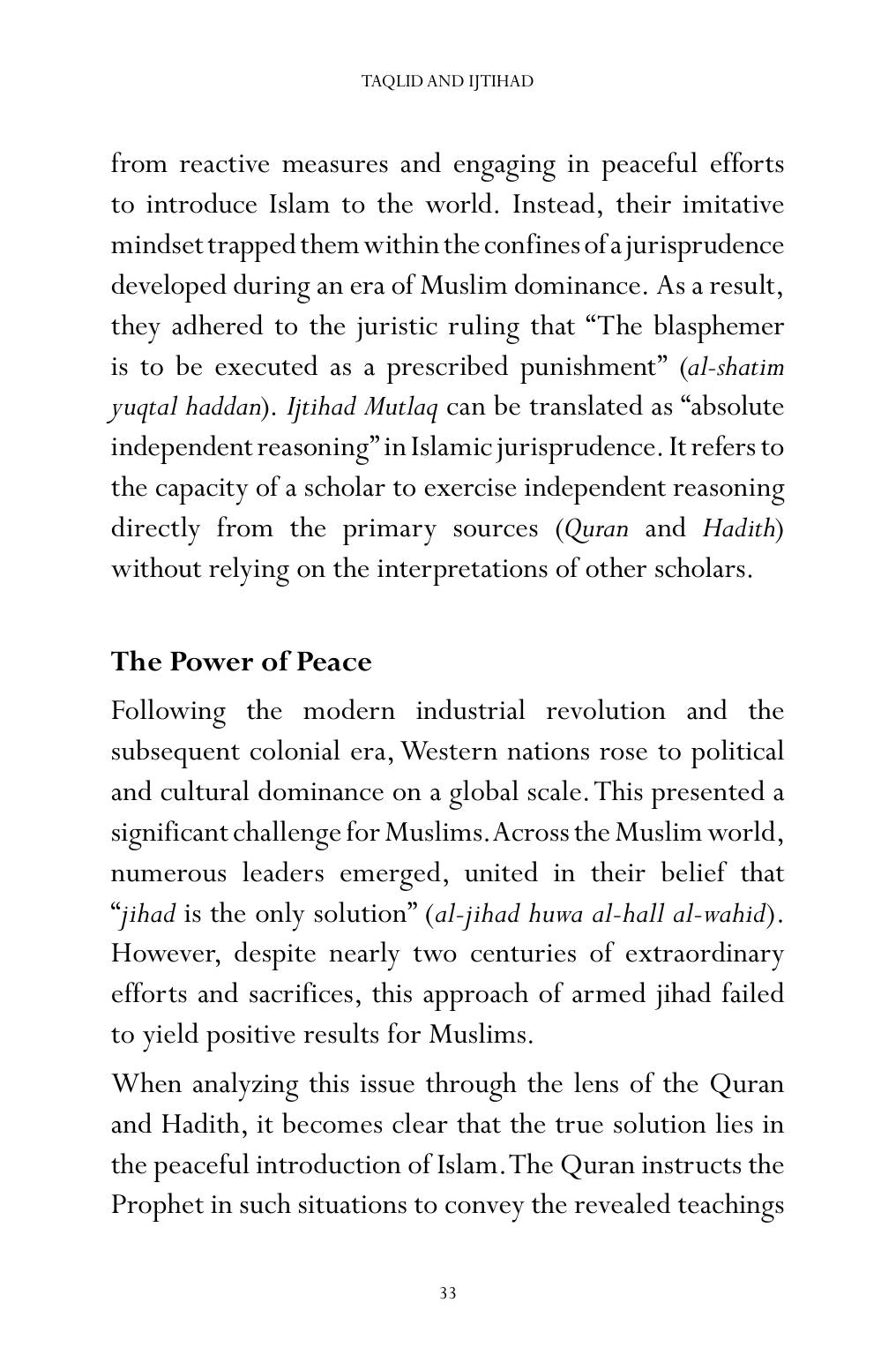
TAQLID AND IJTIHAD from reactive measures and engaging in peaceful efforts to introduce Islam to the world. Instead, their imitative mindset trapped them within the confines of a jurisprudence developed during an era of Muslim dominance. As a result, they adhered to the juristic ruling that “The blasphemer is to be executed as a prescribed punishment” (al-shatim yuqtal haddan). Ijtihad Mutlaq can be translated as “absolute independent reasoning” in Islamic jurisprudence. It refers to the capacity of a scholar to exercise independent reasoning directly from the primary sources (Quran and Hadith) without relying on the interpretations of other scholars. The Power of Peace Following the modern industrial revolution and the subsequent colonial era, Western nations rose to political and cultural dominance on a global scale. This presented a significant challenge for Muslims. Across the Muslim world, numerous leaders emerged, united in their belief that “jihad is the only solution” (al-jihad huwa al-hall al-wahid). However, despite nearly two centuries of extraordinary efforts and sacrifices, this approach of armed jihad failed to yield positive results for Muslims. When analyzing this issue through the lens of the Quran and Hadith, it becomes clear that the true solution lies in the peaceful introduction of Islam. The Quran instructs the Prophet in such situations to convey the revealed teachings
‹ Previous page Next page › About this book Open in the reader