The Traditional Fiqh is Insufficient
English book, p. 37
By Maulana Wahiduddin Khan
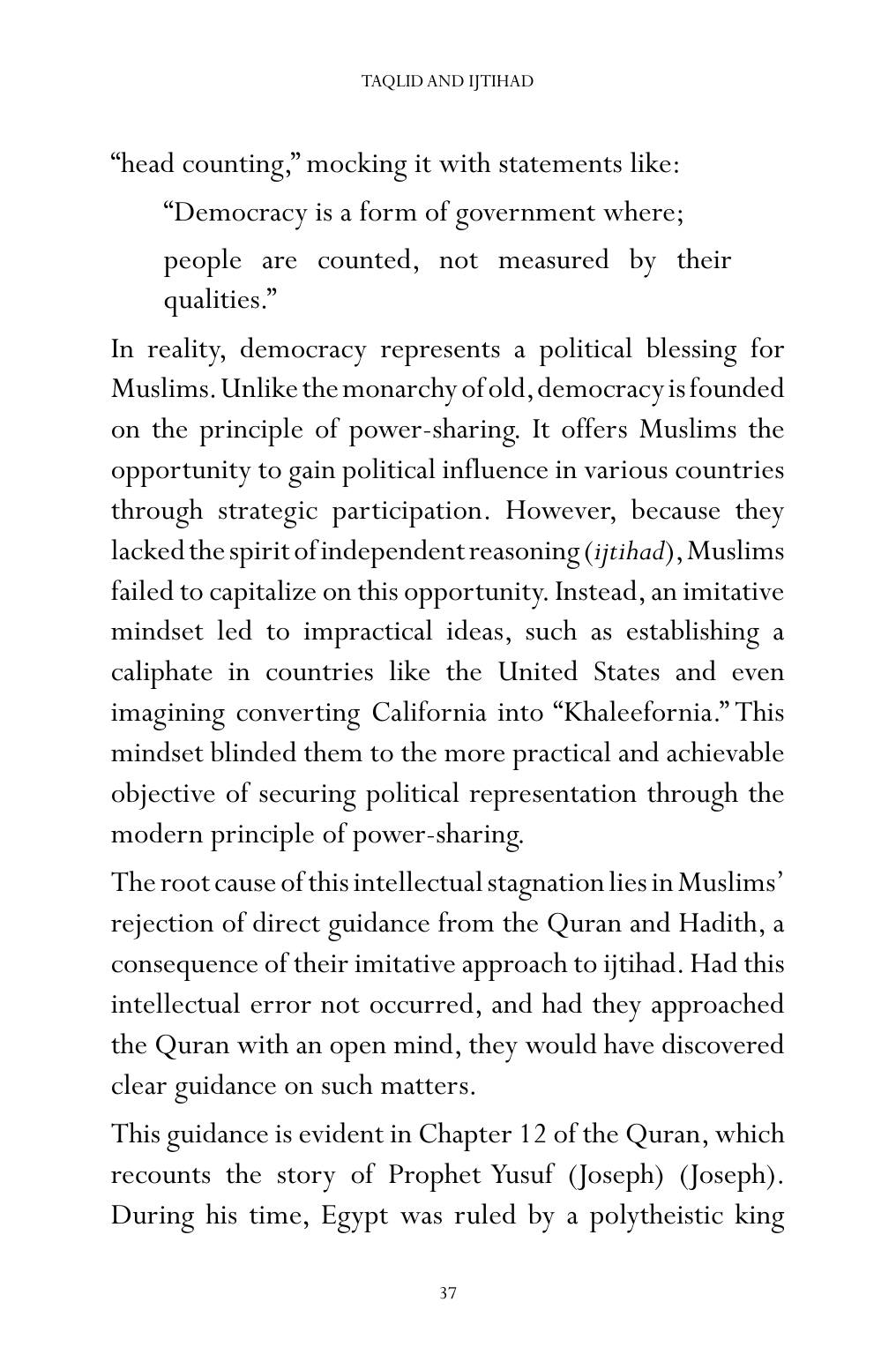
TAQLID AND IJTIHAD “head counting,” mocking it with statements like: “Democracy is a form of government where; people are counted, not measured by their qualities.” In reality, democracy represents a political blessing for Muslims. Unlike the monarchy of old, democracy is founded on the principle of power-sharing. It offers Muslims the opportunity to gain political influence in various countries through strategic participation. However, because they lacked the spirit of independent reasoning (ijtihad), Muslims failed to capitalize on this opportunity. Instead, an imitative mindset led to impractical ideas, such as establishing a caliphate in countries like the United States and even imagining converting California into “Khaleefornia.” This mindset blinded them to the more practical and achievable objective of securing political representation through the modern principle of power-sharing. The root cause of this intellectual stagnation lies in Muslims’ rejection of direct guidance from the Quran and Hadith, a consequence of their imitative approach to ijtihad. Had this intellectual error not occurred, and had they approached the Quran with an open mind, they would have discovered clear guidance on such matters. This guidance is evident in Chapter 12 of the Quran, which recounts the story of Prophet Yusuf (Joseph) (Joseph). During his time, Egypt was ruled by a polytheistic king
‹ Previous page Next page › About this book Open in the reader