Selection for Paradise
English book, p. 104
By Maulana Wahiduddin Khan
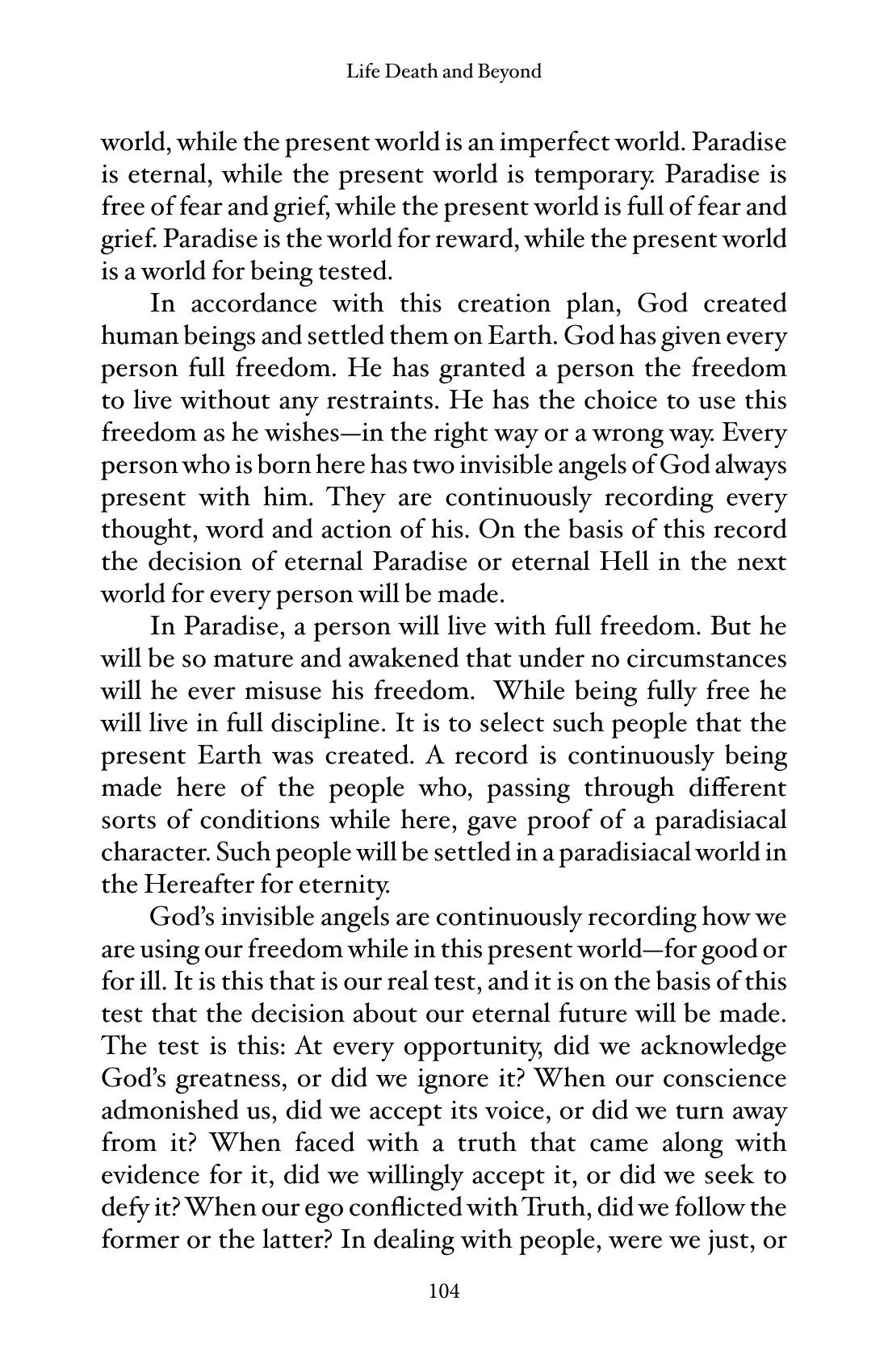
world, while the present world is an imperfect world. Paradise is eternal, while the present world is temporary. Paradise is free of fear and grief, while the present world is full of fear and grief. Paradise is the world for reward, while the present world is a world for being tested. In accordance with this creation plan, God created human beings and settled them on Earth. God has given every person full freedom. He has granted a person the freedom to live without any restraints. He has the choice to use this freedom as he wishes—in the right way or a wrong way. Every person who is born here has two invisible angels of God always present with him. They are continuously recording every thought, word and action of his. On the basis of this record the decision of eternal Paradise or eternal Hell in the next world for every person will be made. In Paradise, a person will live with full freedom. But he will be so mature and awakened that under no circumstances will he ever misuse his freedom. While being fully free he will live in full discipline. It is to select such people that the present Earth was created. A record is continuously being made here of the people who, passing through different sorts of conditions while here, gave proof of a paradisiacal character. Such people will be settled in a paradisiacal world in the Hereafter for eternity. God’s invisible angels are continuously recording how we are using our freedom while in this present world—for good or for ill. It is this that is our real test, and it is on the basis of this test that the decision about our eternal future will be made. The test is this: At every opportunity, did we acknowledge God’s greatness, or did we ignore it? When our conscience admonished us, did we accept its voice, or did we turn away from it? When faced with a truth that came along with evidence for it, did we willingly accept it, or did we seek to defy it? When our ego conflicted with Truth, did we follow the former or the latter? In dealing with people, were we just, or
‹ Previous page Next page › About this book Open in the reader