Why This Heedlessness of Death?
English book, p. 86
By Maulana Wahiduddin Khan
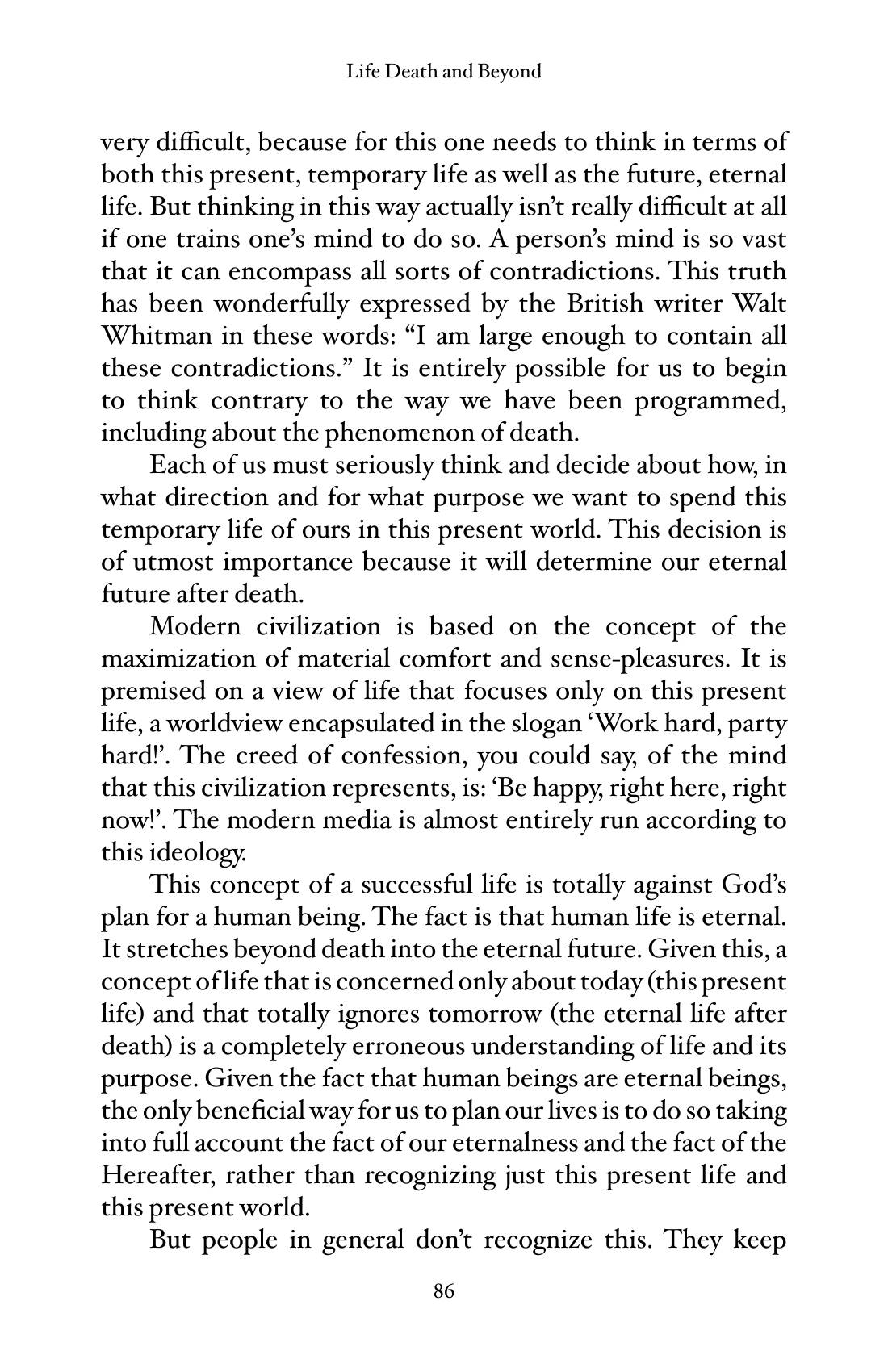
very difficult, because for this one needs to think in terms of both this present, temporary life as well as the future, eternal life. But thinking in this way actually isn’t really difficult at all if one trains one’s mind to do so. A person’s mind is so vast that it can encompass all sorts of contradictions. This truth has been wonderfully expressed by the British writer Walt Whitman in these words: “I am large enough to contain all these contradictions.” It is entirely possible for us to begin to think contrary to the way we have been programmed, including about the phenomenon of death. Each of us must seriously think and decide about how, in what direction and for what purpose we want to spend this temporary life of ours in this present world. This decision is of utmost importance because it will determine our eternal future after death. Modern civilization is based on the concept of the maximization of material comfort and sense-pleasures. It is premised on a view of life that focuses only on this present life, a worldview encapsulated in the slogan ‘Work hard, party hard!’. The creed of confession, you could say, of the mind that this civilization represents, is: ‘Be happy, right here, right now!’. The modern media is almost entirely run according to this ideology. This concept of a successful life is totally against God’s plan for a human being. The fact is that human life is eternal. It stretches beyond death into the eternal future. Given this, a concept of life that is concerned only about today (this present life) and that totally ignores tomorrow (the eternal life after death) is a completely erroneous understanding of life and its purpose. Given the fact that human beings are eternal beings, the only beneficial way for us to plan our lives is to do so taking into full account the fact of our eternalness and the fact of the Hereafter, rather than recognizing just this present life and this present world. But people in general don’t recognize this. They keep
‹ Previous page Next page › About this book Open in the reader