VI The Man Science Failed to Discover
English book, p. 57
By Maulana Wahiduddin Khan
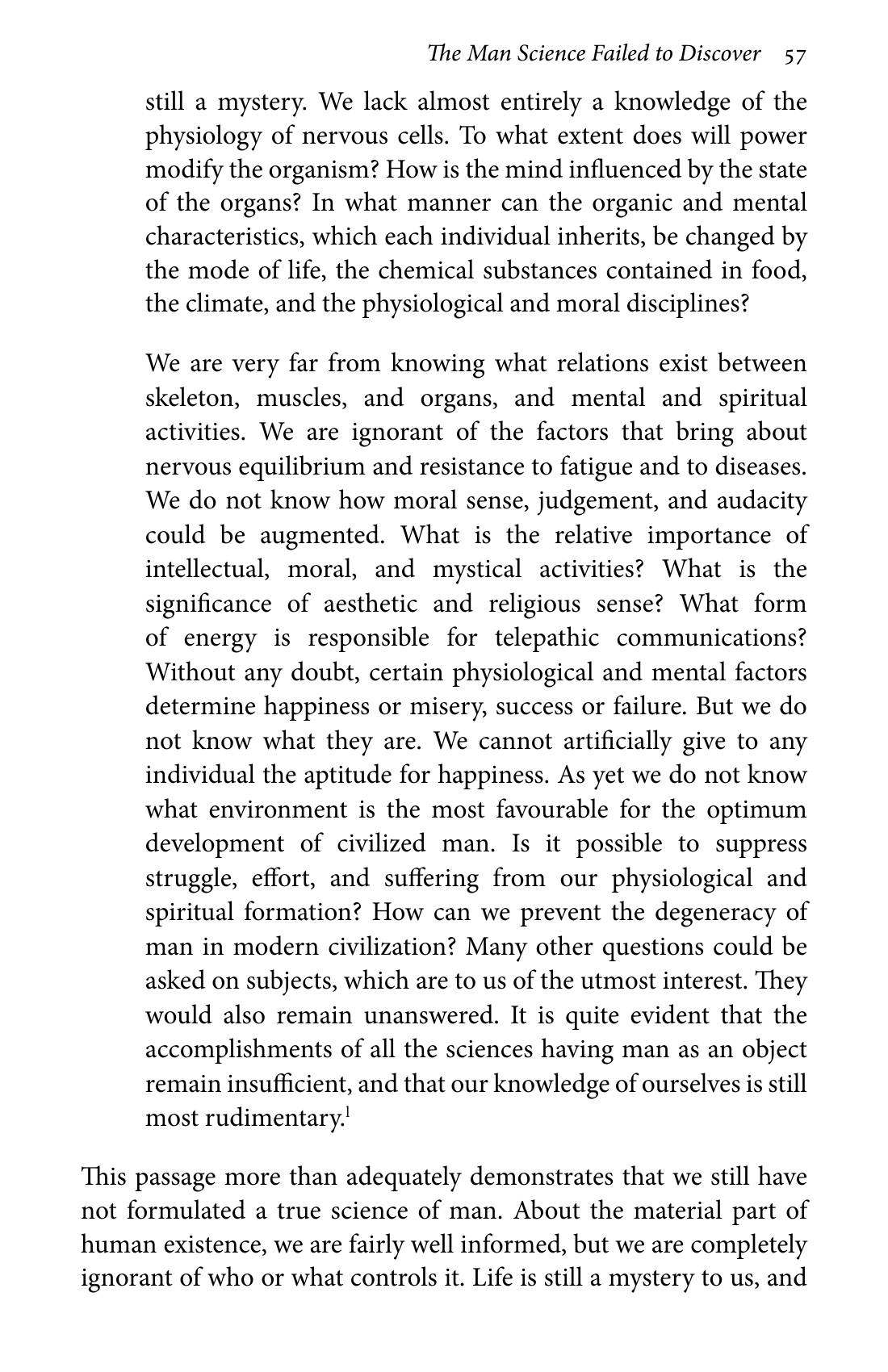
The Man Science Failed to Discove still a mystery. We lack almost entirely a knowledge of the physiology of nervous cells. To what extent does will power modify the organism? How is the mind influenced by the state of the organs? In what manner can the organic and mental characteristics, which each individual inherits, be changed by the mode of life, the chemical substances contained in food, the climate, and the physiological and moral disciplines? We are very far from knowing what relations exist between skeleton, muscles, and organs, and mental and spiritual activities. We are ignorant of the factors that bring about nervous equilibrium and resistance to fatigue and to diseases. We do not know how moral sense, judgement, and audacity could be augmented. What is the relative importance of intellectual, moral, and mystical activities? What is the significance of aesthetic and religious sense? What form of energy is responsible for telepathic communications? Without any doubt, certain physiological and mental factors determine happiness or misery, success or failure. But we do not know what they are. We cannot artificially give to any individual the aptitude for happiness. As yet we do not know what environment is the most favourable for the optimum development of civilized man. Is it possible to suppress struggle, effort, and suffering from our physiological and spiritual formation? How can we prevent the degeneracy of man in modern civilization? Many other questions could be asked on subjects, which are to us of the utmost interest. They would also remain unanswered. It is quite evident that the accomplishments of all the sciences having man as an object remain insufficient, and that our knowledge of ourselves is still most rudimentary.l This passage more than adequately demonstrates that we still have not formulated a true science of man. About the material part of human existence, we are fairly well informed, but we are completely ignorant of who or what controls it. Life is still a mystery to us, and
‹ Previous page Next page › About this book Open in the reader