VII The ‘Religion’ of the Modern Age
English book, p. 71
By Maulana Wahiduddin Khan
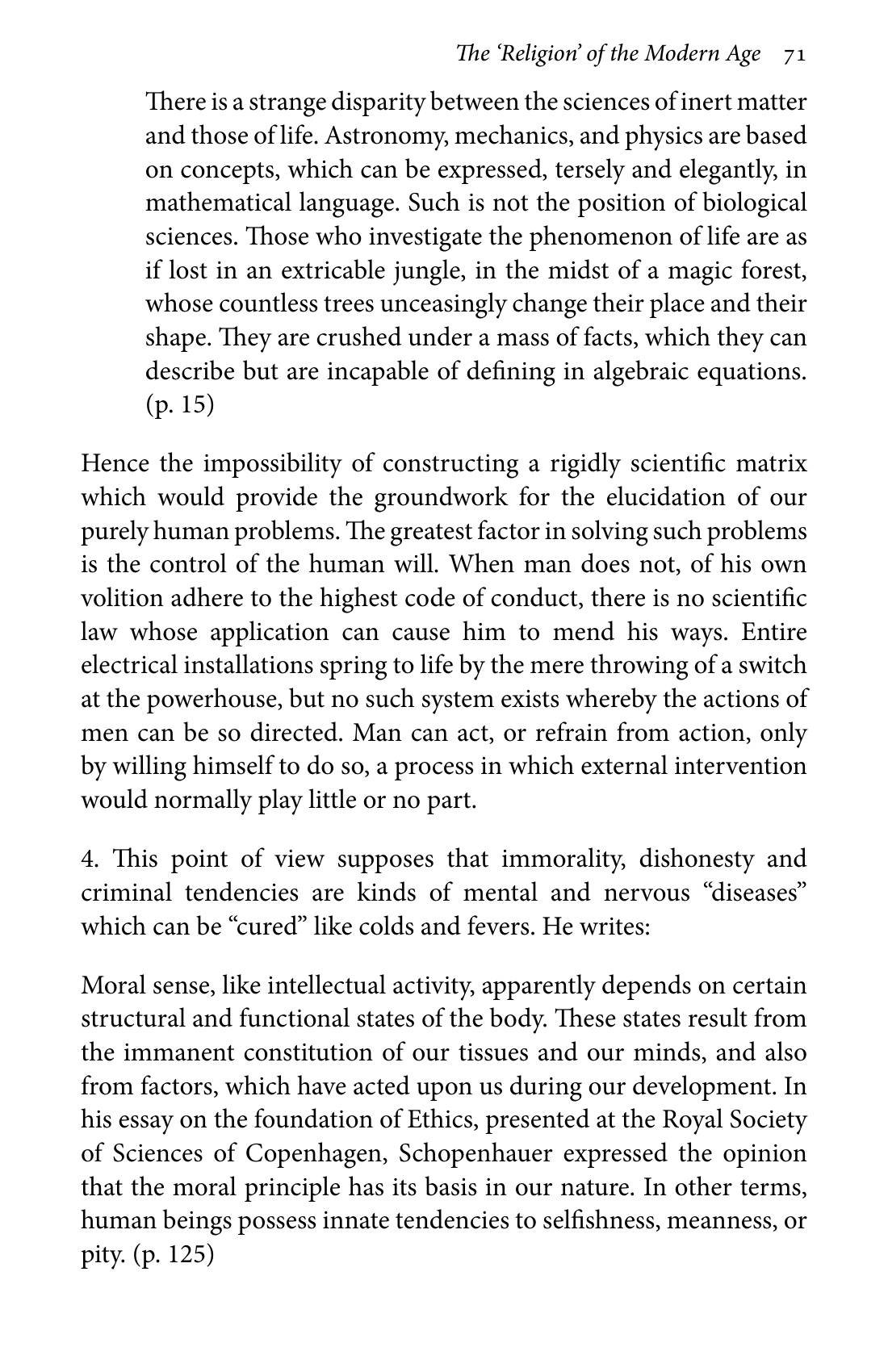
The ‘Religion’ of the Modern Ag There is a strange disparity between the sciences of inert matter and those of life. Astronomy, mechanics, and physics are based on concepts, which can be expressed, tersely and elegantly, in mathematical language. Such is not the position of biological sciences. Those who investigate the phenomenon of life are as if lost in an extricable jungle, in the midst of a magic forest, whose countless trees unceasingly change their place and their shape. They are crushed under a mass of facts, which they can describe but are incapable of defining in algebraic equations. (p. 15) Hence the impossibility of constructing a rigidly scientific matrix which would provide the groundwork for the elucidation of our purely human problems. The greatest factor in solving such problems is the control of the human will. When man does not, of his own volition adhere to the highest code of conduct, there is no scientific law whose application can cause him to mend his ways. Entire electrical installations spring to life by the mere throwing of a switch at the powerhouse, but no such system exists whereby the actions of men can be so directed. Man can act, or refrain from action, only by willing himself to do so, a process in which external intervention would normally play little or no part. 4. This point of view supposes that immorality, dishonesty and criminal tendencies are kinds of mental and nervous “diseases” which can be “cured” like colds and fevers. He writes: Moral sense, like intellectual activity, apparently depends on certain structural and functional states of the body. These states result from the immanent constitution of our tissues and our minds, and also from factors, which have acted upon us during our development. In his essay on the foundation of Ethics, presented at the Royal Society of Sciences of Copenhagen, Schopenhauer expressed the opinion that the moral principle has its basis in our nature. In other terms, human beings possess innate tendencies to selfishness, meanness, or pity. (p. 125)
‹ Previous page Next page › About this book Open in the reader