Utilization of Modern Opportunities
English book, p. 33
By Maulana Wahiduddin Khan
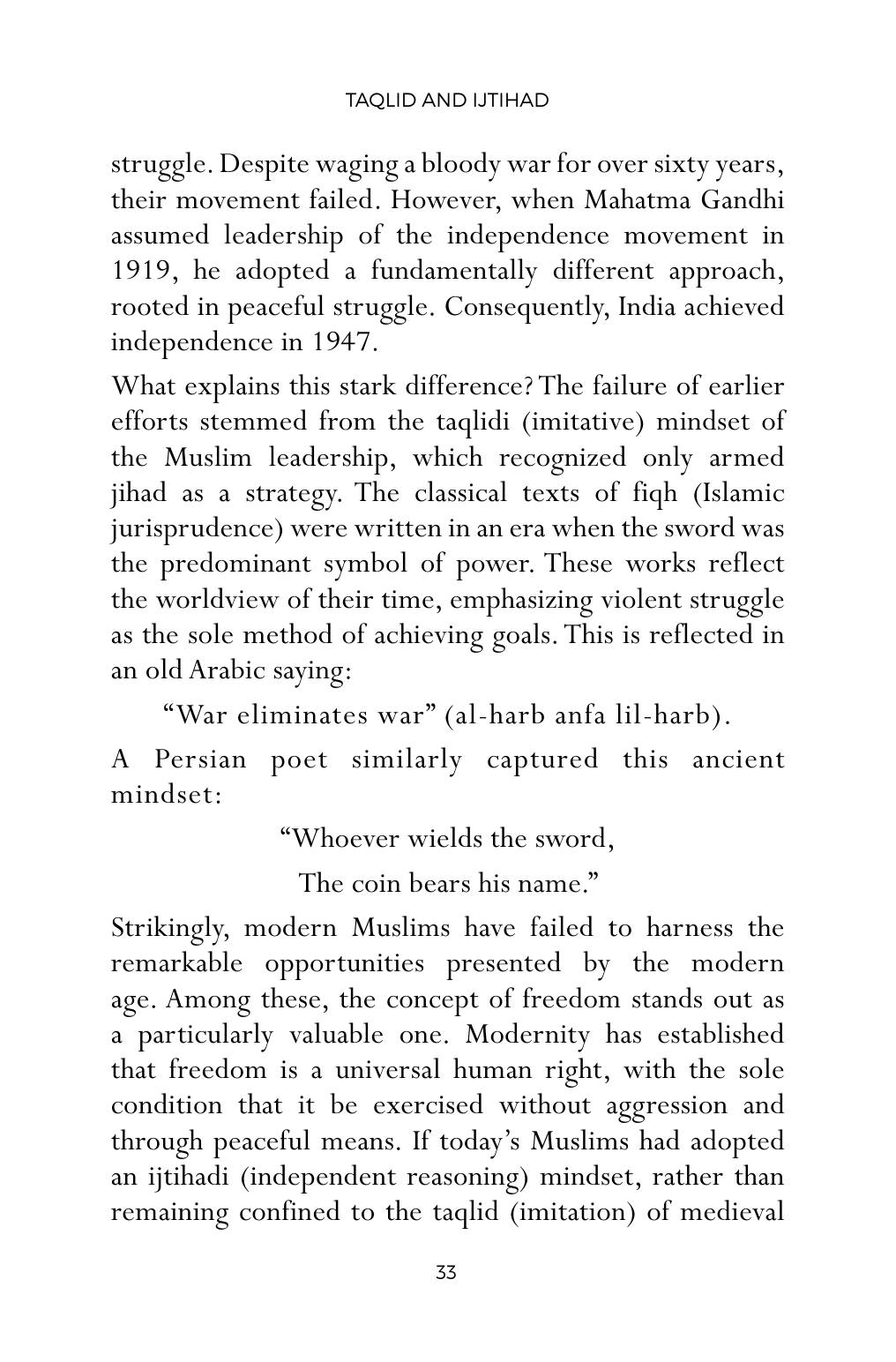
struggle. Despite waging a bloody war for over sixty years, their movement failed. However, when Mahatma Gandhi assumed leadership of the independence movement in 1919, he adopted a fundamentally different approach, rooted in peaceful struggle. Consequently, India achieved independence in 1947. What explains this stark difference? The failure of earlier efforts stemmed from the taqlidi (imitative) mindset of the Muslim leadership, which recognized only armed jihad as a strategy. The classical texts of fiqh (Islamic jurisprudence) were written in an era when the sword was the predominant symbol of power. These works reflect the worldview of their time, emphasizing violent struggle as the sole method of achieving goals. This is reflected in an old Arabic saying: “War eliminates war” (al-harb anfa lil-harb). A Persian poet similarly captured this ancient mindset: “Whoever wields the sword, The coin bears his name.” Strikingly, modern Muslims have failed to harness the remarkable opportunities presented by the modern age. Among these, the concept of freedom stands out as a particularly valuable one. Modernity has established that freedom is a universal human right, with the sole condition that it be exercised without aggression and through peaceful means. If today’s Muslims had adopted an ijtihadi (independent reasoning) mindset, rather than remaining confined to the taqlid (imitation) of medieval
‹ Previous page Next page › About this book Open in the reader