Principles Over Personalities
English book, p. 44
By Maulana Wahiduddin Khan
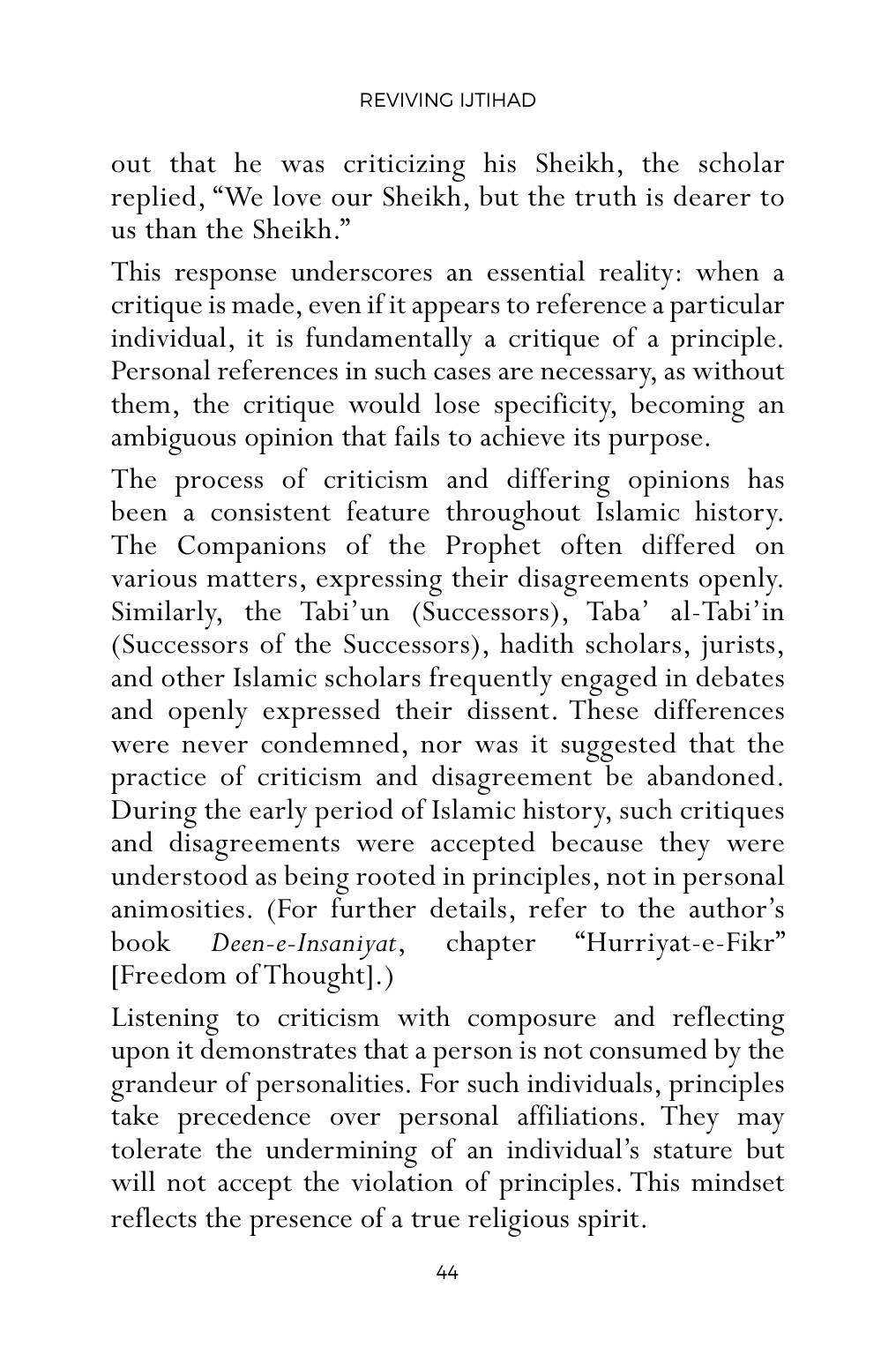
out that he was criticizing his Sheikh, the scholar replied, “We love our Sheikh, but the truth is dearer to us than the Sheikh.” This response underscores an essential reality: when a critique is made, even if it appears to reference a particular individual, it is fundamentally a critique of a principle. Personal references in such cases are necessary, as without them, the critique would lose specificity, becoming an ambiguous opinion that fails to achieve its purpose. The process of criticism and differing opinions has been a consistent feature throughout Islamic history. The Companions of the Prophet often differed on various matters, expressing their disagreements openly. Similarly, the Tabi’un (Successors), Taba’ al-Tabi’in (Successors of the Successors), hadith scholars, jurists, and other Islamic scholars frequently engaged in debates and openly expressed their dissent. These differences were never condemned, nor was it suggested that the practice of criticism and disagreement be abandoned. During the early period of Islamic history, such critiques and disagreements were accepted because they were understood as being rooted in principles, not in personal animosities. (For further details, refer to the author’s book Deen-e-Insaniyat, chapter “Hurriyat-e-Fikr” [Freedom of Thought].) Listening to criticism with composure and reflecting upon it demonstrates that a person is not consumed by the grandeur of personalities. For such individuals, principles take precedence over personal affiliations. They may tolerate the undermining of an individual’s stature but will not accept the violation of principles. This mindset reflects the presence of a true religious spirit.
‹ Previous page Next page › About this book Open in the reader