Duties Before Rights
English book, p. 34
By Maulana Wahiduddin Khan
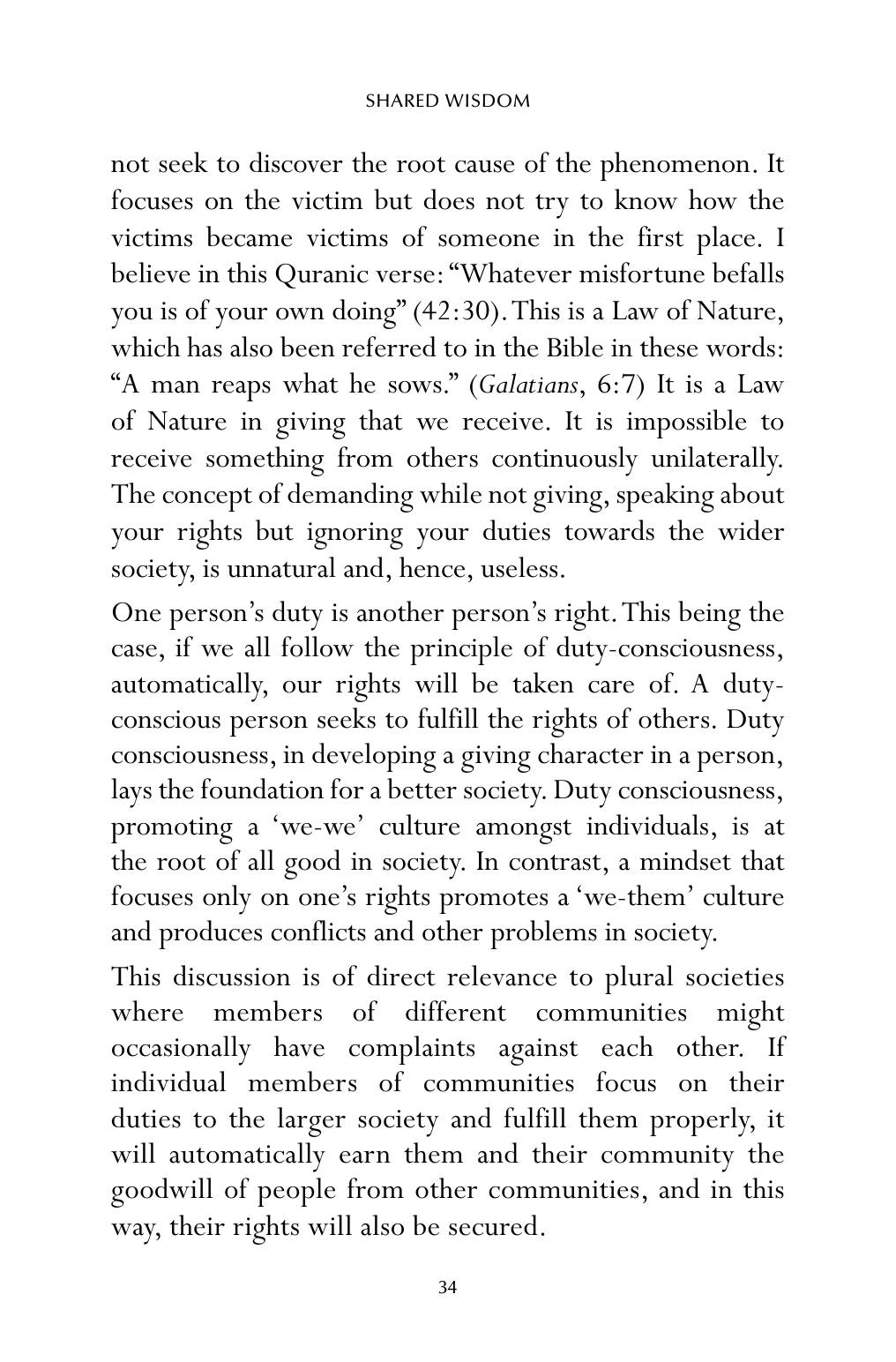
not seek to discover the root cause of the phenomenon. It focuses on the victim but does not try to know how the victims became victims of someone in the first place. I believe in this Quranic verse: “Whatever misfortune befa lls you is of your own doing” (42:30). This is a Law of Nature, which has also been referred to in the Bible in these words: “A man reaps what he sows.” (Galatians, 6:7) It is a Law of Nature in giving that we receive. It is impossible to receive something from others continuously unilaterally. The concept of demanding while not giving, speaking about your rights but ignoring your duties towards the wider society, is unnatural and, hence, useless. One person’s duty is another person’s right. This being the case, if we all follow the principle of duty-consciousness, automatically, our rights will be taken care of. A dutyconscious person seeks to fulfill the rights of others. Duty consciousness, in developing a giving character in a person, lays the foundation for a better society. Duty consciousness, promoting a ‘we-we’ culture amongst individuals, is at the root of all good in society. In contrast, a mindset that focuses only on one’s rights promotes a ‘we-them’ culture and produces conflicts and other problems in society. This discussion is of direct relevance to plural societies where members of different communities might occasionally have complaints against each other. If individual members of communities focus on their duties to the larger society and fulfill them properly, it will automatically earn them and their community the goodwill of people from other communities, and in this way, their rights will also be secured.
‹ Previous page Next page › About this book Open in the reader