The Concept of Jihad
English book, p. 359
By Maulana Wahiduddin Khan
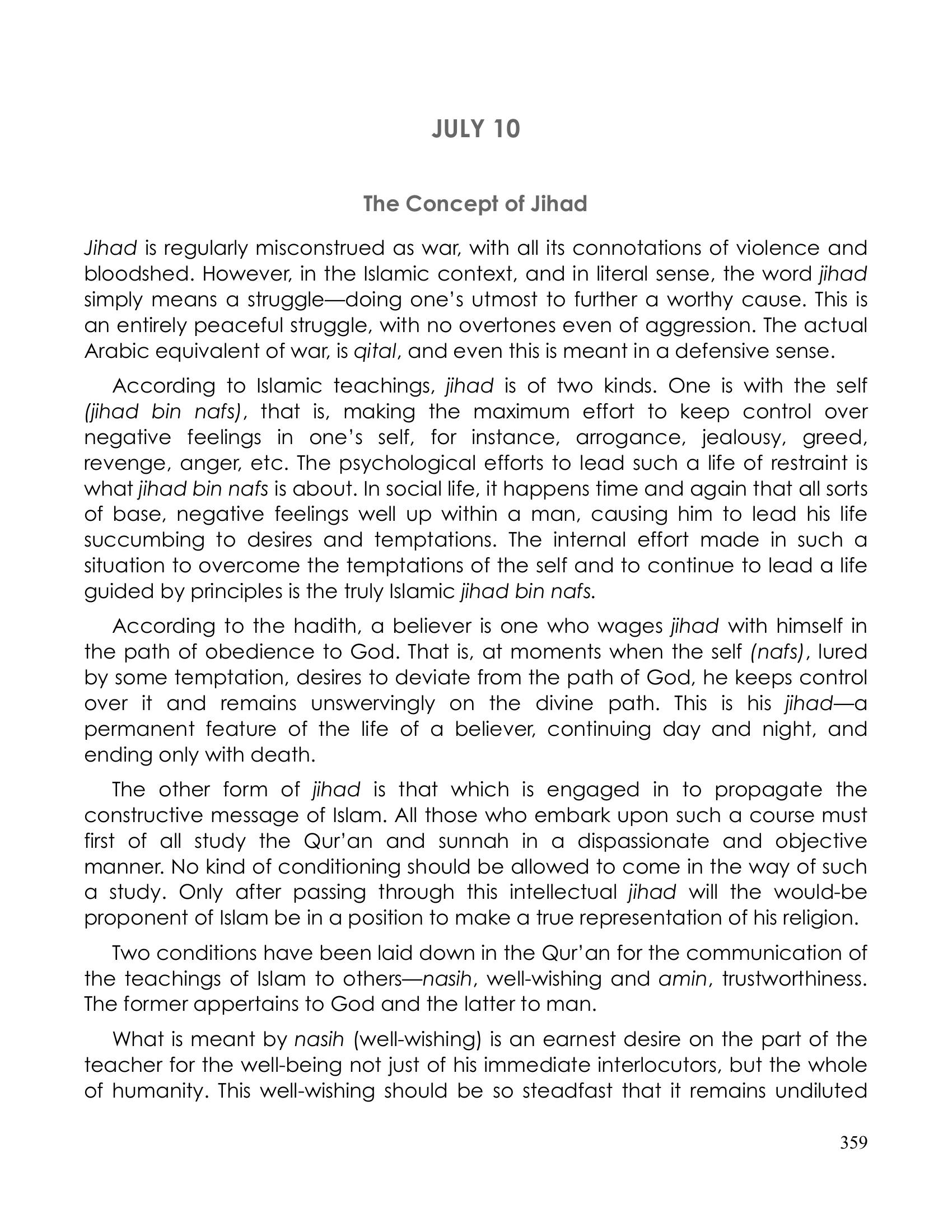
JULY 10 The Concept of Jihad Jihad is regularly misconstrued as war, with all its connotations of violence and bloodshed. However, in the Islamic context, and in literal sense, the word jihad simply means a struggle—doing one’s utmost to further a worthy cause. This is an entirely peaceful struggle, with no overtones even of aggression. The actual Arabic equivalent of war, is qital, and even this is meant in a defensive sense. According to Islamic teachings, jihad is of two kinds. One is with the self (jihad bin nafs), that is, making the maximum effort to keep control over negative feelings in one’s self, for instance, arrogance, jealousy, greed, revenge, anger, etc. The psychological efforts to lead such a life of restraint is what jihad bin nafs is about. In social life, it happens time and again that all sorts of base, negative feelings well up within a man, causing him to lead his life succumbing to desires and temptations. The internal effort made in such a situation to overcome the temptations of the self and to continue to lead a life guided by principles is the truly Islamic jihad bin nafs. According to the hadith, a believer is one who wages jihad with himself in the path of obedience to God. That is, at moments when the self (nafs), lured by some temptation, desires to deviate from the path of God, he keeps control over it and remains unswervingly on the divine path. This is his jihad—a permanent feature of the life of a believer, continuing day and night, and ending only with death. The other form of jihad is that which is engaged in to propagate the constructive message of Islam. All those who embark upon such a course must first of all study the Qur’an and sunnah in a dispassionate and objective manner. No kind of conditioning should be allowed to come in the way of such a study. Only after passing through this intellectual jihad will the would-be proponent of Islam be in a position to make a true representation of his religion. Two conditions have been laid down in the Qur’an for the communication of the teachings of Islam to others—nasih, well-wishing and amin, trustworthiness. The former appertains to God and the latter to man. What is meant by nasih (well-wishing) is an earnest desire on the part of the teacher for the well-being not just of his immediate interlocutors, but the whole of humanity. This well-wishing should be so steadfast that it remains undiluted
‹ Previous page Next page › About this book Open in the reader