Questions and Answers
English book, p. 77
By Maulana Wahiduddin Khan
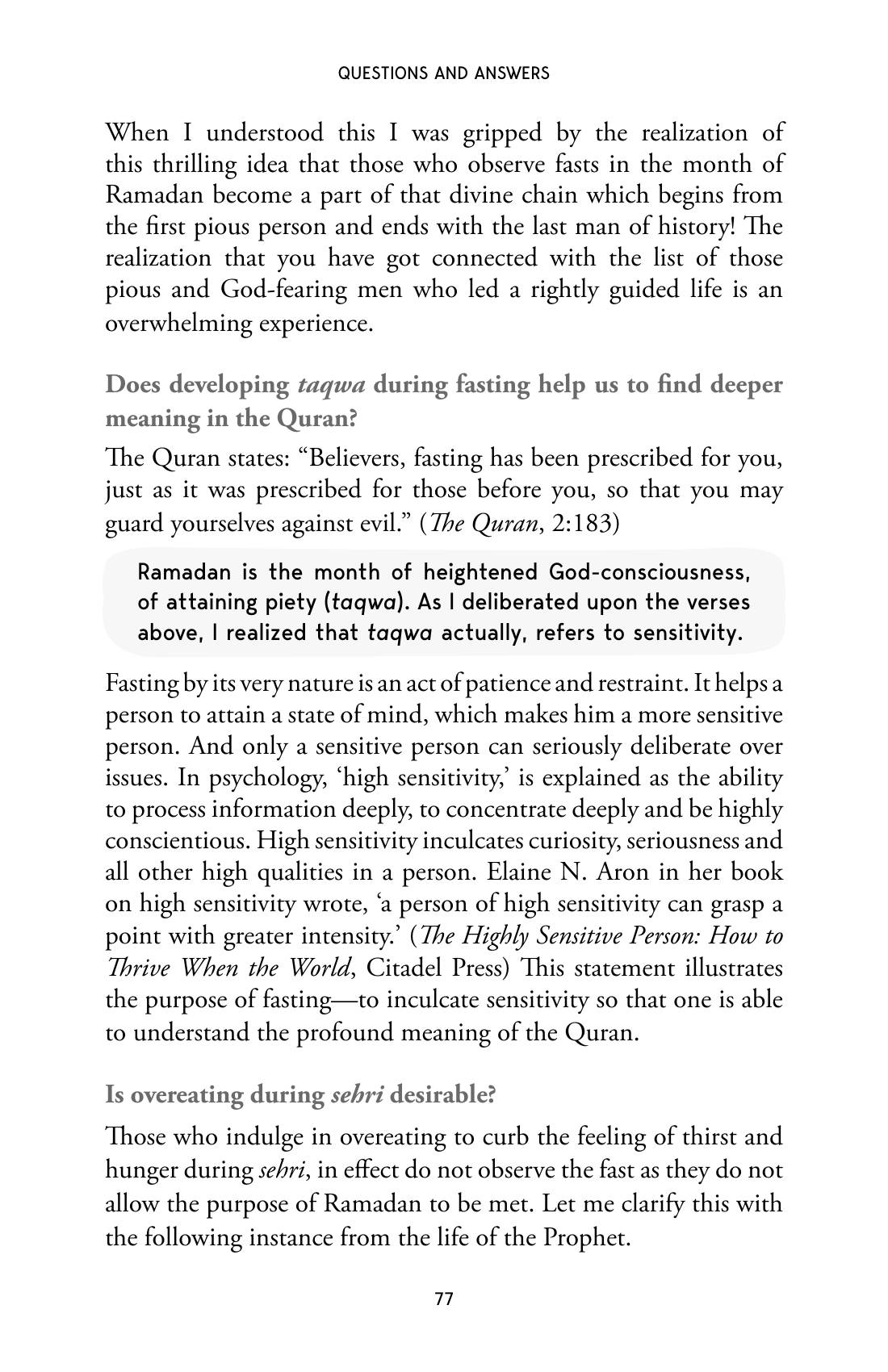
QUESTIONS AND ANSWERS When I understood this I was gripped by the realization of this thrilling idea that those who observe fasts in the month of Ramadan become a part of that divine chain which begins from the first pious person and ends with the last man of history! The realization that you have got connected with the list of those pious and God-fearing men who led a rightly guided life is an overwhelming experience. Does developing taqwa during fasting help us to find deeper meaning in the Quran? The Quran states: “Believers, fasting has been prescribed for you, just as it was prescribed for those before you, so that you may guard yourselves against evil.” (The Quran, 2:183) Ramadan is the month of heightened God-consciousness, of attaining piety (taqwa). As I deliberated upon the verses above, I realized that taqwa actually, refers to sensitivity. Fasting by its very nature is an act of patience and restraint. It helps a person to attain a state of mind, which makes him a more sensitive person. And only a sensitive person can seriously deliberate over issues. In psychology, ‘high sensitivity,’ is explained as the ability to process information deeply, to concentrate deeply and be highly conscientious. High sensitivity inculcates curiosity, seriousness and all other high qualities in a person. Elaine N. Aron in her book on high sensitivity wrote, ‘a person of high sensitivity can grasp a point with greater intensity.’ (The Highly Sensitive Person: How to Thrive When the World, Citadel Press) This statement illustrates the purpose of fasting—to inculcate sensitivity so that one is able to understand the profound meaning of the Quran. Is overeating during sehri desirable? Those who indulge in overeating to curb the feeling of thirst and hunger during sehri, in effect do not observe the fast as they do not allow the purpose of Ramadan to be met. Let me clarify this with the following instance from the life of the Prophet.
‹ Previous page Next page › About this book Open in the reader