The Art of Dematerialization
English book, p. 13
By Maulana Wahiduddin Khan
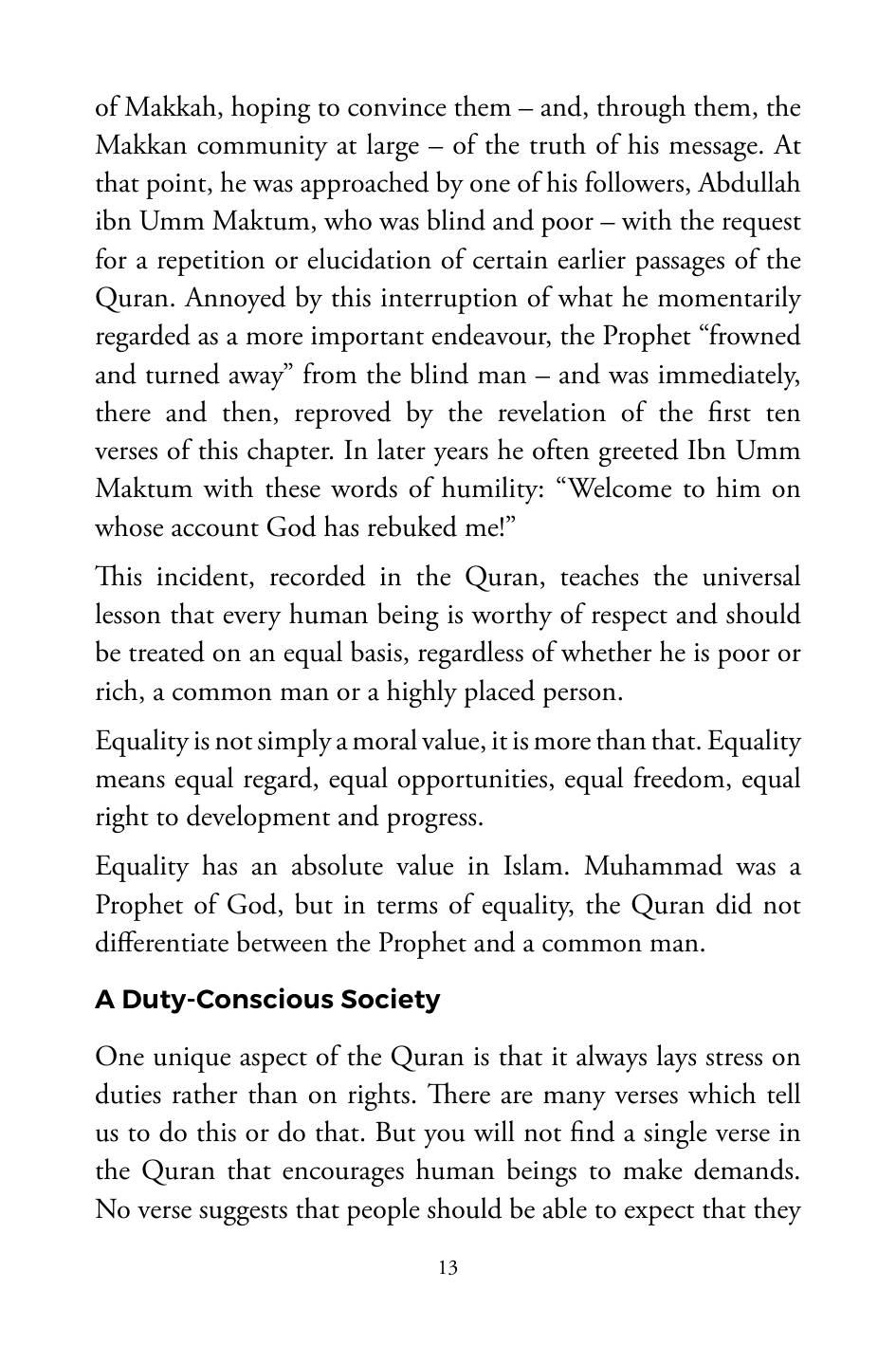
of Makkah, hoping to convince them – and, through them, the Makkan community at large – of the truth of his message. At that point, he was approached by one of his followers, Abdullah ibn Umm Maktum, who was blind and poor – with the request for a repetition or elucidation of certain earlier passages of the Quran. Annoyed by this interruption of what he momentarily regarded as a more important endeavour, the Prophet “frowned and turned away” from the blind man – and was immediately, there and then, reproved by the revelation of the first ten verses of this chapter. In later years he often greeted Ibn Umm Maktum with these words of humility: “Welcome to him on whose account God has rebuked me!” This incident, recorded in the Quran, teaches the universal lesson that every human being is worthy of respect and should be treated on an equal basis, regardless of whether he is poor or rich, a common man or a highly placed person. Equality is not simply a moral value, it is more than that. Equality means equal regard, equal opportunities, equal freedom, equal right to development and progress. Equality has an absolute value in Islam. Muhammad was a Prophet of God, but in terms of equality, the Quran did not differentiate between the Prophet and a common man. A Duty-Conscious Society One unique aspect of the Quran is that it always lays stress on duties rather than on rights. There are many verses which tell us to do this or do that. But you will not find a single verse in the Quran that encourages human beings to make demands. No verse suggests that people should be able to expect that they
‹ Previous page Next page › About this book Open in the reader