An Institutionalized Buffer
English book, p. 74
By Maulana Wahiduddin Khan
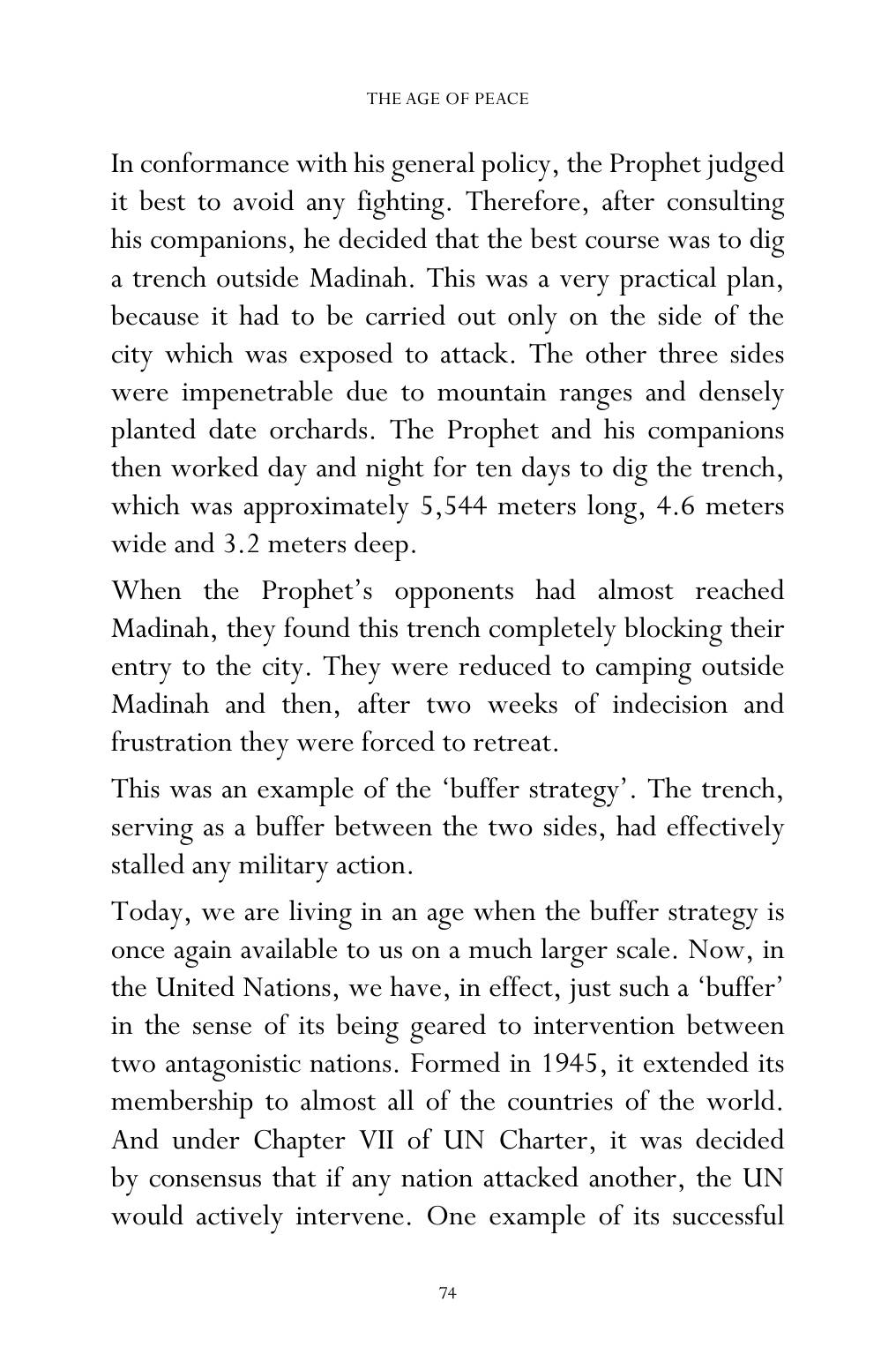
In conformance with his general policy, the Prophet judged it best to avoid any fighting. Therefore, after consulting his companions, he decided that the best course was to dig a trench outside Madinah. This was a very practical plan, because it had to be carried out only on the side of the city which was exposed to attack. The other three sides were impenetrable due to mountain ranges and densely planted date orchards. The Prophet and his companions then worked day and night for ten days to dig the trench, which was approximately 5,544 meters long, 4.6 meters wide and 3.2 meters deep. When the Prophet’s opponents had almost reached Madinah, they found this trench completely blocking their entry to the city. They were reduced to camping outside Madinah and then, after two weeks of indecision and frustration they were forced to retreat. This was an example of the ‘buffer strategy’. The trench, serving as a buffer between the two sides, had effectively stalled any military action. Today, we are living in an age when the buffer strategy is once again available to us on a much larger scale. Now, in the United Nations, we have, in effect, just such a ‘buffer’ in the sense of its being geared to intervention between two antagonistic nations. Formed in 1945, it extended its membership to almost all of the countries of the world. And under Chapter VII of UN Charter, it was decided by consensus that if any nation attacked another, the UN would actively intervene. One example of its successful
‹ Previous page Next page › About this book Open in the reader