The Condition For Success
English book, p. 45
By Maulana Wahiduddin Khan
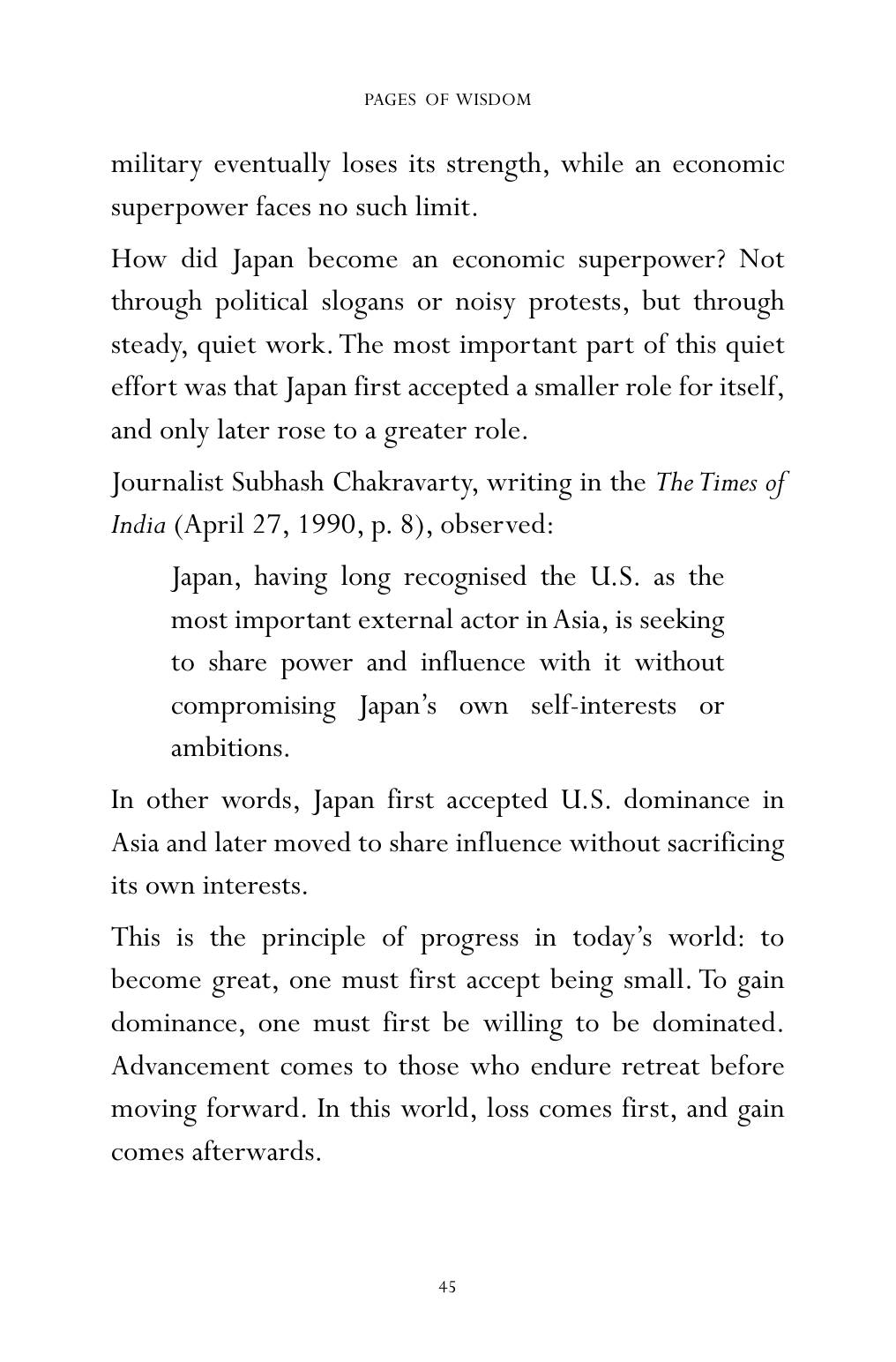
pages of wisdom military eventually loses its strength, while an economic superpower faces no such limit. How did Japan become an economic superpower? Not through political slogans or noisy protests, but through steady, quiet work. The most important part of this quiet effort was that Japan first accepted a smaller role for itself, and only later rose to a greater role. Journalist Subhash Chakravarty, writing in the The Times of India (April 27, 1990, p. 8), observed: Japan, having long recognised the U.S. as the most important external actor in Asia, is seeking to share power and influence with it without compromising Japan’s own self-interests or ambitions. In other words, Japan first accepted U.S. dominance in Asia and later moved to share influence without sacrificing its own interests. This is the principle of progress in today’s world: to become great, one must first accept being small. To gain dominance, one must first be willing to be dominated. Advancement comes to those who endure retreat before moving forward. In this world, loss comes first, and gain comes afterwards.
‹ Previous page Next page › About this book Open in the reader