How Difficult, How Easy
English book, p. 79
By Maulana Wahiduddin Khan
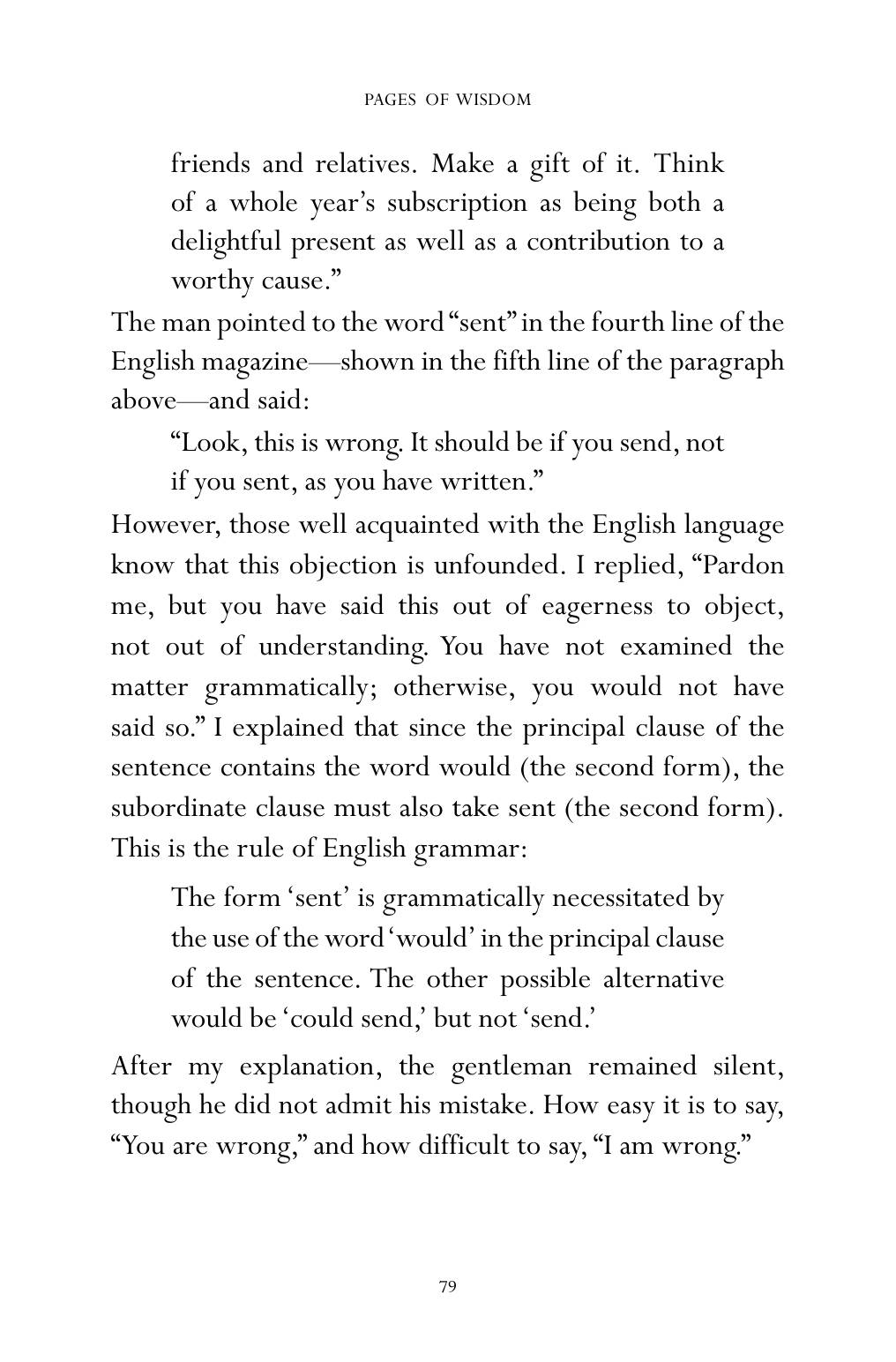
pages of wisdom friends and relatives. Make a gift of it. Think of a whole year’s subscription as being both a delightful present as well as a contribution to a worthy cause.” The man pointed to the word “sent” in the fourth line of the English magazine—shown in the fifth line of the paragraph above—and said: “Look, this is wrong. It should be if you send, not if you sent, as you have written.” However, those well acquainted with the English language know that this objection is unfounded. I replied, “Pardon me, but you have said this out of eagerness to object, not out of understanding. You have not examined the matter grammatically; otherwise, you would not have said so.” I explained that since the principal clause of the sentence contains the word would (the second form), the subordinate clause must also take sent (the second form). This is the rule of English grammar: The form ‘sent’ is grammatically necessitated by the use of the word ‘would’ in the principal clause of the sentence. The other possible alternative would be ‘could send,’ but not ‘send.’ After my explanation, the gentleman remained silent, though he did not admit his mistake. How easy it is to say, “You are wrong,” and how difficult to say, “I am wrong.”
‹ Previous page Next page › About this book Open in the reader