A Return to Kashmiriat
English book, p. 26
By Maulana Wahiduddin Khan
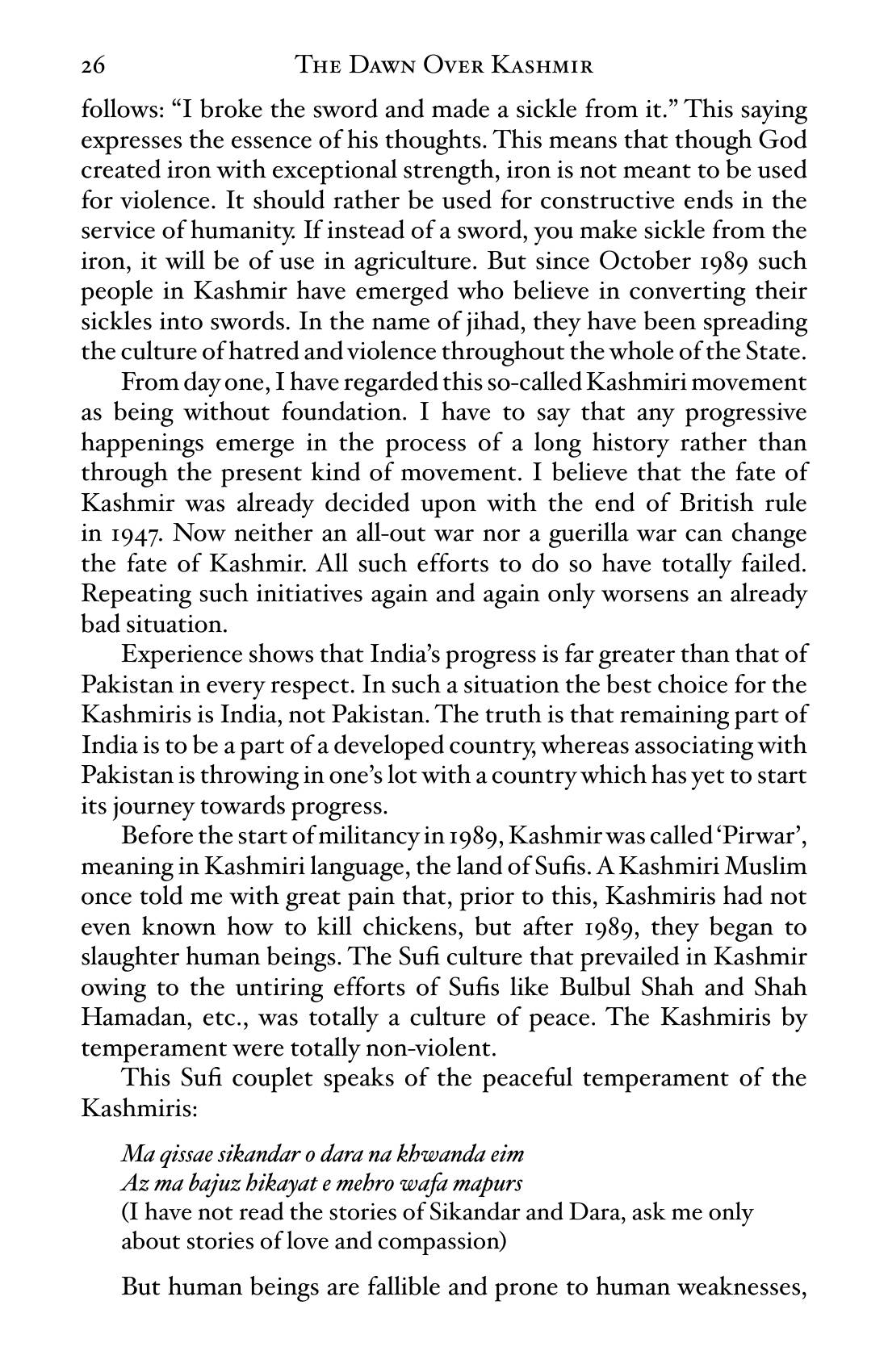
follows: “I broke the sword and made a sickle from it.” This saying expresses the essence of his thoughts. This means that though God created iron with exceptional strength, iron is not meant to be used for violence. It should rather be used for constructive ends in the service of humanity. If instead of a sword, you make sickle from the iron, it will be of use in agriculture. But since October 1989 such people in Kashmir have emerged who believe in converting their sickles into swords. In the name of jihad, they have been spreading the culture of hatred and violence throughout the whole of the State. From day one, I have regarded this so-called Kashmiri movement as being without foundation. I have to say that any progressive happenings emerge in the process of a long history rather than through the present kind of movement. I believe that the fate of Kashmir was already decided upon with the end of British rule in 1947. Now neither an all-out war nor a guerilla war can change the fate of Kashmir. All such efforts to do so have totally failed. Repeating such initiatives again and again only worsens an already bad situation. Experience shows that India’s progress is far greater than that of Pakistan in every respect. In such a situation the best choice for the Kashmiris is India, not Pakistan. The truth is that remaining part of India is to be a part of a developed country, whereas associating with Pakistan is throwing in one’s lot with a country which has yet to start its journey towards progress. Before the start of militancy in 1989, Kashmir was called ‘Pirwar’, meaning in Kashmiri language, the land of Sufis. A Kashmiri Muslim once told me with great pain that, prior to this, Kashmiris had not even known how to kill chickens, but after 1989, they began to slaughter human beings. The Sufi culture that prevailed in Kashmir owing to the untiring efforts of Sufis like Bulbul Shah and Shah Hamadan, etc., was totally a culture of peace. The Kashmiris by temperament were totally non-violent. This Sufi couplet speaks of the peaceful temperament of the Kashmiris: Ma qissae sikandar o dara na khwanda eim Az ma bajuz hikayat e mehro wafa mapurs (I have not read the stories of Sikandar and Dara, ask me only about stories of love and compassion) But human beings are fallible and prone to human weaknesses,
‹ Previous page Next page › About this book Open in the reader