Correspondence with Maulana Abul Lais Islahi Nadwi
English book, p. 114
By Maulana Wahiduddin Khan
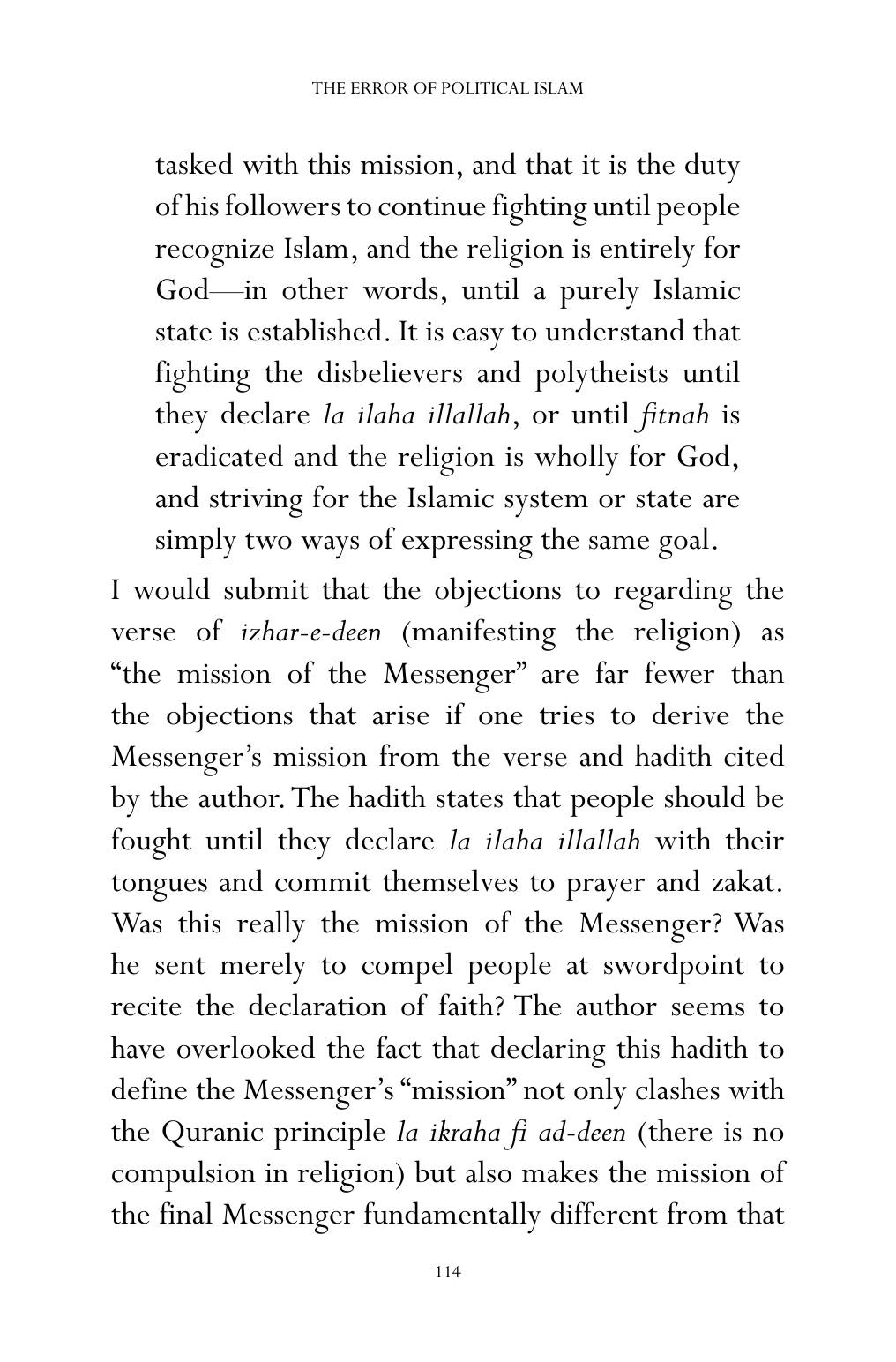
tasked with this mission, and that it is the duty of his followers to continue fighting until people recognize Islam, and the religion is entirely for God—in other words, until a purely Islamic state is established. It is easy to understand that fighting the disbelievers and polytheists until they declare la ilaha illallah, or until fitnah is eradicated and the religion is wholly for God, and striving for the Islamic system or state are simply two ways of expressing the same goal. I would submit that the objections to regarding the verse of izhar-e-deen (manifesting the religion) as “the mission of the Messenger” are far fewer than the objections that arise if one tries to derive the Messenger’s mission from the verse and hadith cited by the author. The hadith states that people should be fought until they declare la ilaha illallah with their tongues and commit themselves to prayer and zakat. Was this really the mission of the Messenger? Was he sent merely to compel people at swordpoint to recite the declaration of faith? The author seems to have overlooked the fact that declaring this hadith to define the Messenger’s “mission” not only clashes with the Quranic principle la ikraha fi ad-deen (there is no compulsion in religion) but also makes the mission of the final Messenger fundamentally different from that
‹ Previous page Next page › About this book Open in the reader