Correspondence with Maulana Abul Lais Islahi Nadwi
English book, p. 116
By Maulana Wahiduddin Khan
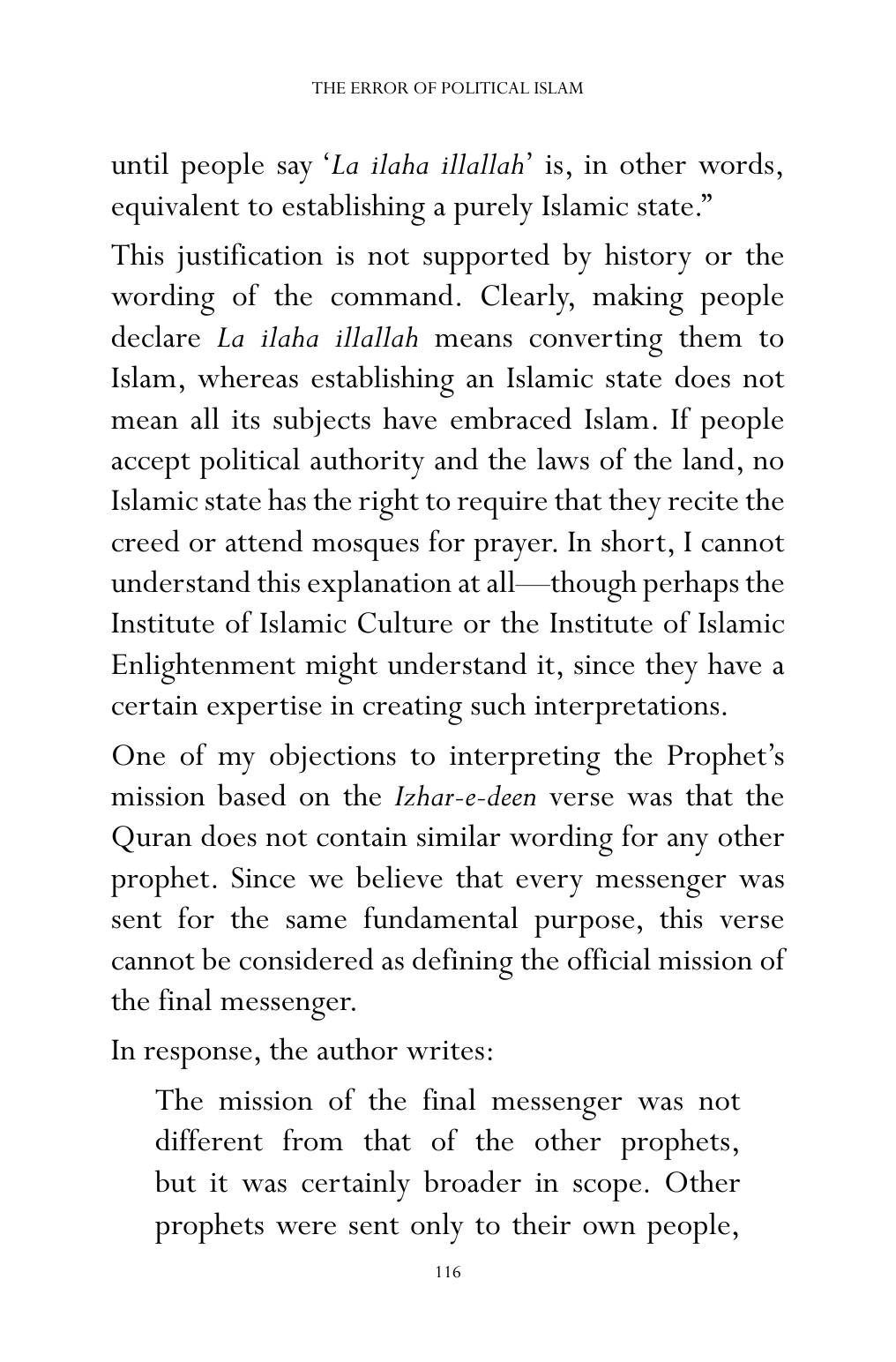
until people say ‘La ilaha illallah’ is, in other words, equivalent to establishing a purely Islamic state.” This justification is not supported by history or the wording of the command. Clearly, making people declare La ilaha illallah means converting them to Islam, whereas establishing an Islamic state does not mean all its subjects have embraced Islam. If people accept political authority and the laws of the land, no Islamic state has the right to require that they recite the creed or attend mosques for prayer. In short, I cannot understand this explanation at all—though perhaps the Institute of Islamic Culture or the Institute of Islamic Enlightenment might understand it, since they have a certain expertise in creating such interpretations. One of my objections to interpreting the Prophet’s mission based on the Izhar-e-deen verse was that the Quran does not contain similar wording for any other prophet. Since we believe that every messenger was sent for the same fundamental purpose, this verse cannot be considered as defining the official mission of the final messenger. In response, the author writes: The mission of the final messenger was not different from that of the other prophets, but it was certainly broader in scope. Other prophets were sent only to their own people,
‹ Previous page Next page › About this book Open in the reader