Arguments from the Quran
English book, p. 364
By Maulana Wahiduddin Khan
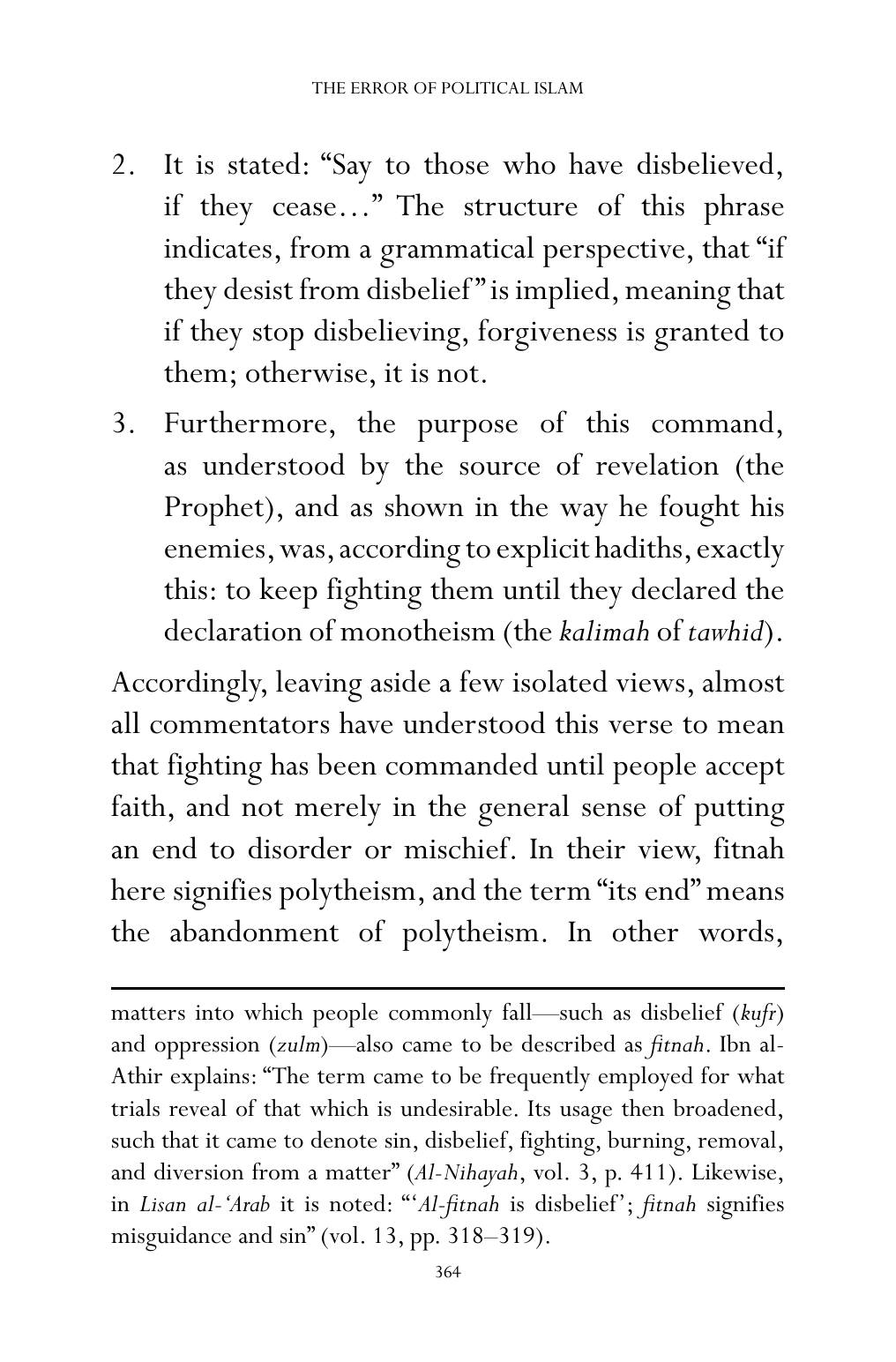
2. It is stated: “Say to those who have disbelieved, if they cease…” The structure of this phrase indicates, from a grammatical perspective, that “if they desist from disbelief” is implied, meaning that if they stop disbelieving, forgiveness is granted to them; otherwise, it is not. 3. Furthermore, the purpose of this command, as understood by the source of revelation (the Prophet), and as shown in the way he fought his enemies, was, according to explicit hadiths, exactly this: to keep fighting them until they declared the declaration of monotheism (the kalimah of tawhid). Accordingly, leaving aside a few isolated views, almost all commentators have understood this verse to mean that fighting has been commanded until people accept faith, and not merely in the general sense of putting an end to disorder or mischief. In their view, fitnah here signifies polytheism, and the term “its end” means the abandonment of polytheism. In other words, matters into which people commonly fall—such as disbelief (kufr) and oppression (zulm)—also came to be described as fitnah. Ibn alAthir explains: “The term came to be frequently employed for what trials reveal of that which is undesirable. Its usage then broadened, such that it came to denote sin, disbelief, fighting, burning, removal, and diversion from a matter” (Al-Nihayah, vol. 3, p. 411). Likewise, in Lisan al-‘Arab it is noted: “‘Al-fitnah is disbelief’; fitnah signifies misguidance and sin” (vol. 13, pp. 318–319).
‹ Previous page Next page › About this book Open in the reader