A COMPARISON
English book, p. 548
By Maulana Wahiduddin Khan
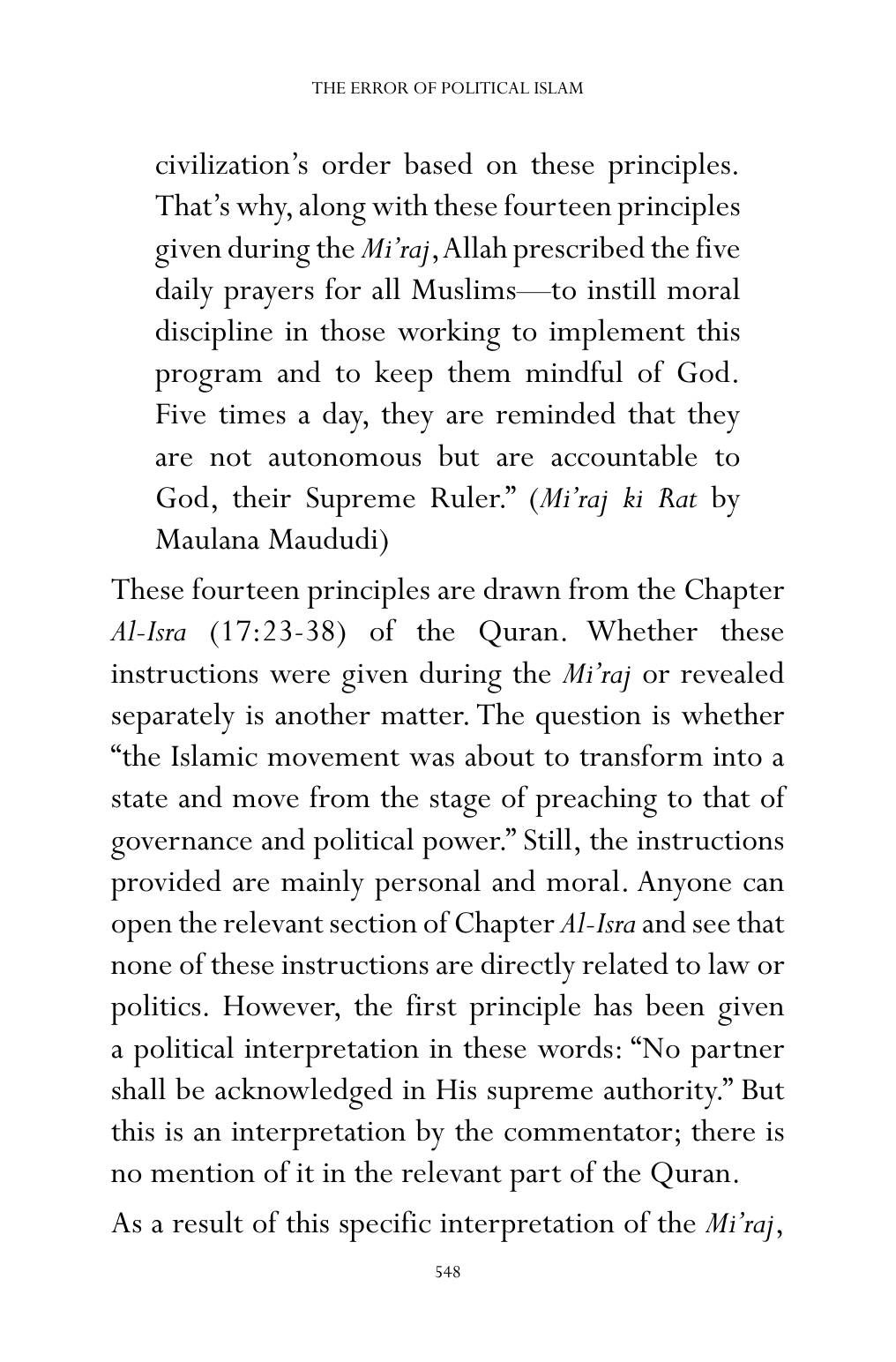
civilization’s order based on these principles. That’s why, along with these fourteen principles given during the Mi’raj, Allah prescribed the five daily prayers for all Muslims—to instill moral discipline in those working to implement this program and to keep them mindful of God. Five times a day, they are reminded that they are not autonomous but are accountable to God, their Supreme Ruler.” (Mi’raj ki Rat by Maulana Maududi) These fourteen principles are drawn from the Chapter Al-Isra (17:23-38) of the Quran. Whether these instructions were given during the Mi’raj or revealed separately is another matter. The question is whether “the Islamic movement was about to transform into a state and move from the stage of preaching to that of governance and political power.” Still, the instructions provided are mainly personal and moral. Anyone can open the relevant section of Chapter Al-Isra and see that none of these instructions are directly related to law or politics. However, the first principle has been given a political interpretation in these words: “No partner shall be acknowledged in His supreme authority.” But this is an interpretation by the commentator; there is no mention of it in the relevant part of the Quran. As a result of this specific interpretation of the Mi’raj,
‹ Previous page Next page › About this book Open in the reader