A Reply to a Letter
English book, p. 111
By Maulana Wahiduddin Khan
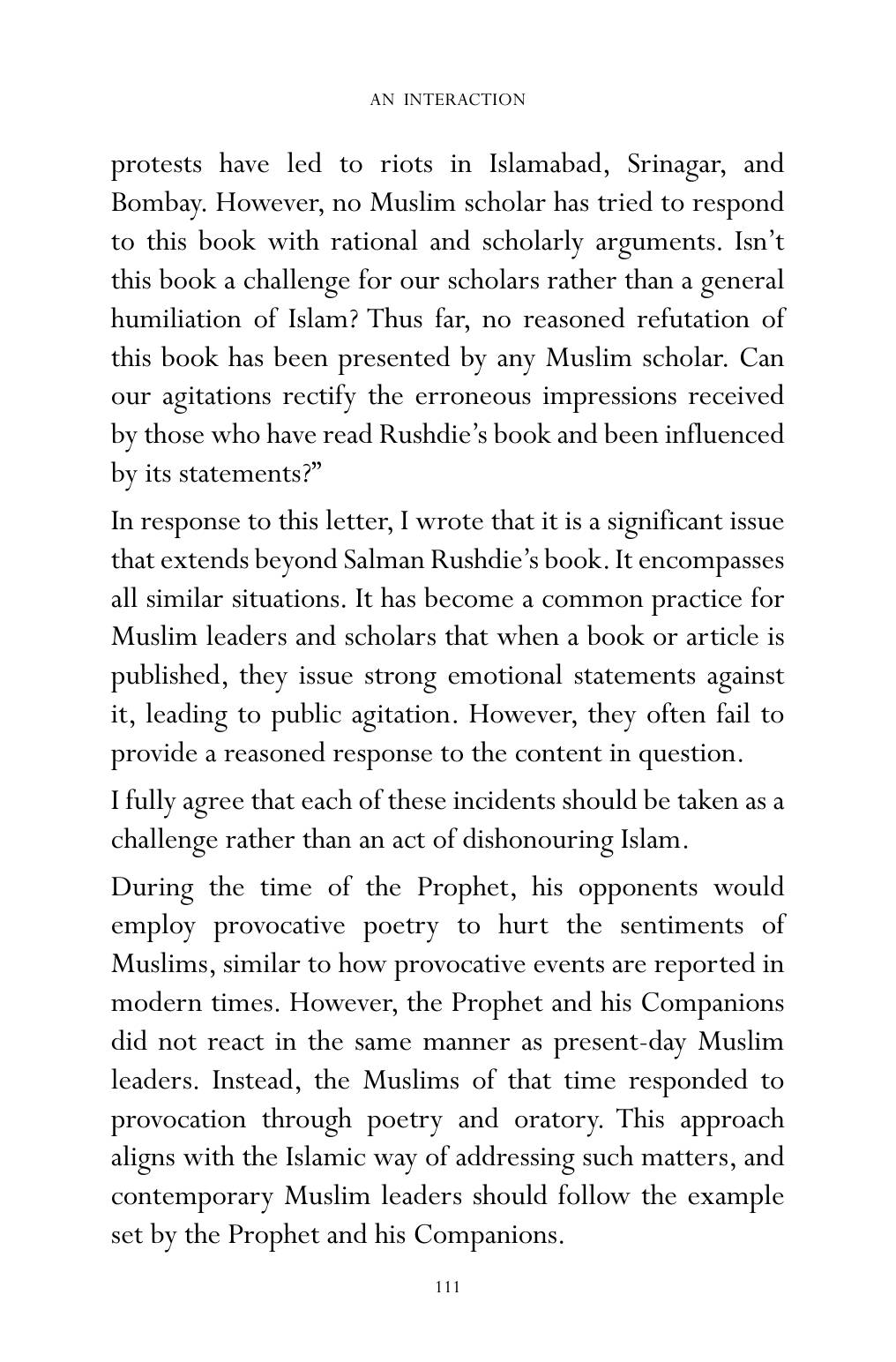
AN INTERACTION protests have led to riots in Islamabad, Srinagar, and Bombay. However, no Muslim scholar has tried to respond to this book with rational and scholarly arguments. Isn’t this book a challenge for our scholars rather than a general humiliation of Islam? Thus far, no reasoned refutation of this book has been presented by any Muslim scholar. Can our agitations rectify the erroneous impressions received by those who have read Rushdie’s book and been influenced by its statements?” In response to this letter, I wrote that it is a significant issue that extends beyond Salman Rushdie’s book. It encompasses all similar situations. It has become a common practice for Muslim leaders and scholars that when a book or article is published, they issue strong emotional statements against it, leading to public agitation. However, they often fail to provide a reasoned response to the content in question. I fully agree that each of these incidents should be taken as a challenge rather than an act of dishonouring Islam. During the time of the Prophet, his opponents would employ provocative poetry to hurt the sentiments of Muslims, similar to how provocative events are reported in modern times. However, the Prophet and his Companions did not react in the same manner as present-day Muslim leaders. Instead, the Muslims of that time responded to provocation through poetry and oratory. This approach aligns with the Islamic way of addressing such matters, and contemporary Muslim leaders should follow the example set by the Prophet and his Companions.
‹ Previous page Next page › About this book Open in the reader