Arguments from Jurisprudence
English book, p. 146
By Maulana Wahiduddin Khan
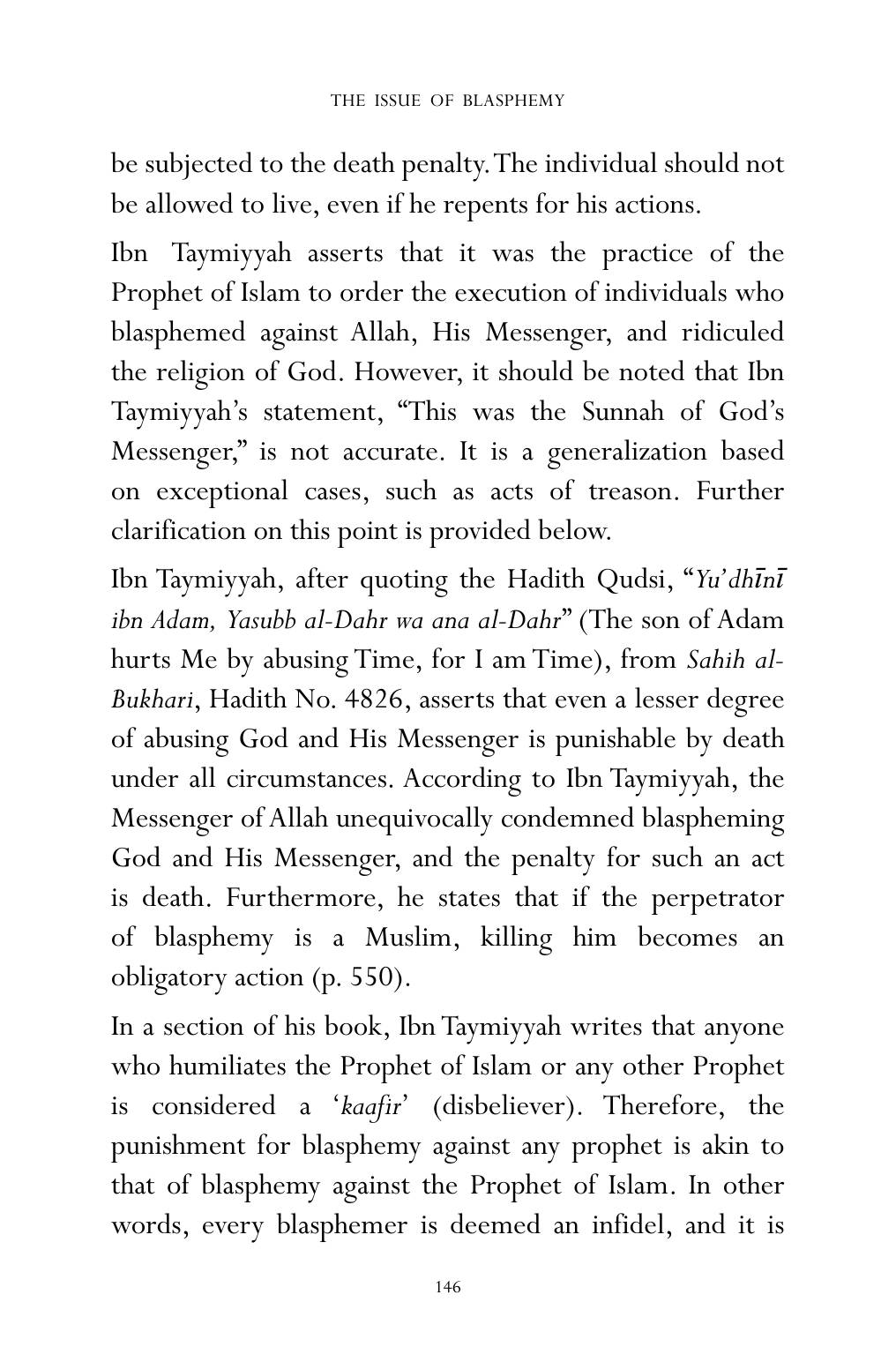
be subjected to the death penalty. The individual should not be allowed to live, even if he repents for his actions. Ibn Taymiyyah asserts that it was the practice of the Prophet of Islam to order the execution of individuals who blasphemed against Allah, His Messenger, and ridiculed the religion of God. However, it should be noted that Ibn Taymiyyah’s statement, “This was the Sunnah of God’s Messenger,” is not accurate. It is a generalization based on exceptional cases, such as acts of treason. Further clarification on this point is provided below. Ibn Taymiyyah, after quoting the Hadith Qudsi, “Yu’dhīnī ibn Adam, Yasubb al-Dahr wa ana al-Dahr” (The son of Adam hurts Me by abusing Time, for I am Time), from Sahih alBukhari, Hadith No. 4826, asserts that even a lesser degree of abusing God and His Messenger is punishable by death under all circumstances. According to Ibn Taymiyyah, the Messenger of Allah unequivocally condemned blaspheming God and His Messenger, and the penalty for such an act is death. Furthermore, he states that if the perpetrator of blasphemy is a Muslim, killing him becomes an obligatory action (p. 550). In a section of his book, Ibn Taymiyyah writes that anyone who humiliates the Prophet of Islam or any other Prophet is considered a ‘kaafir’ (disbeliever). Therefore, the punishment for blasphemy against any prophet is akin to that of blasphemy against the Prophet of Islam. In other words, every blasphemer is deemed an infidel, and it is
‹ Previous page Next page › About this book Open in the reader