A New Trend Emerged in Recent Times
English book, p. 34
By Maulana Wahiduddin Khan
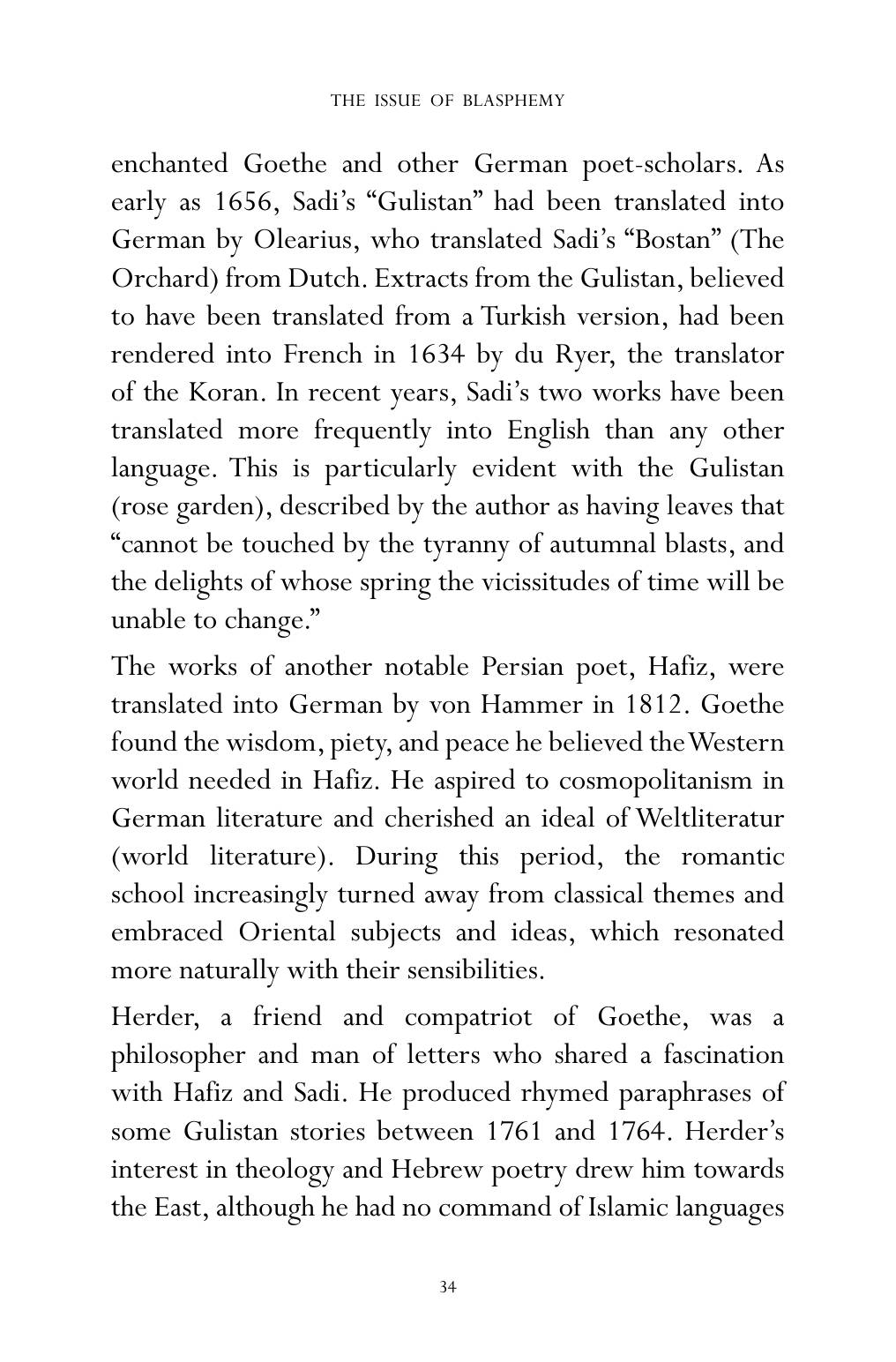
enchanted Goethe and other German poet-scholars. As early as 1656, Sadi’s “Gulistan” had been translated into German by Olearius, who translated Sadi’s “Bostan” (The Orchard) from Dutch. Extracts from the Gulistan, believed to have been translated from a Turkish version, had been rendered into French in 1634 by du Ryer, the translator of the Koran. In recent years, Sadi’s two works have been translated more frequently into English than any other language. This is particularly evident with the Gulistan (rose garden), described by the author as having leaves that “cannot be touched by the tyranny of autumnal blasts, and the delights of whose spring the vicissitudes of time will be unable to change.” The works of another notable Persian poet, Hafiz, were translated into German by von Hammer in 1812. Goethe found the wisdom, piety, and peace he believed the Western world needed in Hafiz. He aspired to cosmopolitanism in German literature and cherished an ideal of Weltliteratur (world literature). During this period, the romantic school increasingly turned away from classical themes and embraced Oriental subjects and ideas, which resonated more naturally with their sensibilities. Herder, a friend and compatriot of Goethe, was a philosopher and man of letters who shared a fascination with Hafiz and Sadi. He produced rhymed paraphrases of some Gulistan stories between 1761 and 1764. Herder’s interest in theology and Hebrew poetry drew him towards the East, although he had no command of Islamic languages
‹ Previous page Next page › About this book Open in the reader