The Prophet in Makkah
English book, p. 194
By Maulana Wahiduddin Khan
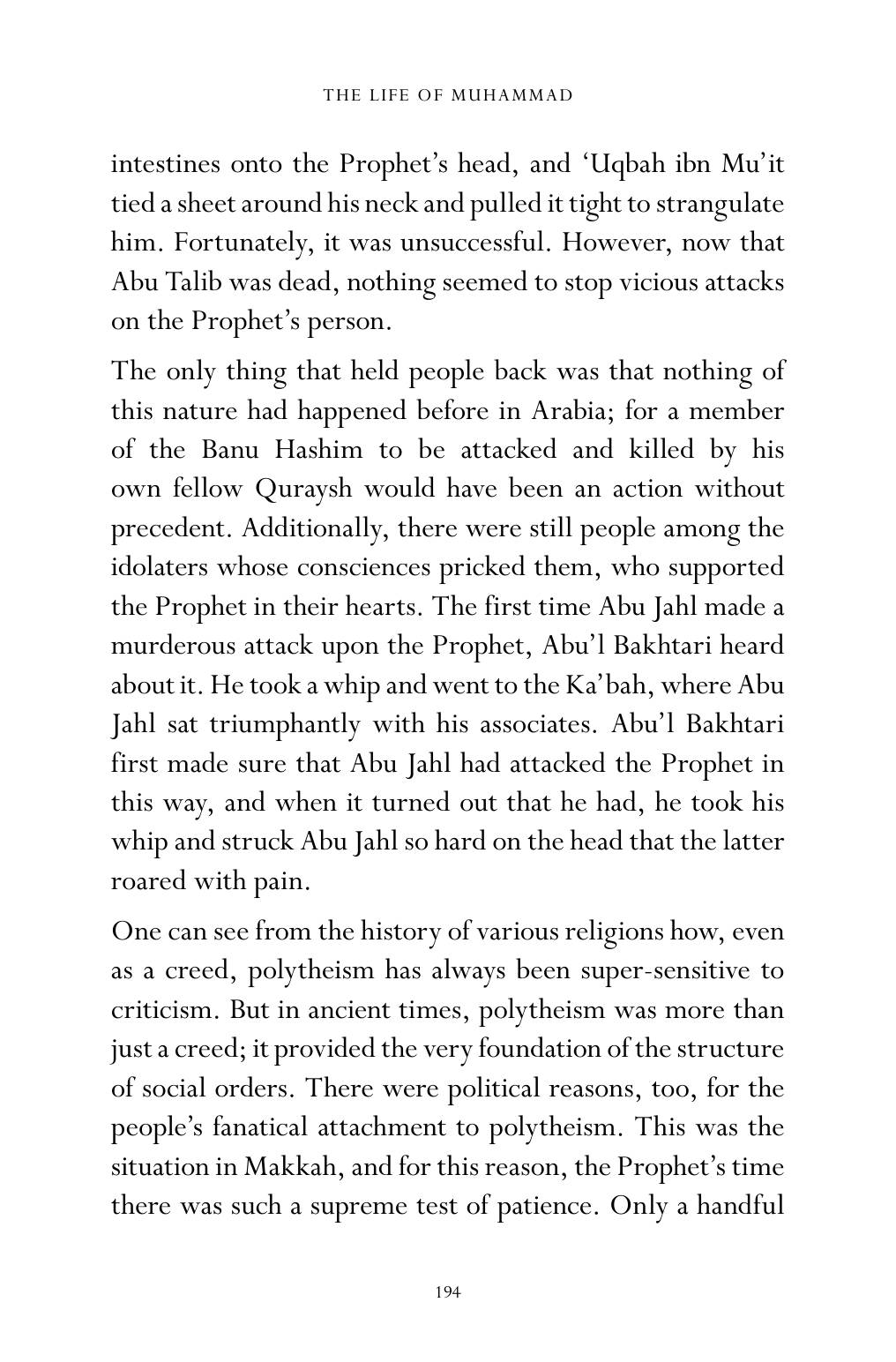
intestines onto the Prophet’s head, and ‘Uqbah ibn Mu’it tied a sheet around his neck and pulled it tight to strangulate him. Fortunately, it was unsuccessful. However, now that Abu Talib was dead, nothing seemed to stop vicious attacks on the Prophet’s person. The only thing that held people back was that nothing of this nature had happened before in Arabia; for a member of the Banu Hashim to be attacked and killed by his own fellow Quraysh would have been an action without precedent. Additionally, there were still people among the idolaters whose consciences pricked them, who supported the Prophet in their hearts. The first time Abu Jahl made a murderous attack upon the Prophet, Abu’l Bakhtari heard about it. He took a whip and went to the Ka’bah, where Abu Jahl sat triumphantly with his associates. Abu’l Bakhtari first made sure that Abu Jahl had attacked the Prophet in this way, and when it turned out that he had, he took his whip and struck Abu Jahl so hard on the head that the latter roared with pain. One can see from the history of various religions how, even as a creed, polytheism has always been super-sensitive to criticism. But in ancient times, polytheism was more than just a creed; it provided the very foundation of the structure of social orders. There were political reasons, too, for the people’s fanatical attachment to polytheism. This was the situation in Makkah, and for this reason, the Prophet’s time there was such a supreme test of patience. Only a handful
‹ Previous page Next page › About this book Open in the reader