The Emergence and Legacy of the Prophet Muhammad
English book, p. 21
By Maulana Wahiduddin Khan
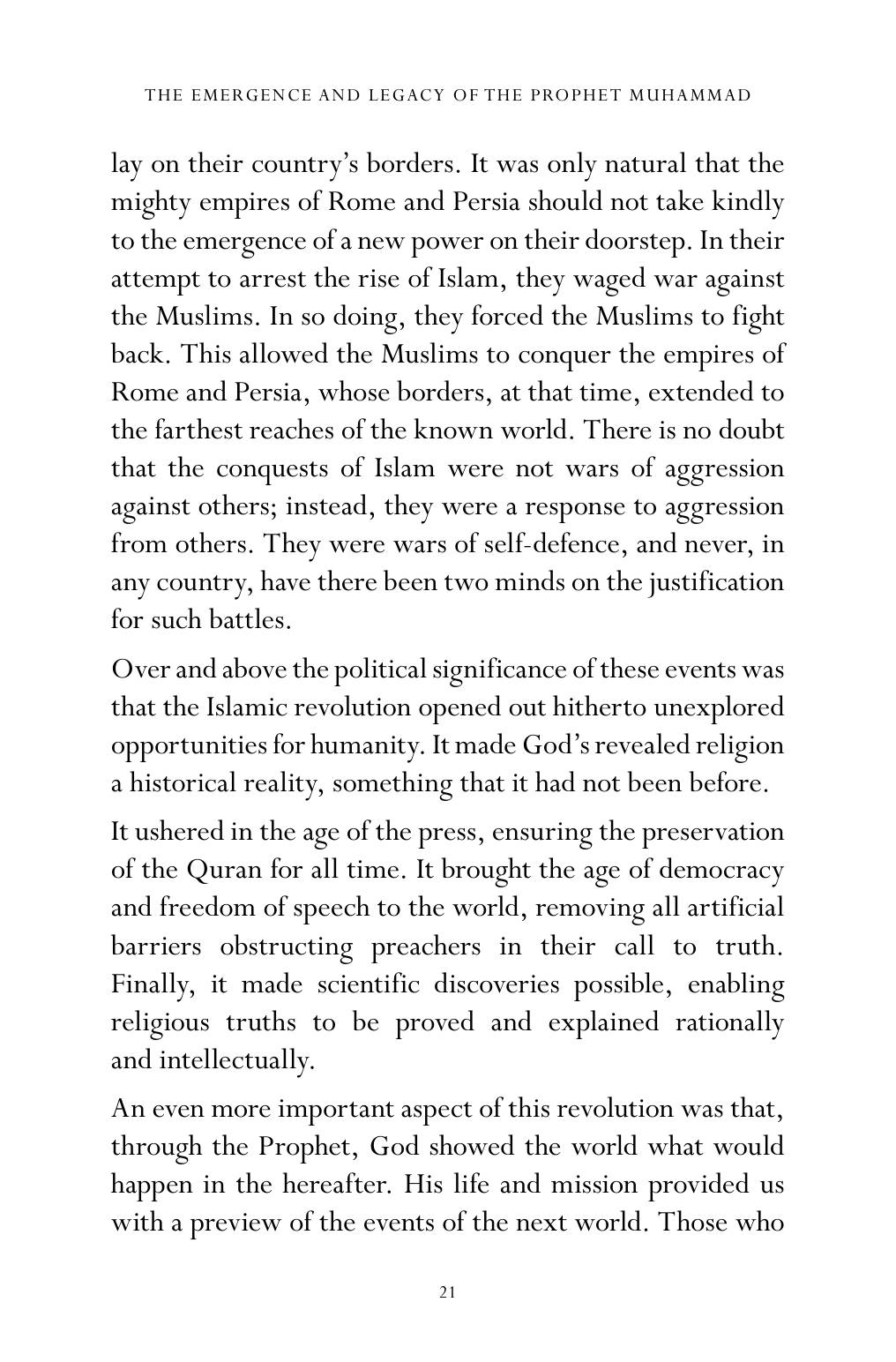
THE EMERGENCE AND LEGACY OF THE PROPHET MUHAMMAD lay on their country’s borders. It was only natural that the mighty empires of Rome and Persia should not take kindly to the emergence of a new power on their doorstep. In their attempt to arrest the rise of Islam, they waged war against the Muslims. In so doing, they forced the Muslims to fight back. This allowed the Muslims to conquer the empires of Rome and Persia, whose borders, at that time, extended to the farthest reaches of the known world. There is no doubt that the conquests of Islam were not wars of aggression against others; instead, they were a response to aggression from others. They were wars of self-defence, and never, in any country, have there been two minds on the justification for such battles. Over and above the political significance of these events was that the Islamic revolution opened out hitherto unexplored opportunities for humanity. It made God’s revealed religion a historical reality, something that it had not been before. It ushered in the age of the press, ensuring the preservation of the Quran for all time. It brought the age of democracy and freedom of speech to the world, removing all artificial barriers obstructing preachers in their call to truth. Finally, it made scientific discoveries possible, enabling religious truths to be proved and explained rationally and intellectually. An even more important aspect of this revolution was that, through the Prophet, God showed the world what would happen in the hereafter. His life and mission provided us with a preview of the events of the next world. Those who
‹ Previous page Next page › About this book Open in the reader