The Quran—The Miracle Given to the Prophet
English book, p. 268
By Maulana Wahiduddin Khan
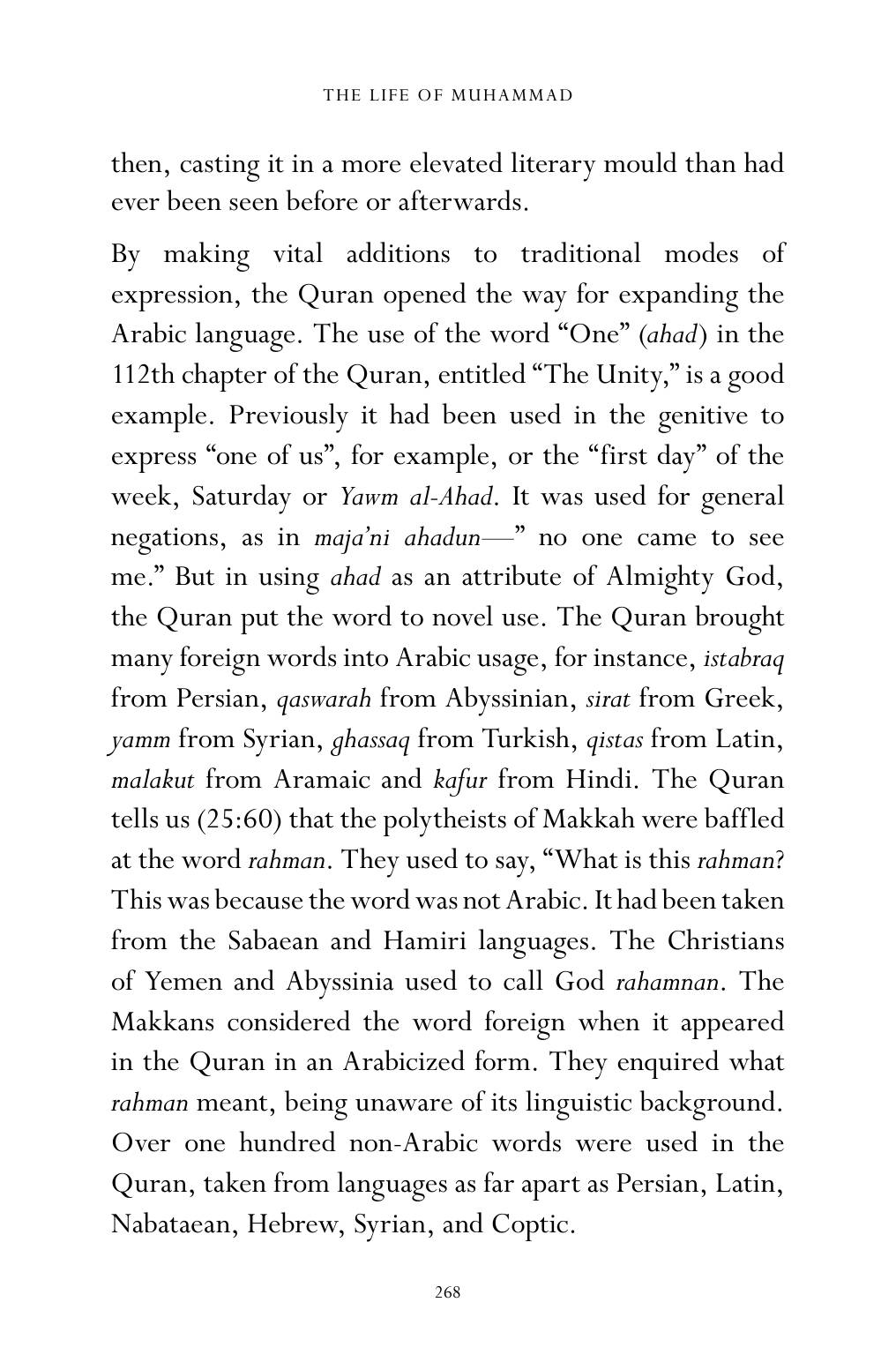
then, casting it in a more elevated literary mould than had ever been seen before or afterwards. By making vital additions to traditional modes of expression, the Quran opened the way for expanding the Arabic language. The use of the word “One” (ahad) in the 112th chapter of the Quran, entitled “The Unity,” is a good example. Previously it had been used in the genitive to express “one of us”, for example, or the “first day” of the week, Saturday or Yawm al-Ahad. It was used for general negations, as in maja’ni ahadun—” no one came to see me.” But in using ahad as an attribute of Almighty God, the Quran put the word to novel use. The Quran brought many foreign words into Arabic usage, for instance, istabraq from Persian, qaswarah from Abyssinian, sirat from Greek, yamm from Syrian, ghassaq from Turkish, qistas from Latin, malakut from Aramaic and kafur from Hindi. The Quran tells us (25:60) that the polytheists of Makkah were baffled at the word rahman. They used to say, “What is this rahman? This was because the word was not Arabic. It had been taken from the Sabaean and Hamiri languages. The Christians of Yemen and Abyssinia used to call God rahamnan. The Makkans considered the word foreign when it appeared in the Quran in an Arabicized form. They enquired what rahman meant, being unaware of its linguistic background. Over one hundred non-Arabic words were used in the Quran, taken from languages as far apart as Persian, Latin, Nabataean, Hebrew, Syrian, and Coptic.
‹ Previous page Next page › About this book Open in the reader