The Companions of the Prophet
English book, p. 280
By Maulana Wahiduddin Khan
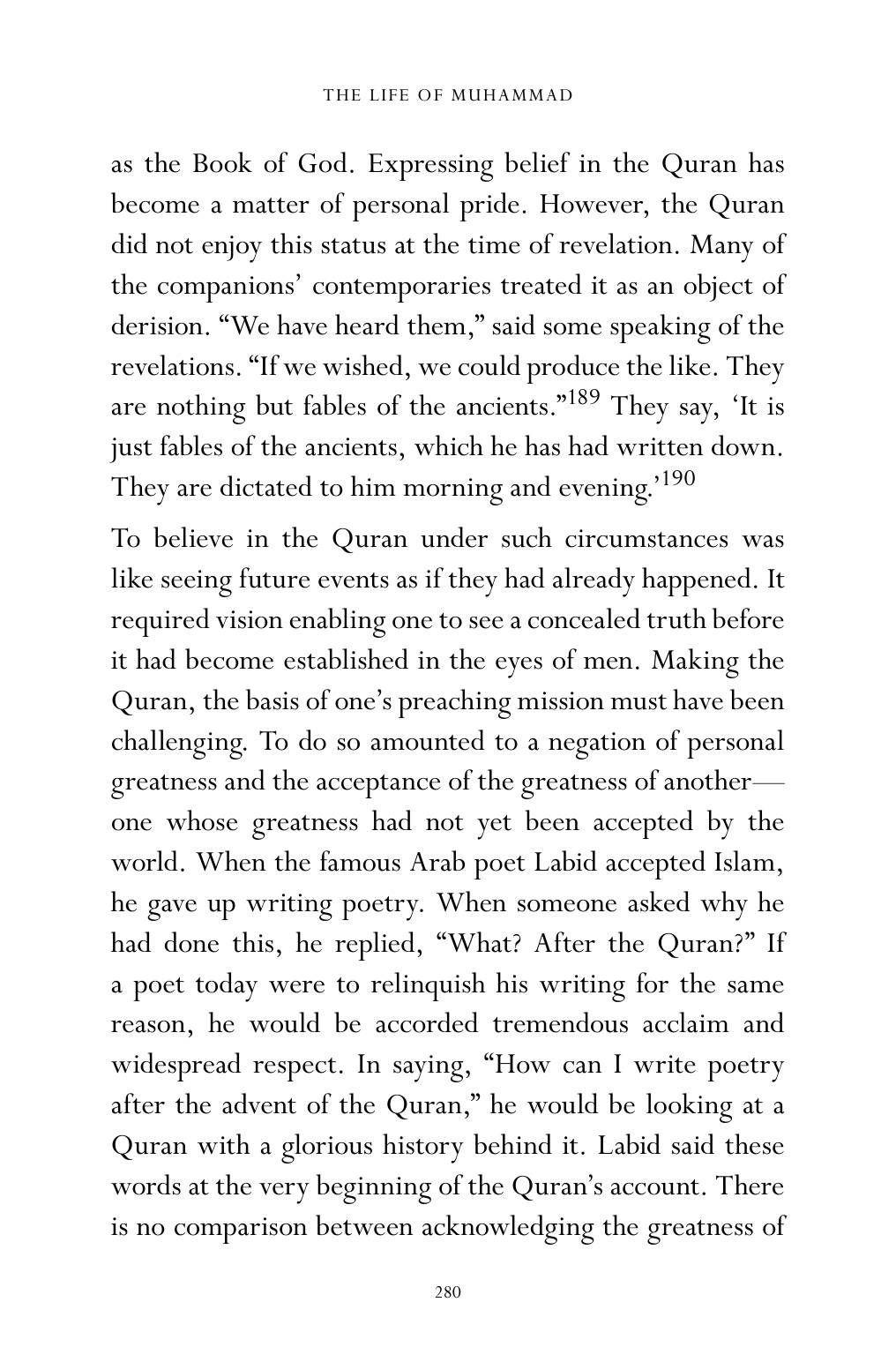
as the Book of God. Expressing belief in the Quran has become a matter of personal pride. However, the Quran did not enjoy this status at the time of revelation. Many of the companions’ contemporaries treated it as an object of derision. “We have heard them,” said some speaking of the revelations. “If we wished, we could produce the like. They are nothing but fables of the ancients.”189 They say, ‘It is just fables of the ancients, which he has had written down. They are dictated to him morning and evening.’190 To believe in the Quran under such circumstances was like seeing future events as if they had already happened. It required vision enabling one to see a concealed truth before it had become established in the eyes of men. Making the Quran, the basis of one’s preaching mission must have been challenging. To do so amounted to a negation of personal greatness and the acceptance of the greatness of another— one whose greatness had not yet been accepted by the world. When the famous Arab poet Labid accepted Islam, he gave up writing poetry. When someone asked why he had done this, he replied, “What? After the Quran?” If a poet today were to relinquish his writing for the same reason, he would be accorded tremendous acclaim and widespread respect. In saying, “How can I write poetry after the advent of the Quran,” he would be looking at a Quran with a glorious history behind it. Labid said these words at the very beginning of the Quran’s account. There is no comparison between acknowledging the greatness of
‹ Previous page Next page › About this book Open in the reader