Exemplary Conduct
English book, p. 34
By Maulana Wahiduddin Khan
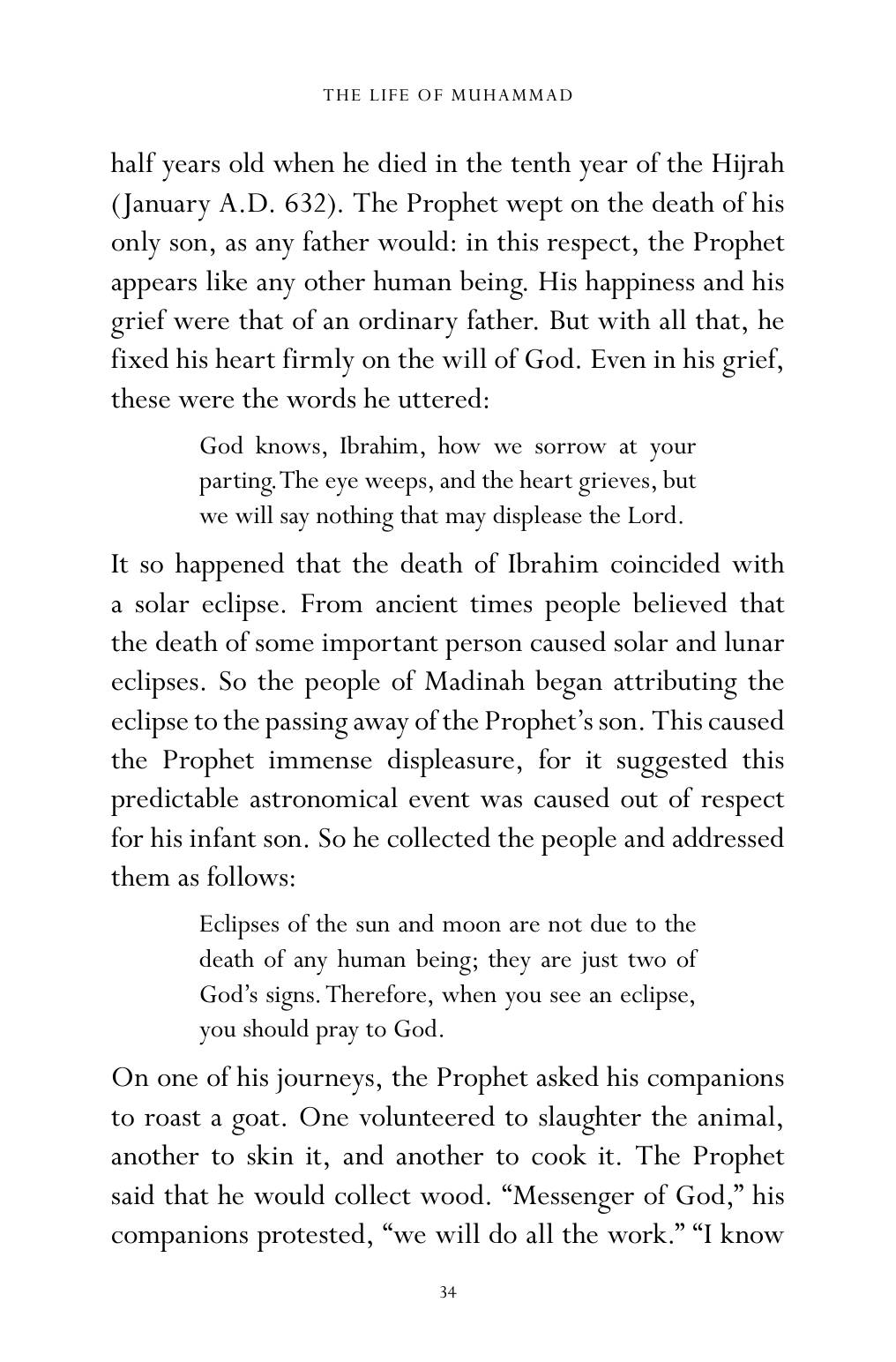
half years old when he died in the tenth year of the Hijrah (January A.D. 632). The Prophet wept on the death of his only son, as any father would: in this respect, the Prophet appears like any other human being. His happiness and his grief were that of an ordinary father. But with all that, he fixed his heart firmly on the will of God. Even in his grief, these were the words he uttered: God knows, Ibrahim, how we sorrow at your parting. The eye weeps, and the heart grieves, but we will say nothing that may displease the Lord. It so happened that the death of Ibrahim coincided with a solar eclipse. From ancient times people believed that the death of some important person caused solar and lunar eclipses. So the people of Madinah began attributing the eclipse to the passing away of the Prophet’s son. This caused the Prophet immense displeasure, for it suggested this predictable astronomical event was caused out of respect for his infant son. So he collected the people and addressed them as follows: Eclipses of the sun and moon are not due to the death of any human being; they are just two of God’s signs. Therefore, when you see an eclipse, you should pray to God. On one of his journeys, the Prophet asked his companions to roast a goat. One volunteered to slaughter the animal, another to skin it, and another to cook it. The Prophet said that he would collect wood. “Messenger of God,” his companions protested, “we will do all the work.” “I know
‹ Previous page Next page › About this book Open in the reader