Sublime Character
English book, p. 53
By Maulana Wahiduddin Khan
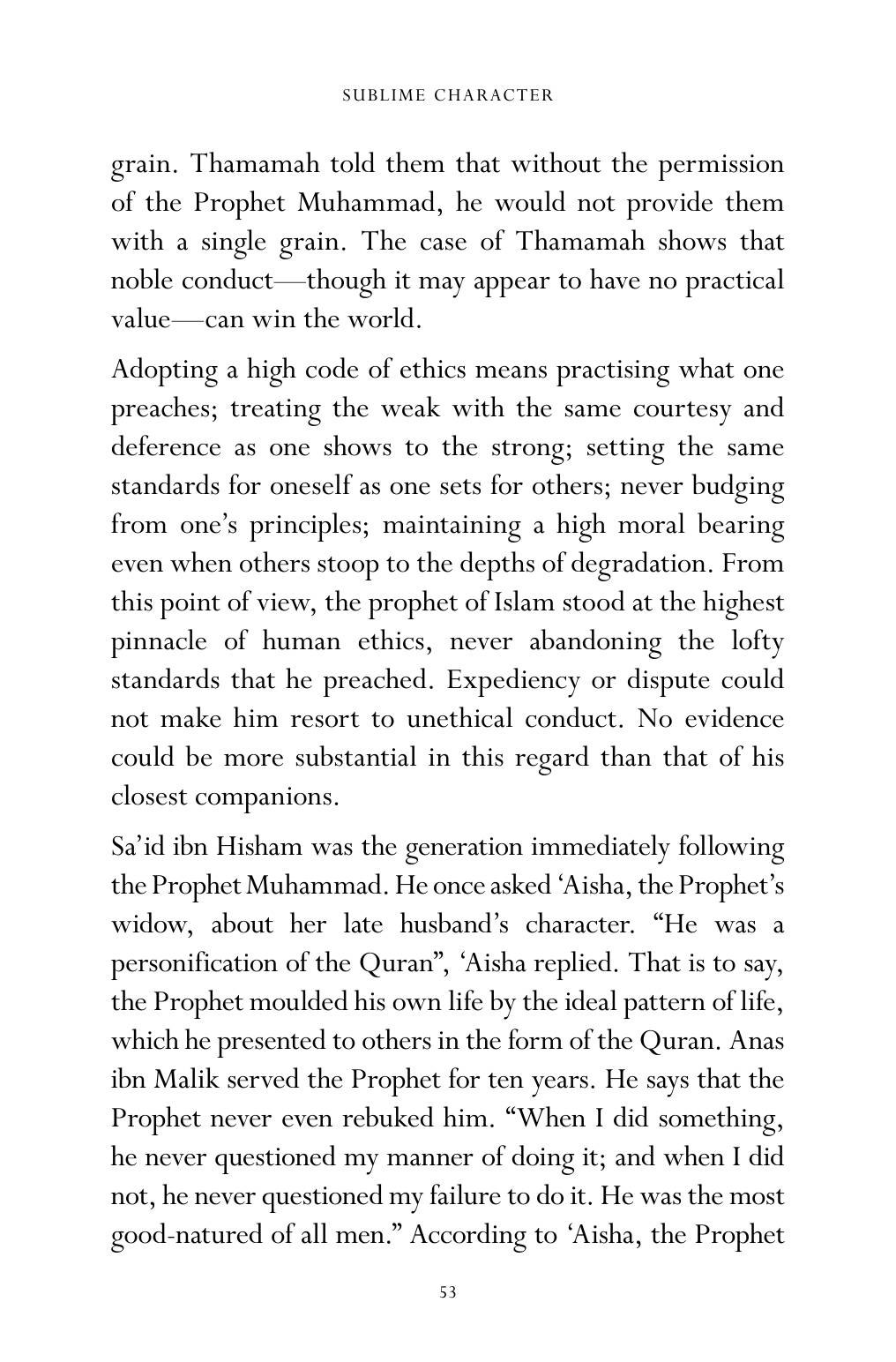
SUBLIME CHARACTER grain. Thamamah told them that without the permission of the Prophet Muhammad, he would not provide them with a single grain. The case of Thamamah shows that noble conduct—though it may appear to have no practical value—can win the world. Adopting a high code of ethics means practising what one preaches; treating the weak with the same courtesy and deference as one shows to the strong; setting the same standards for oneself as one sets for others; never budging from one’s principles; maintaining a high moral bearing even when others stoop to the depths of degradation. From this point of view, the prophet of Islam stood at the highest pinnacle of human ethics, never abandoning the lofty standards that he preached. Expediency or dispute could not make him resort to unethical conduct. No evidence could be more substantial in this regard than that of his closest companions. Sa’id ibn Hisham was the generation immediately following the Prophet Muhammad. He once asked ‘Aisha, the Prophet’s widow, about her late husband’s character. “He was a personification of the Quran”, ‘Aisha replied. That is to say, the Prophet moulded his own life by the ideal pattern of life, which he presented to others in the form of the Quran. Anas ibn Malik served the Prophet for ten years. He says that the Prophet never even rebuked him. “When I did something, he never questioned my manner of doing it; and when I did not, he never questioned my failure to do it. He was the most good-natured of all men.” According to ‘Aisha, the Prophet
‹ Previous page Next page › About this book Open in the reader