CHAPTER TWO The Quran — The Prophet’s Miracle
English book, p. 40
By Maulana Wahiduddin Khan
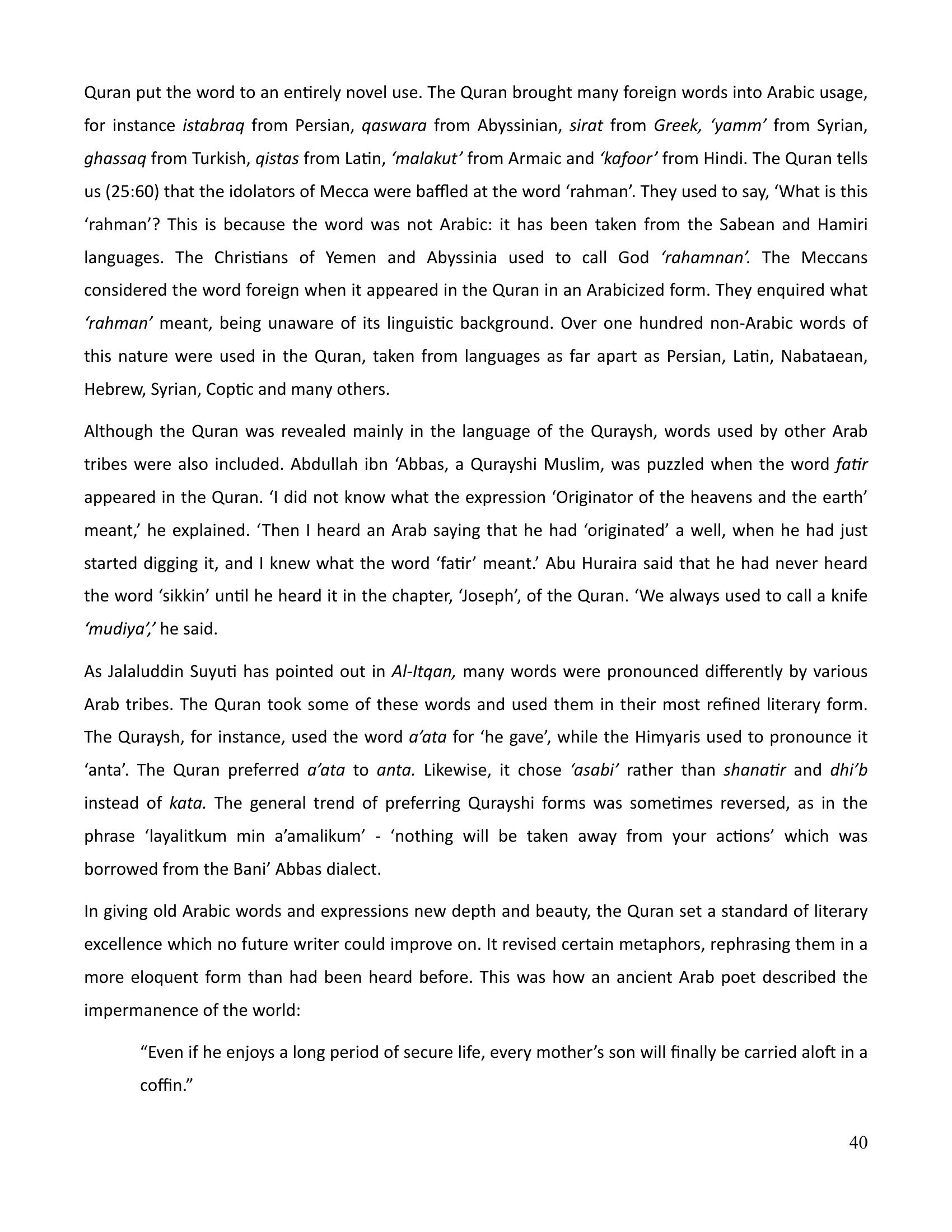
Quran put the word to an entirely novel use. The Quran brought many foreign words into Arabic usage, for instance istabraq from Persian, qaswara from Abyssinian, sirat from Greek, ‘yamm’ from Syrian, ghassaq from Turkish, qistas from Latin, ‘malakut’ from Armaic and ‘kafoor’ from Hindi. The Quran tells us (25:60) that the idolators of Mecca were baffled at the word ‘rahman’. They used to say, ‘What is this ‘rahman’? This is because the word was not Arabic: it has been taken from the Sabean and Hamiri languages. The Christians of Yemen and Abyssinia used to call God ‘rahamnan’. The Meccans considered the word foreign when it appeared in the Quran in an Arabicized form. They enquired what ‘rahman’ meant, being unaware of its linguistic background. Over one hundred non-Arabic words of this nature were used in the Quran, taken from languages as far apart as Persian, Latin, Nabataean, Hebrew, Syrian, Coptic and many others. Although the Quran was revealed mainly in the language of the Quraysh, words used by other Arab tribes were also included. Abdullah ibn ‘Abbas, a Qurayshi Muslim, was puzzled when the word fatir appeared in the Quran. ‘I did not know what the expression ‘Originator of the heavens and the earth’ meant,’ he explained. ‘Then I heard an Arab saying that he had ‘originated’ a well, when he had just started digging it, and I knew what the word ‘fatir’ meant.’ Abu Huraira said that he had never heard the word ‘sikkin’ until he heard it in the chapter, ‘Joseph’, of the Quran. ‘We always used to call a knife ‘mudiya’,’ he said. As Jalaluddin Suyuti has pointed out in Al-Itqan, many words were pronounced differently by various Arab tribes. The Quran took some of these words and used them in their most refined literary form. The Quraysh, for instance, used the word a’ata for ‘he gave’, while the Himyaris used to pronounce it ‘anta’. The Quran preferred a’ata to anta. Likewise, it chose ‘asabi’ rather than shanatir and dhi’b instead of kata. The general trend of preferring Qurayshi forms was sometimes reversed, as in the phrase ‘layalitkum min a’amalikum’ - ‘nothing will be taken away from your actions’ which was borrowed from the Bani’ Abbas dialect. In giving old Arabic words and expressions new depth and beauty, the Quran set a standard of literary excellence which no future writer could improve on. It revised certain metaphors, rephrasing them in a more eloquent form than had been heard before. This was how an ancient Arab poet described the impermanence of the world: “Even if he enjoys a long period of secure life, every mother’s son will finally be carried aloft in a coffin.”
‹ Previous page Next page › About this book Open in the reader