Worship and Morality
English book, p. 183
By Maulana Wahiduddin Khan
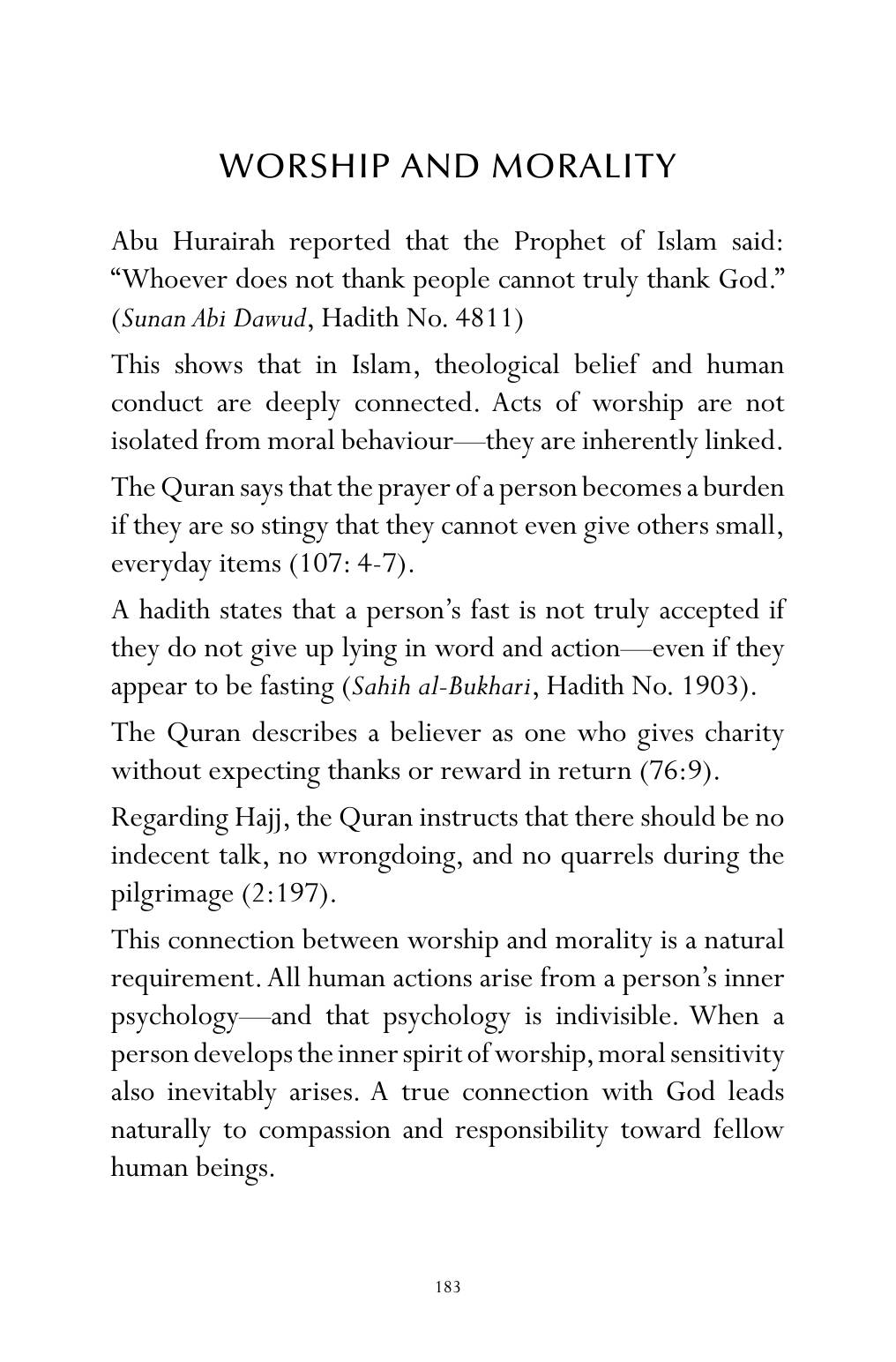
WORSHIP AND MORALITY Abu Hurairah reported that the Prophet of Islam said: “Whoever does not thank people cannot truly thank God.” (Sunan Abi Dawud, Hadith No. 4811) This shows that in Islam, theological belief and human conduct are deeply connected. Acts of worship are not isolated from moral behaviour—they are inherently linked. The Quran says that the prayer of a person becomes a burden if they are so stingy that they cannot even give others small, everyday items (107: 4-7). A hadith states that a person’s fast is not truly accepted if they do not give up lying in word and action—even if they appear to be fasting (Sahih al-Bukhari, Hadith No. 1903). The Quran describes a believer as one who gives charity without expecting thanks or reward in return (76:9). Regarding Hajj, the Quran instructs that there should be no indecent talk, no wrongdoing, and no quarrels during the pilgrimage (2:197). This connection between worship and morality is a natural requirement. All human actions arise from a person’s inner psychology—and that psychology is indivisible. When a person develops the inner spirit of worship, moral sensitivity also inevitably arises. A true connection with God leads naturally to compassion and responsibility toward fellow human beings.
‹ Previous page Next page › About this book Open in the reader