An Example of Noble Character
English book, p. 261
By Maulana Wahiduddin Khan
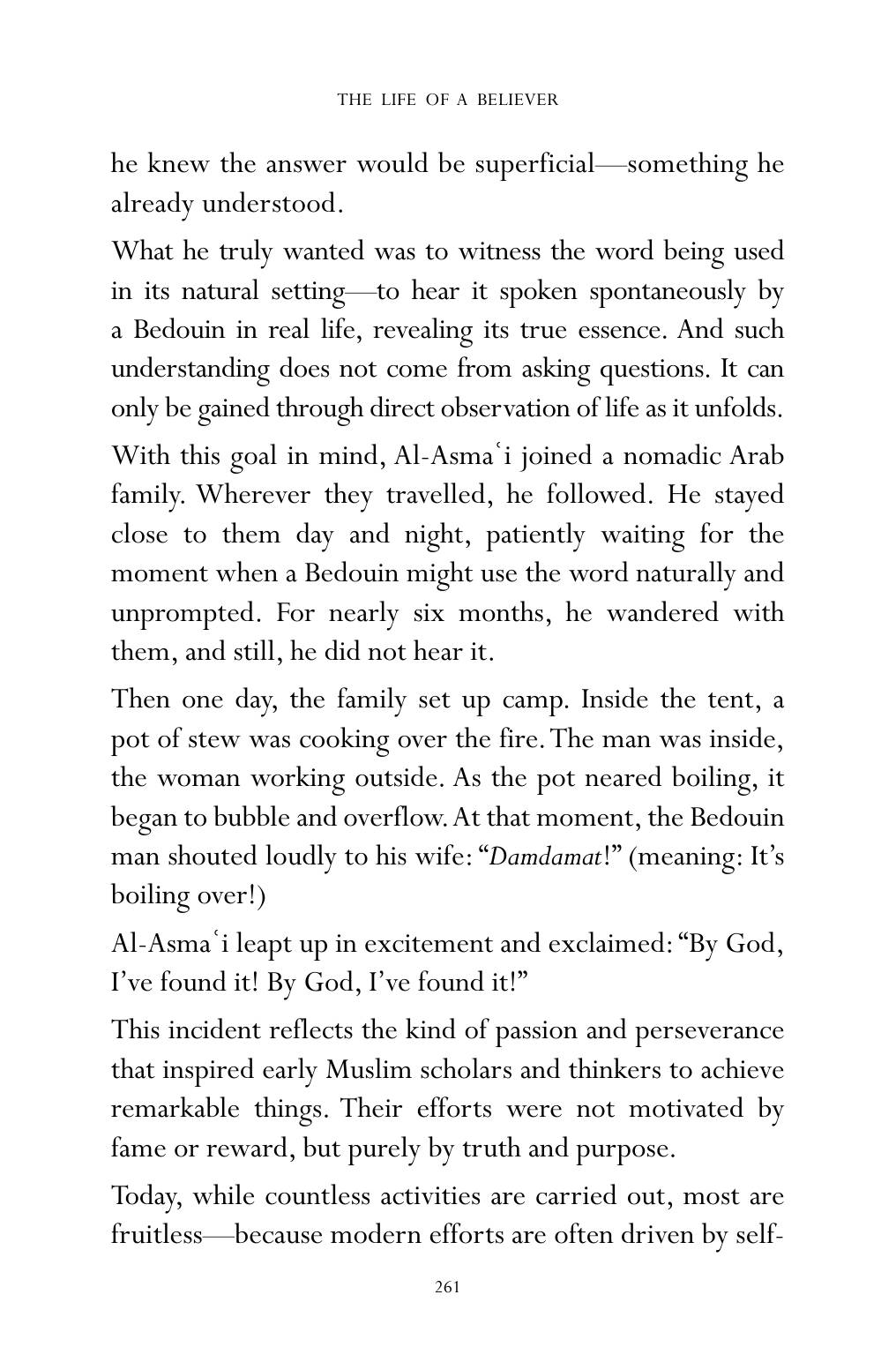
THE LIFE OF A BELIEVER he knew the answer would be superficial—something he already understood. What he truly wanted was to witness the word being used in its natural setting—to hear it spoken spontaneously by a Bedouin in real life, revealing its true essence. And such understanding does not come from asking questions. It can only be gained through direct observation of life as it unfolds. With this goal in mind, Al-Asmaʿi joined a nomadic Arab family. Wherever they travelled, he followed. He stayed close to them day and night, patiently waiting for the moment when a Bedouin might use the word naturally and unprompted. For nearly six months, he wandered with them, and still, he did not hear it. Then one day, the family set up camp. Inside the tent, a pot of stew was cooking over the fire. The man was inside, the woman working outside. As the pot neared boiling, it began to bubble and overflow. At that moment, the Bedouin man shouted loudly to his wife: “Damdamat!” (meaning: It’s boiling over!) Al-Asmaʿi leapt up in excitement and exclaimed: “By God, I’ve found it! By God, I’ve found it!” This incident reflects the kind of passion and perseverance that inspired early Muslim scholars and thinkers to achieve remarkable things. Their efforts were not motivated by fame or reward, but purely by truth and purpose. Today, while countless activities are carried out, most are fruitless—because modern efforts are often driven by self-
‹ Previous page Next page › About this book Open in the reader