An Example of Noble Character
English book, p. 280
By Maulana Wahiduddin Khan
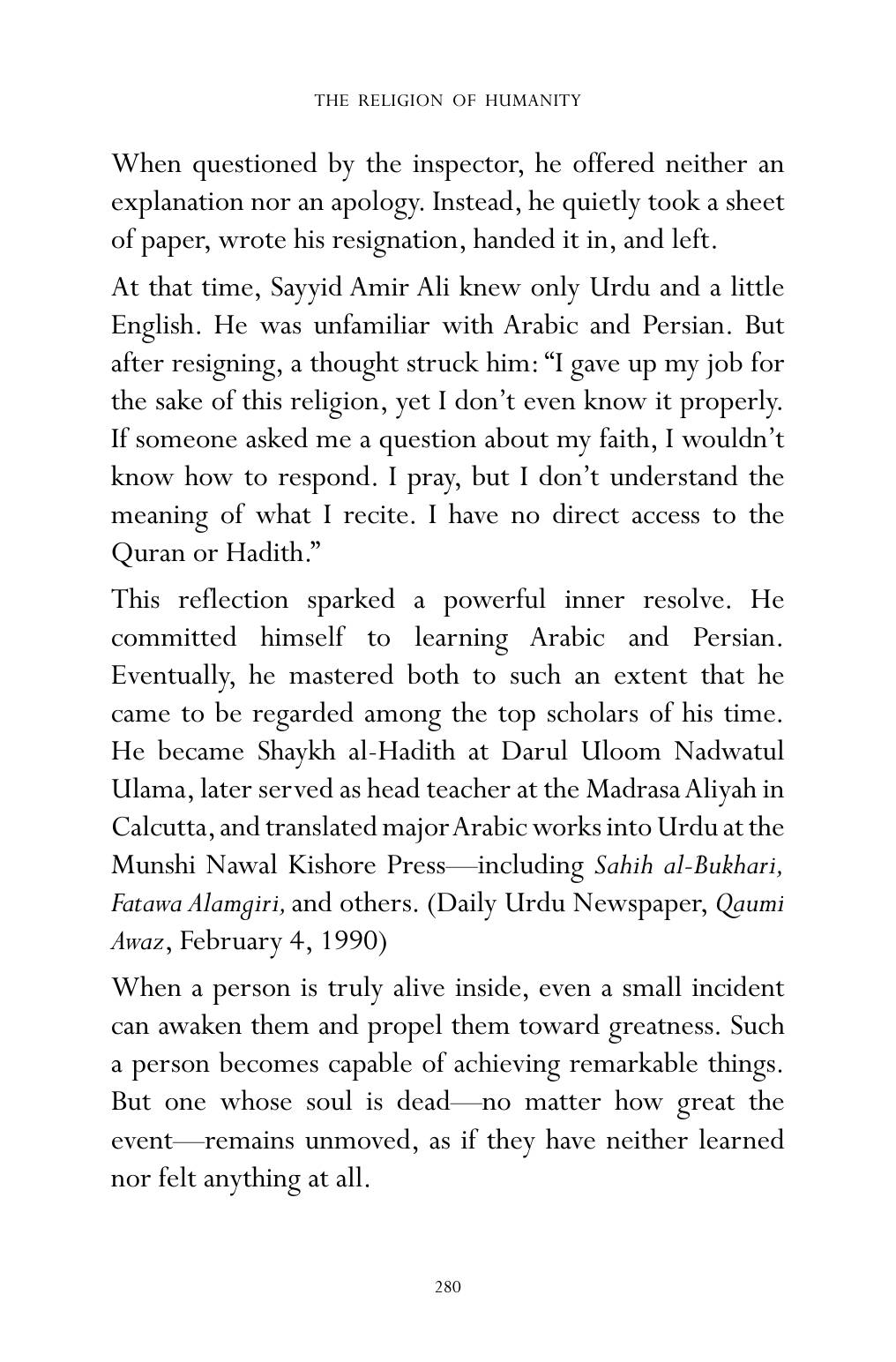
When questioned by the inspector, he offered neither an explanation nor an apology. Instead, he quietly took a sheet of paper, wrote his resignation, handed it in, and left. At that time, Sayyid Amir Ali knew only Urdu and a little English. He was unfamiliar with Arabic and Persian. But after resigning, a thought struck him: “I gave up my job for the sake of this religion, yet I don’t even know it properly. If someone asked me a question about my faith, I wouldn’t know how to respond. I pray, but I don’t understand the meaning of what I recite. I have no direct access to the Quran or Hadith.” This reflection sparked a powerful inner resolve. He committed himself to learning Arabic and Persian. Eventually, he mastered both to such an extent that he came to be regarded among the top scholars of his time. He became Shaykh al-Hadith at Darul Uloom Nadwatul Ulama, later served as head teacher at the Madrasa Aliyah in Calcutta, and translated major Arabic works into Urdu at the Munshi Nawal Kishore Press—including Sahih al-Bukhari, Fatawa Alamgiri, and others. (Daily Urdu Newspaper, Qaumi Awaz, February 4, 1990) When a person is truly alive inside, even a small incident can awaken them and propel them toward greatness. Such a person becomes capable of achieving remarkable things. But one whose soul is dead—no matter how great the event—remains unmoved, as if they have neither learned nor felt anything at all.
‹ Previous page Next page › About this book Open in the reader