Islam and the Quran
English book, p. 118
By Maulana Wahiduddin Khan
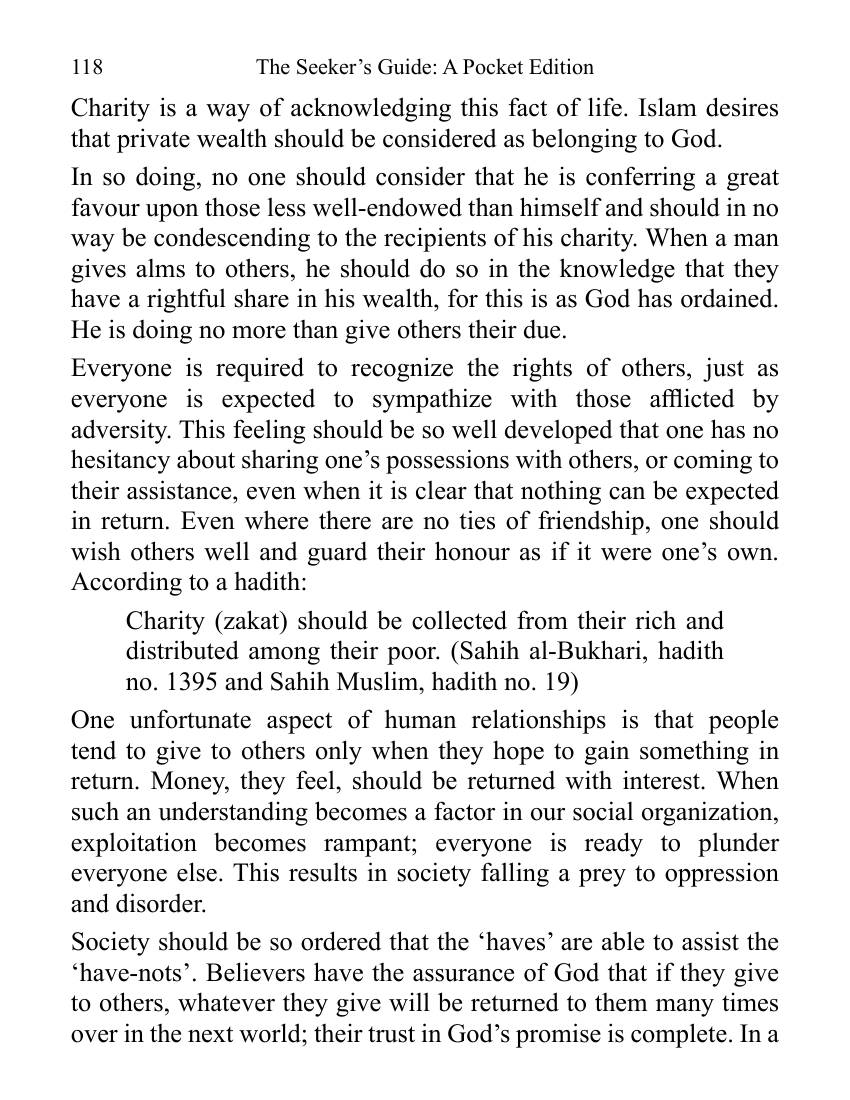
Charity is a way of acknowledging this fact of life. Islam desires that private wealth should be considered as belonging to God. In so doing, no one should consider that he is conferring a great favour upon those less well-endowed than himself and should in no way be condescending to the recipients of his charity. When a man gives alms to others, he should do so in the knowledge that they have a rightful share in his wealth, for this is as God has ordained. He is doing no more than give others their due. Everyone is required to recognize the rights of others, just as everyone is expected to sympathize with those afflicted by adversity. This feeling should be so well developed that one has no hesitancy about sharing one’s possessions with others, or coming to their assistance, even when it is clear that nothing can be expected in return. Even where there are no ties of friendship, one should wish others well and guard their honour as if it were one’s own. According to a hadith: Charity (zakat) should be collected from their rich and distributed among their poor. (Sahih al-Bukhari, hadith no. 1395 and Sahih Muslim, hadith no. 19) One unfortunate aspect of human relationships is that people tend to give to others only when they hope to gain something in return. Money, they feel, should be returned with interest. When such an understanding becomes a factor in our social organization, exploitation becomes rampant; everyone is ready to plunder everyone else. This results in society falling a prey to oppression and disorder. Society should be so ordered that the ‘haves’ are able to assist the ‘have-nots’. Believers have the assurance of God that if they give to others, whatever they give will be returned to them many times over in the next world; their trust in God’s promise is complete. In a
‹ Previous page Next page › About this book Open in the reader