Islam and the Quran
English book, p. 123
By Maulana Wahiduddin Khan
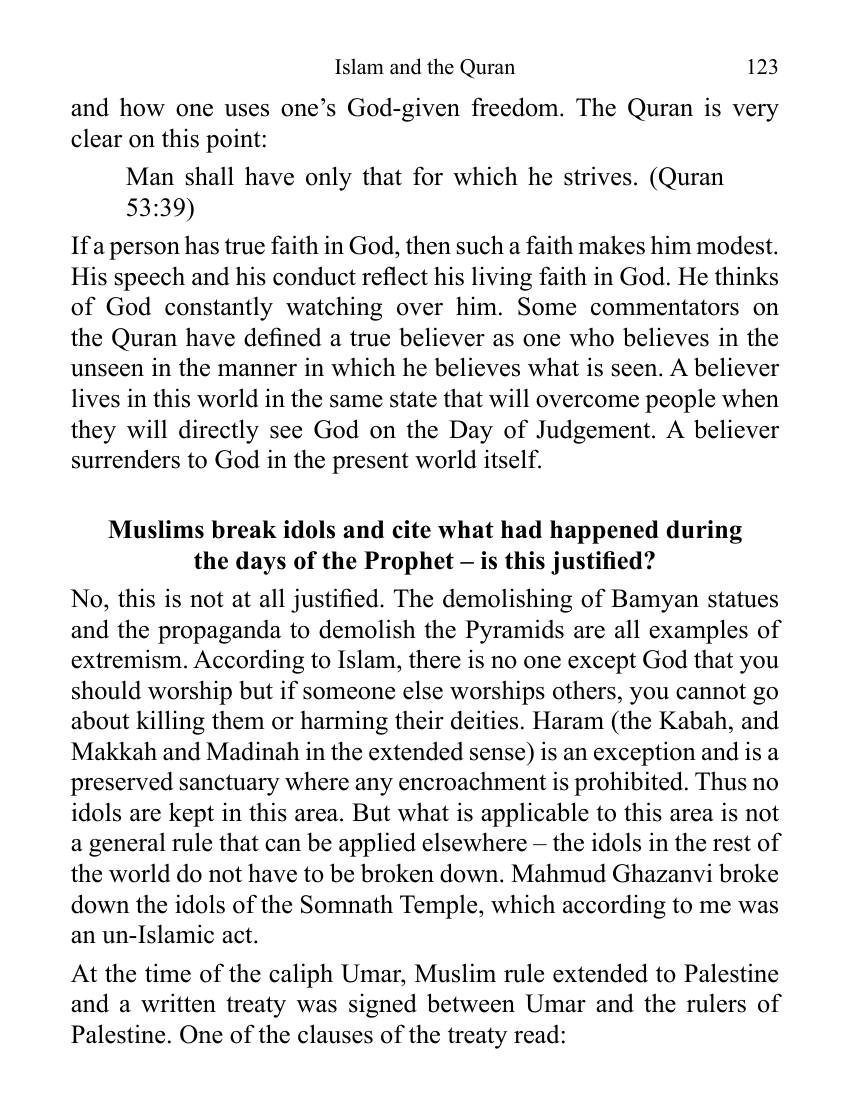
Islam and the Quran and how one uses one’s God-given freedom. The Quran is very clear on this point: Man shall have only that for which he strives. (Quran 53:39) If a person has true faith in God, then such a faith makes him modest. His speech and his conduct reflect his living faith in God. He thinks of God constantly watching over him. Some commentators on the Quran have defined a true believer as one who believes in the unseen in the manner in which he believes what is seen. A believer lives in this world in the same state that will overcome people when they will directly see God on the Day of Judgement. A believer surrenders to God in the present world itself. Muslims break idols and cite what had happened during the days of the Prophet – is this justified? No, this is not at all justified. The demolishing of Bamyan statues and the propaganda to demolish the Pyramids are all examples of extremism. According to Islam, there is no one except God that you should worship but if someone else worships others, you cannot go about killing them or harming their deities. Haram (the Kabah, and Makkah and Madinah in the extended sense) is an exception and is a preserved sanctuary where any encroachment is prohibited. Thus no idols are kept in this area. But what is applicable to this area is not a general rule that can be applied elsewhere – the idols in the rest of the world do not have to be broken down. Mahmud Ghazanvi broke down the idols of the Somnath Temple, which according to me was an un-Islamic act. At the time of the caliph Umar, Muslim rule extended to Palestine and a written treaty was signed between Umar and the rulers of Palestine. One of the clauses of the treaty read:
‹ Previous page Next page › About this book Open in the reader