God and His Creation Plan
English book, p. 45
By Maulana Wahiduddin Khan
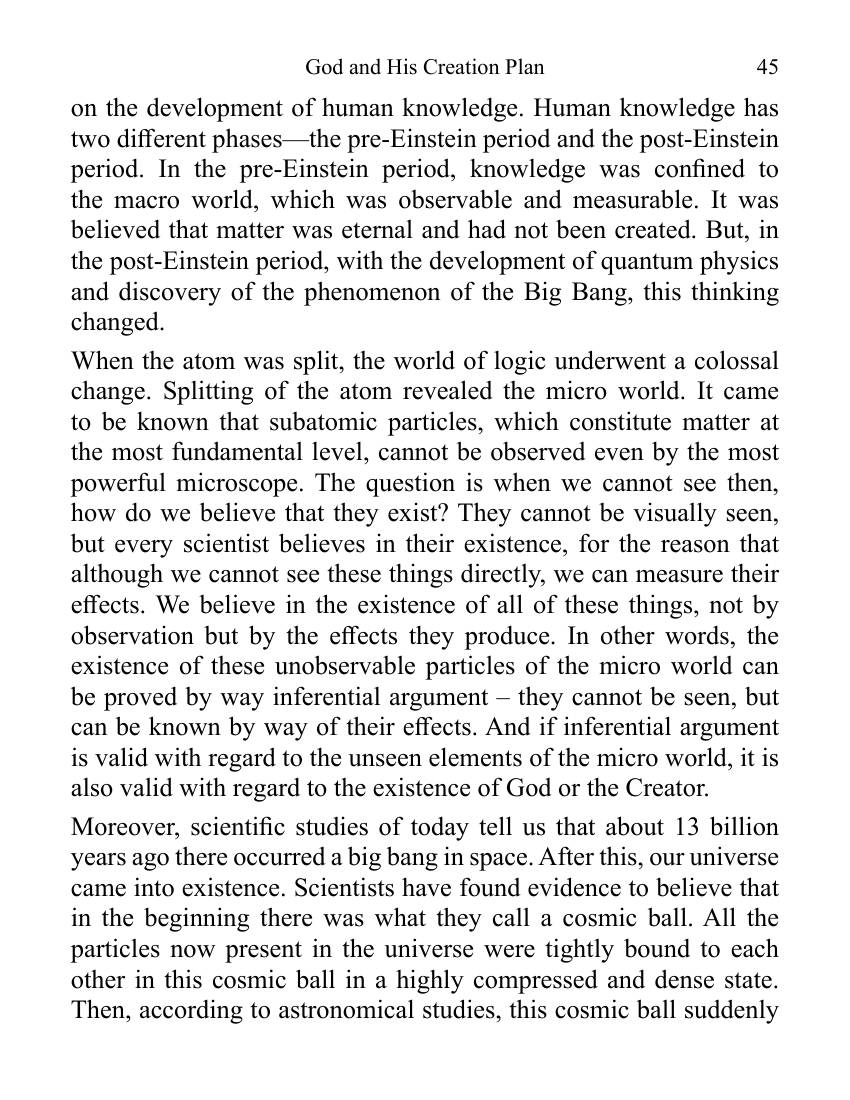
God and His Creation Plan on the development of human knowledge. Human knowledge has two different phases—the pre-Einstein period and the post-Einstein period. In the pre-Einstein period, knowledge was confined to the macro world, which was observable and measurable. It was believed that matter was eternal and had not been created. But, in the post-Einstein period, with the development of quantum physics and discovery of the phenomenon of the Big Bang, this thinking changed. When the atom was split, the world of logic underwent a colossal change. Splitting of the atom revealed the micro world. It came to be known that subatomic particles, which constitute matter at the most fundamental level, cannot be observed even by the most powerful microscope. The question is when we cannot see then, how do we believe that they exist? They cannot be visually seen, but every scientist believes in their existence, for the reason that although we cannot see these things directly, we can measure their effects. We believe in the existence of all of these things, not by observation but by the effects they produce. In other words, the existence of these unobservable particles of the micro world can be proved by way inferential argument – they cannot be seen, but can be known by way of their effects. And if inferential argument is valid with regard to the unseen elements of the micro world, it is also valid with regard to the existence of God or the Creator. Moreover, scientific studies of today tell us that about 13 billion years ago there occurred a big bang in space. After this, our universe came into existence. Scientists have found evidence to believe that in the beginning there was what they call a cosmic ball. All the particles now present in the universe were tightly bound to each other in this cosmic ball in a highly compressed and dense state. Then, according to astronomical studies, this cosmic ball suddenly
‹ Previous page Next page › About this book Open in the reader