Lesson from Flowing Water
English book, PDF p. 130
By Maulana Wahiduddin Khan
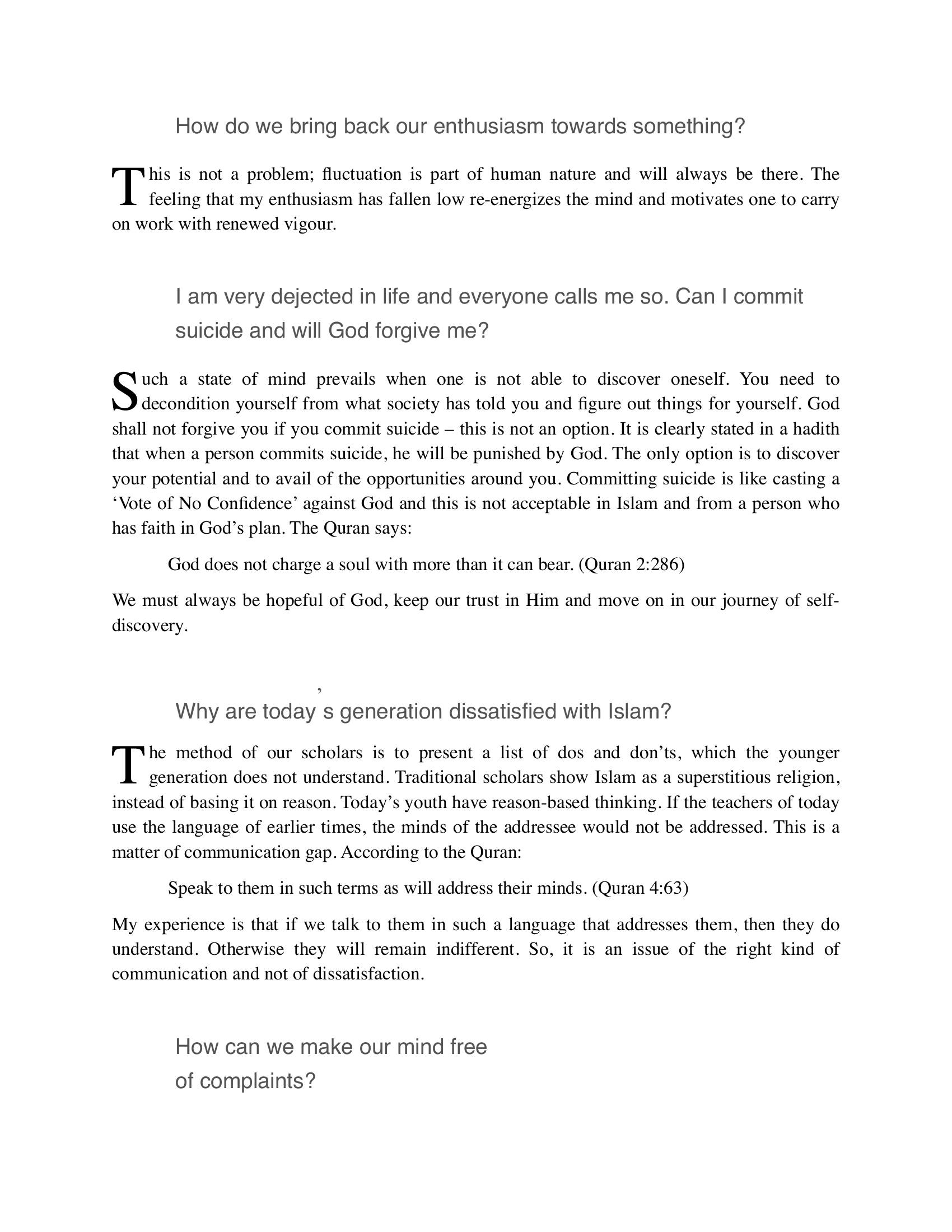
How do we bring back our enthusiasm towards something? T his is not a problem; fluctuation is part of human nature and will always be there. The feeling that my enthusiasm has fallen low re-energizes the mind and motivates one to carry on work with renewed vigour. I am very dejected in life and everyone calls me so. Can I commit suicide and will God forgive me? S uch a state of mind prevails when one is not able to discover oneself. You need to decondition yourself from what society has told you and figure out things for yourself. God shall not forgive you if you commit suicide – this is not an option. It is clearly stated in a hadith that when a person commits suicide, he will be punished by God. The only option is to discover your potential and to avail of the opportunities around you. Committing suicide is like casting a ‘Vote of No Confidence’ against God and this is not acceptable in Islam and from a person who has faith in God’s plan. The Quran says: God does not charge a soul with more than it can bear. (Quran 2:286) We must always be hopeful of God, keep our trust in Him and move on in our journey of selfdiscovery. Why are today’s generation dissatisfied with Islam? T he method of our scholars is to present a list of dos and don’ts, which the younger generation does not understand. Traditional scholars show Islam as a superstitious religion, instead of basing it on reason. Today’s youth have reason-based thinking. If the teachers of today use the language of earlier times, the minds of the addressee would not be addressed. This is a matter of communication gap. According to the Quran: Speak to them in such terms as will address their minds. (Quran 4:63) My experience is that if we talk to them in such a language that addresses them, then they do understand. Otherwise they will remain indifferent. So, it is an issue of the right kind of communication and not of dissatisfaction. How can we make our mind free of complaints?
‹ Previous page Next page › About this book Open in the reader