Interfaith Dialogue in Islam
English book, PDF p. 41
By Maulana Wahiduddin Khan
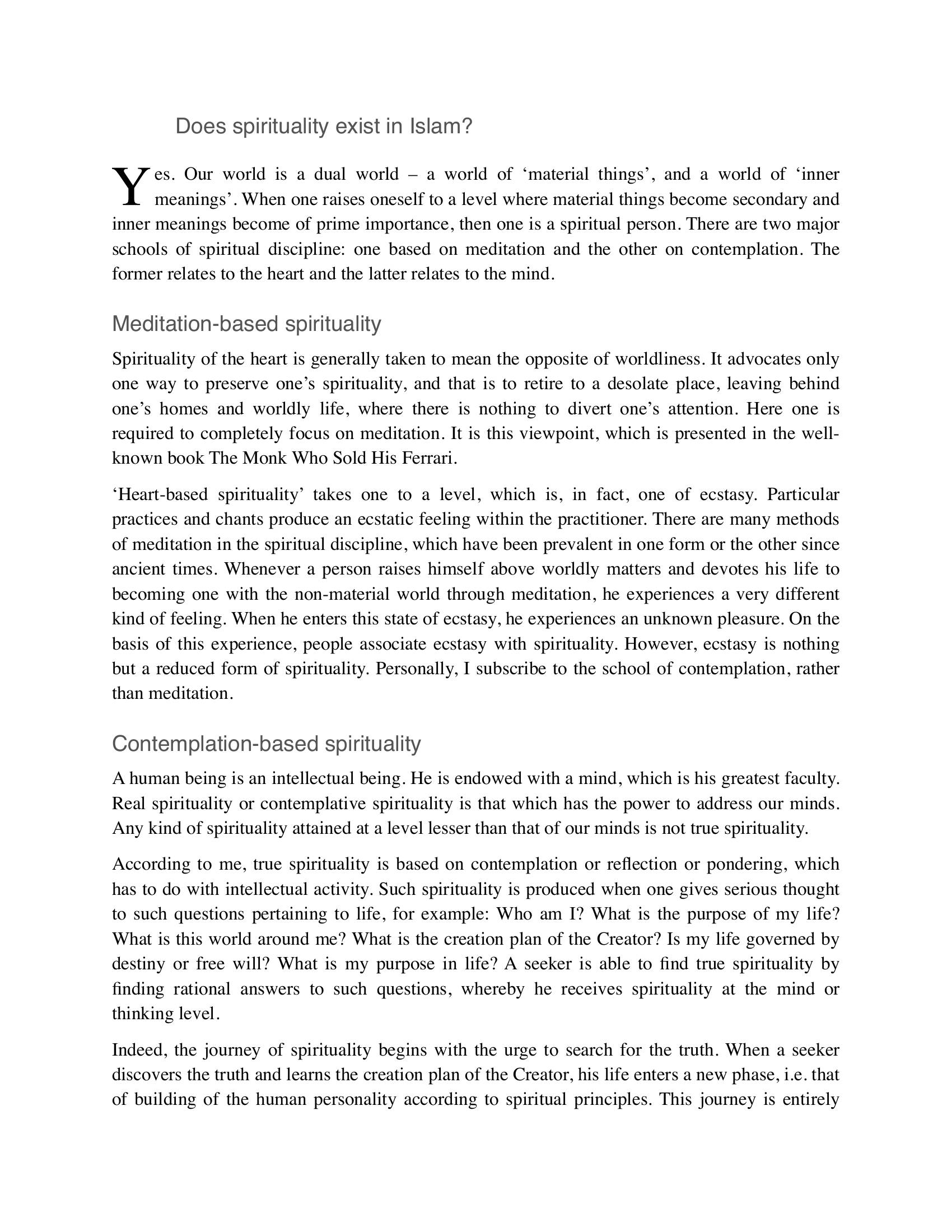
Does spirituality exist in Islam? Y es. Our world is a dual world – a world of ‘material things’, and a world of ‘inner meanings’. When one raises oneself to a level where material things become secondary and inner meanings become of prime importance, then one is a spiritual person. There are two major schools of spiritual discipline: one based on meditation and the other on contemplation. The former relates to the heart and the latter relates to the mind. Meditation-based spirituality Spirituality of the heart is generally taken to mean the opposite of worldliness. It advocates only one way to preserve one’s spirituality, and that is to retire to a desolate place, leaving behind one’s homes and worldly life, where there is nothing to divert one’s attention. Here one is required to completely focus on meditation. It is this viewpoint, which is presented in the wellknown book The Monk Who Sold His Ferrari. ‘Heart-based spirituality’ takes one to a level, which is, in fact, one of ecstasy. Particular practices and chants produce an ecstatic feeling within the practitioner. There are many methods of meditation in the spiritual discipline, which have been prevalent in one form or the other since ancient times. Whenever a person raises himself above worldly matters and devotes his life to becoming one with the non-material world through meditation, he experiences a very different kind of feeling. When he enters this state of ecstasy, he experiences an unknown pleasure. On the basis of this experience, people associate ecstasy with spirituality. However, ecstasy is nothing but a reduced form of spirituality. Personally, I subscribe to the school of contemplation, rather than meditation. Contemplation-based spirituality A human being is an intellectual being. He is endowed with a mind, which is his greatest faculty. Real spirituality or contemplative spirituality is that which has the power to address our minds. Any kind of spirituality attained at a level lesser than that of our minds is not true spirituality. According to me, true spirituality is based on contemplation or reflection or pondering, which has to do with intellectual activity. Such spirituality is produced when one gives serious thought to such questions pertaining to life, for example: Who am I? What is the purpose of my life? What is this world around me? What is the creation plan of the Creator? Is my life governed by destiny or free will? What is my purpose in life? A seeker is able to find true spirituality by finding rational answers to such questions, whereby he receives spirituality at the mind or thinking level. Indeed, the journey of spirituality begins with the urge to search for the truth. When a seeker discovers the truth and learns the creation plan of the Creator, his life enters a new phase, i.e. that of building of the human personality according to spiritual principles. This journey is entirely
‹ Previous page Next page › About this book Open in the reader