The Demands of Worship
English book, p. 18
By Maulana Wahiduddin Khan
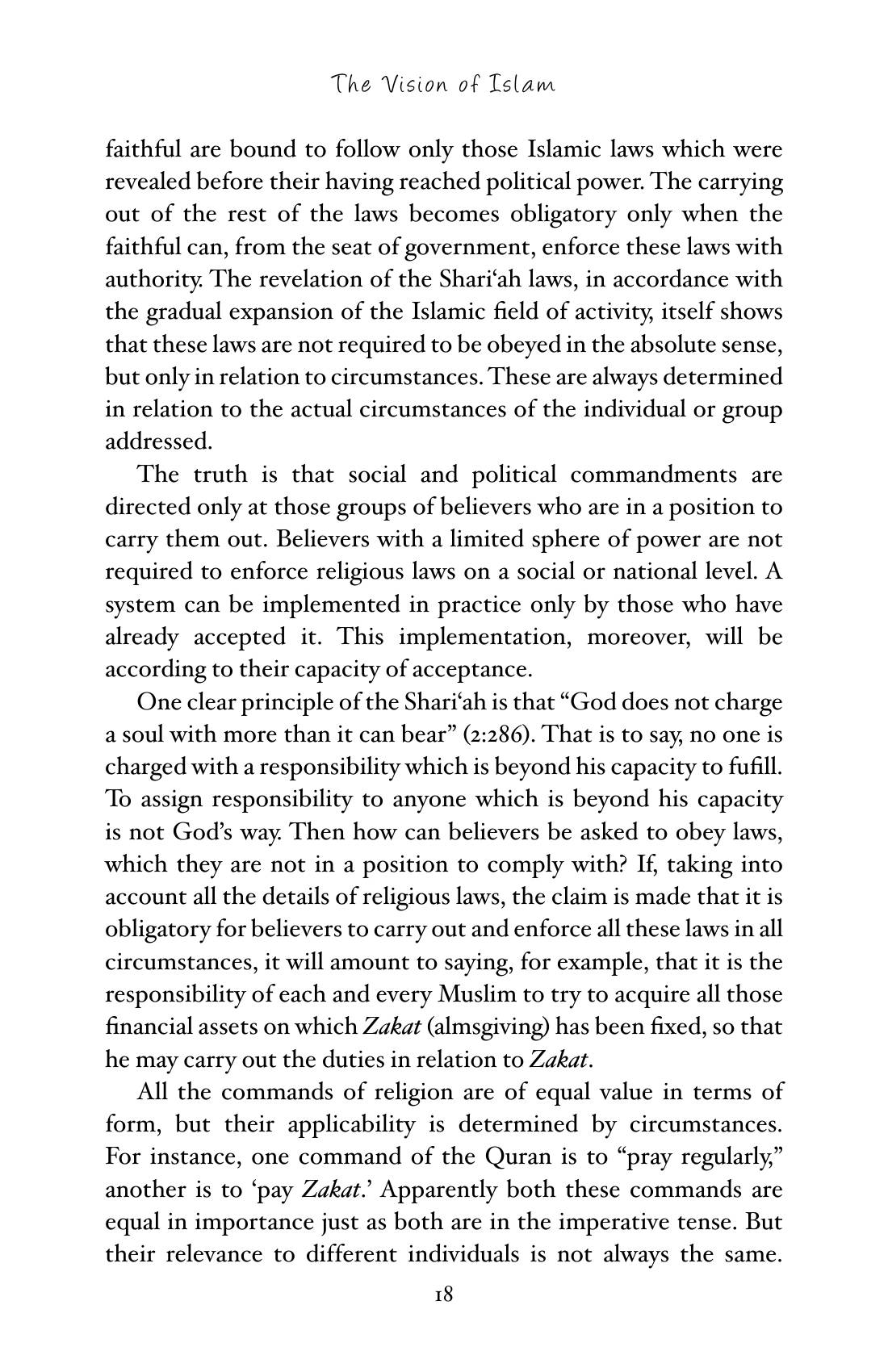
faithful are bound to follow only those Islamic laws which were revealed before their having reached political power. The carrying out of the rest of the laws becomes obligatory only when the faithful can, from the seat of government, enforce these laws with authority. The revelation of the Shari‘ah laws, in accordance with the gradual expansion of the Islamic field of activity, itself shows that these laws are not required to be obeyed in the absolute sense, but only in relation to circumstances. These are always determined in relation to the actual circumstances of the individual or group addressed. The truth is that social and political commandments are directed only at those groups of believers who are in a position to carry them out. Believers with a limited sphere of power are not required to enforce religious laws on a social or national level. A system can be implemented in practice only by those who have already accepted it. This implementation, moreover, will be according to their capacity of acceptance. One clear principle of the Shari‘ah is that “God does not charge a soul with more than it can bear” (2:286). That is to say, no one is charged with a responsibility which is beyond his capacity to fufill. To assign responsibility to anyone which is beyond his capacity is not God’s way. Then how can believers be asked to obey laws, which they are not in a position to comply with? If, taking into account all the details of religious laws, the claim is made that it is obligatory for believers to carry out and enforce all these laws in all circumstances, it will amount to saying, for example, that it is the responsibility of each and every Muslim to try to acquire all those financial assets on which Zakat (almsgiving) has been fixed, so that he may carry out the duties in relation to Zakat. All the commands of religion are of equal value in terms of form, but their applicability is determined by circumstances. For instance, one command of the Quran is to “pray regularly,” another is to ‘pay Zakat.’ Apparently both these commands are equal in importance just as both are in the imperative tense. But their relevance to different individuals is not always the same.
‹ Previous page Next page › About this book Open in the reader