The Language of Dawah
English book, p. 77
By Maulana Wahiduddin Khan
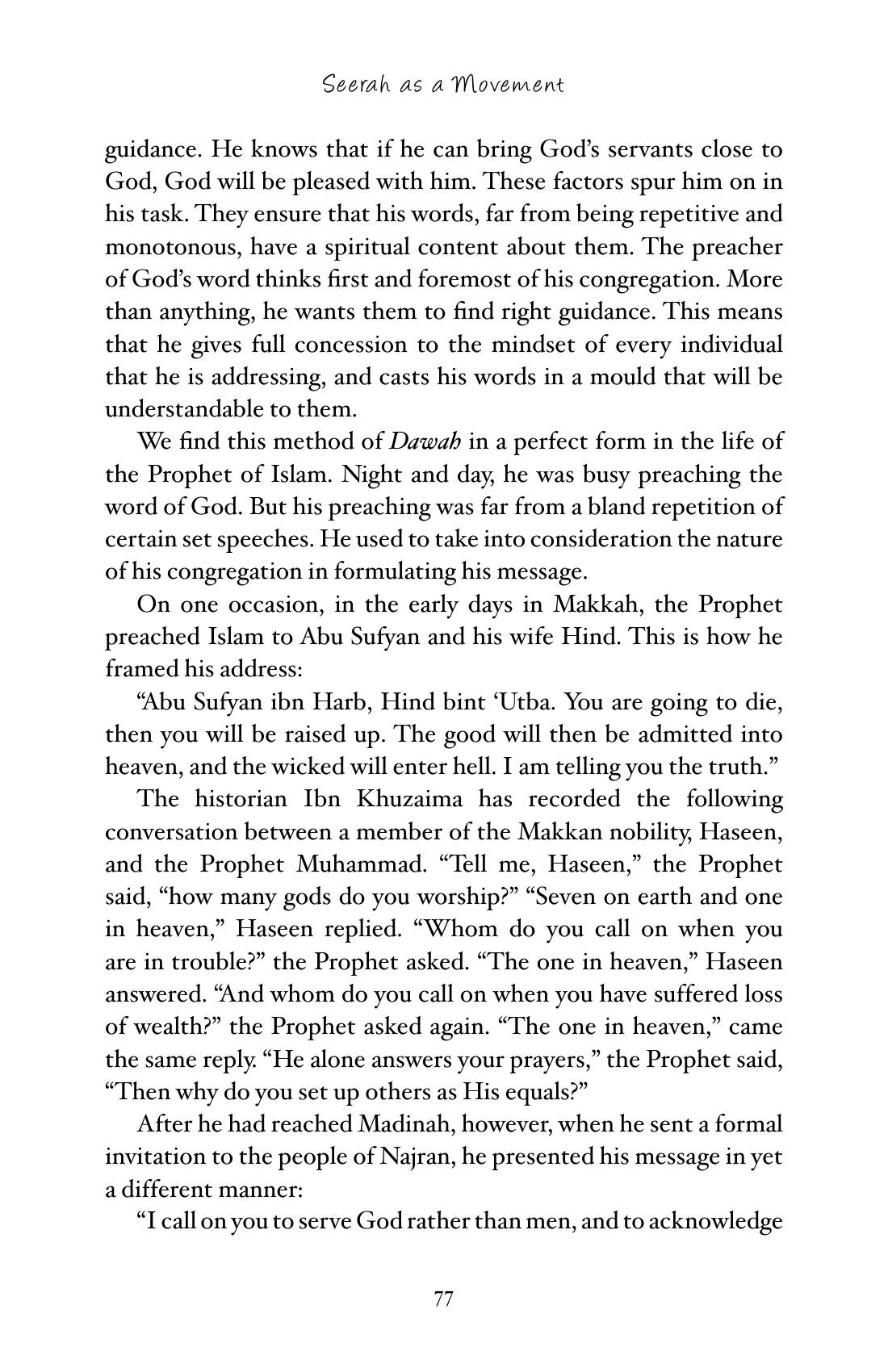
Seerah as a Movement guidance. He knows that if he can bring God’s servants close to God, God will be pleased with him. These factors spur him on in his task. They ensure that his words, far from being repetitive and monotonous, have a spiritual content about them. The preacher of God’s word thinks first and foremost of his congregation. More than anything, he wants them to find right guidance. This means that he gives full concession to the mindset of every individual that he is addressing, and casts his words in a mould that will be understandable to them. We find this method of Dawah in a perfect form in the life of the Prophet of Islam. Night and day, he was busy preaching the word of God. But his preaching was far from a bland repetition of certain set speeches. He used to take into consideration the nature of his congregation in formulating his message. On one occasion, in the early days in Makkah, the Prophet preached Islam to Abu Sufyan and his wife Hind. This is how he framed his address: “Abu Sufyan ibn Harb, Hind bint ‘Utba. You are going to die, then you will be raised up. The good will then be admitted into heaven, and the wicked will enter hell. I am telling you the truth.” The historian Ibn Khuzaima has recorded the following conversation between a member of the Makkan nobility, Haseen, and the Prophet Muhammad. “Tell me, Haseen,” the Prophet said, “how many gods do you worship?” “Seven on earth and one in heaven,” Haseen replied. “Whom do you call on when you are in trouble?” the Prophet asked. “The one in heaven,” Haseen answered. “And whom do you call on when you have suffered loss of wealth?” the Prophet asked again. “The one in heaven,” came the same reply. “He alone answers your prayers,” the Prophet said, “Then why do you set up others as His equals?” After he had reached Madinah, however, when he sent a formal invitation to the people of Najran, he presented his message in yet a different manner: “I call on you to serve God rather than men, and to acknowledge
‹ Previous page Next page › About this book Open in the reader