Fasting Of Ramadan
English book, p. 51
By Maulana Wahiduddin Khan
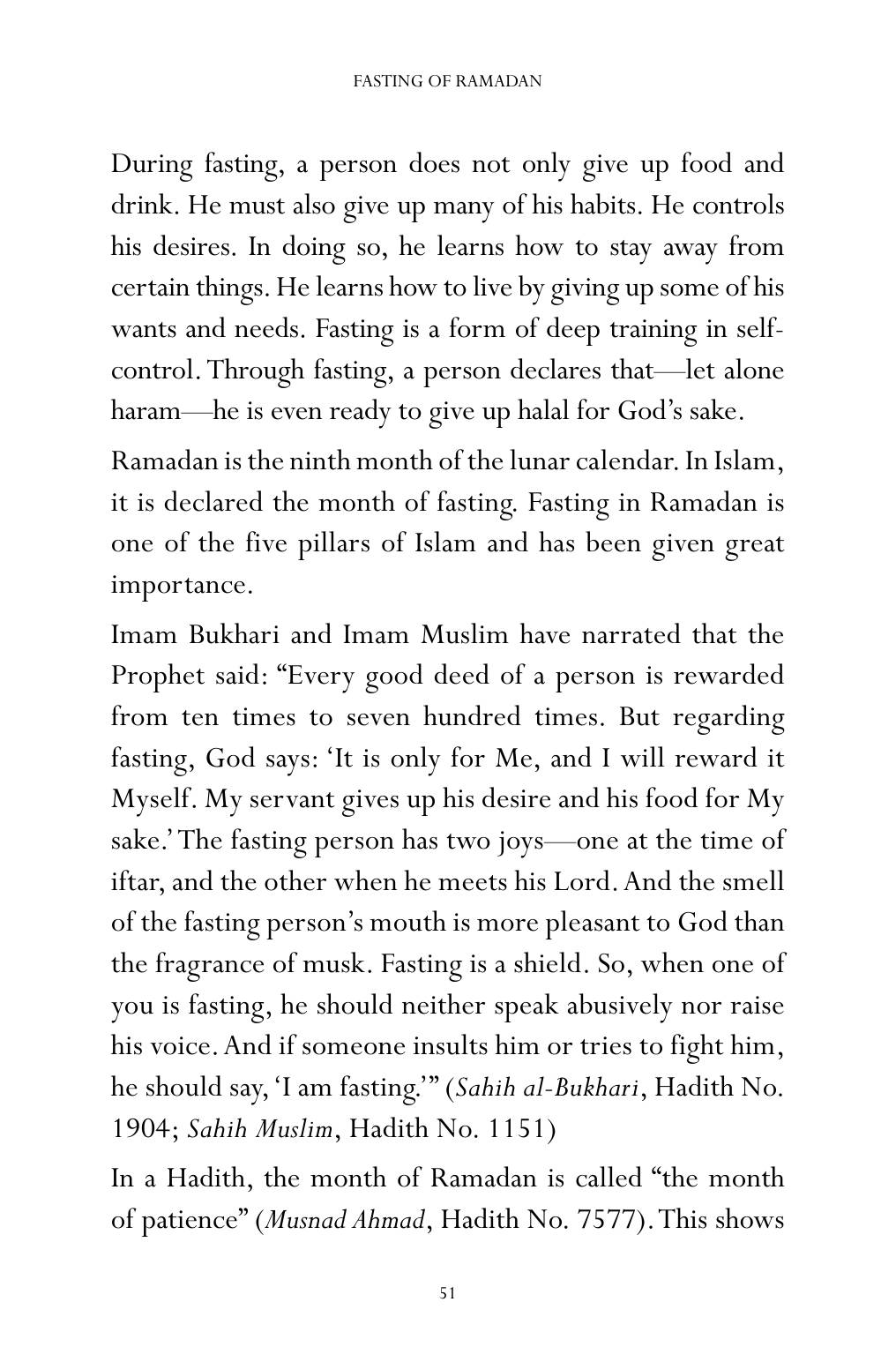
Fasting of Ramadan During fasting, a person does not only give up food and drink. He must also give up many of his habits. He controls his desires. In doing so, he learns how to stay away from certain things. He learns how to live by giving up some of his wants and needs. Fasting is a form of deep training in selfcontrol. Through fasting, a person declares that—let alone haram—he is even ready to give up halal for God’s sake. Ramadan is the ninth month of the lunar calendar. In Islam, it is declared the month of fasting. Fasting in Ramadan is one of the five pillars of Islam and has been given great importance. Imam Bukhari and Imam Muslim have narrated that the Prophet said: “Every good deed of a person is rewarded from ten times to seven hundred times. But regarding fasting, God says: ‘It is only for Me, and I will reward it Myself. My servant gives up his desire and his food for My sake.’ The fasting person has two joys—one at the time of iftar, and the other when he meets his Lord. And the smell of the fasting person’s mouth is more pleasant to God than the fragrance of musk. Fasting is a shield. So, when one of you is fasting, he should neither speak abusively nor raise his voice. And if someone insults him or tries to fight him, he should say, ‘I am fasting.’” (Sahih al-Bukhari, Hadith No. 1904; Sahih Muslim, Hadith No. 1151) In a Hadith, the month of Ramadan is called “the month of patience” (Musnad Ahmad, Hadith No. 7577). This shows
‹ Previous page Next page › About this book Open in the reader